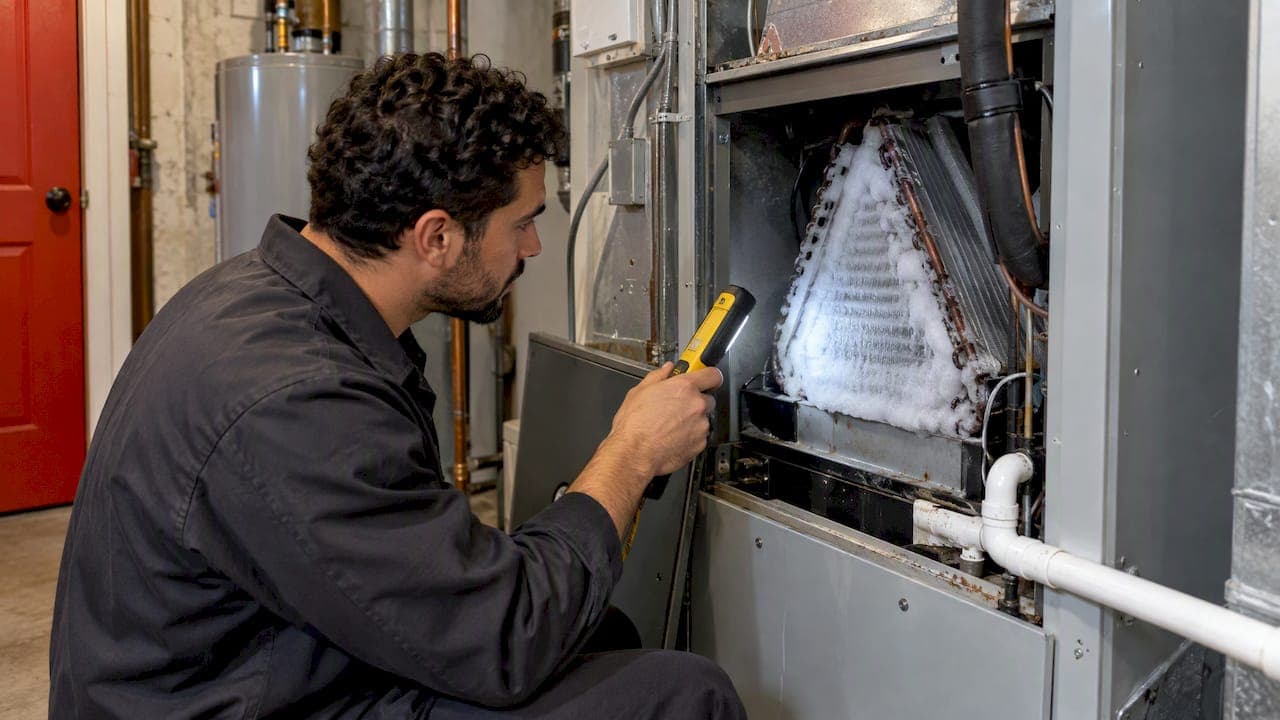
If your AC coil is frozen, turn the cooling off right away, let the ice melt, and then look for the reason it formed. Running the system while the coil is iced over can cause major damage to the system. The most common cause is something you can check yourself, like a dirty filter. If the ice comes back after you fix the airflow, the cause is usually deeper, and that is a job for a licensed technician.
This guide covers how to confirm the coil is frozen, how to thaw it without hurting anything, what usually causes it, and how to stop it from happening again.
TL;DR
- Switch the thermostat to OFF and the fan to ON. Never chip or scrape the ice.
- A light frost can clear in about 1 to 3 hours. Heavy ice can take 4 to 8 hours or longer.
- Check the air filter and make sure every supply and return vent is open first. Restricted airflow is the most common cause.
- If the coil freezes again after you fix airflow, suspect low refrigerant, a leak or a mechanical fault, and call a technician.
- Replace filters every 1 to 3 months during cooling season and book a spring tune-up.
Table of Contents
- How to tell your AC coil is frozen
- What to do right now
- Why AC coils freeze
- Why your AC coil keeps freezing
- How to prevent a frozen coil
- When to call an HVAC technician
- Need help with a frozen coil?
- FAQ
- Sources
How to tell your AC coil is frozen
The evaporator coil sits inside your air handler or furnace cabinet. It is the part that pulls heat and moisture out of your indoor air. Because it is normally cold and wet, it can ice over when something throws the system out of balance.
The signs to look for:
- Warm or weak airflow. The system runs, but the air from the vents is not cold, or barely moves. Ice blocks air from passing through the coil.
- Visible ice or frost. You may see it on the coil itself or on the refrigerant line running into the indoor unit. Ice on the coil or refrigerant lines is the clearest sign.
- Water around the indoor unit. As ice melts, it can produce puddles under the air handler. Excessive condensation or an overflowing drain pan can also point to melting ice.
- A system that runs and runs. If the house never reaches the set temperature, the coil may be insulated by a layer of ice.
If you find water on the floor and are not sure whether it is from ice or a clogged drain, our guide to AC leaking water inside walks through the difference.
Evaporator coil vs. condenser coil
People search for "frozen AC coil" and mean different things. The indoor coil (evaporator) is the one that freezes during normal cooling operation. The outdoor coil (condenser) releases heat and is not meant to carry ice in summer. If you see ice on the outdoor unit while it is cooling, it usually traces back to the same indoor problems, such as airflow or refrigerant, so the steps below still apply.
Heat pumps are a special case. In heating mode the outdoor coil can frost and runs a defrost cycle. If the defrost cycle keeps getting longer and ice covers the unit, you may have a bad defrost control board and should call for repair. Our checklist for a heat pump that isn't heating covers that scenario.

What to do right now
The steps are simple, and the order matters.
- Turn the AC off. Set the thermostat to OFF. Running a frozen system can cause damage that cannot be repaired.
- Run the fan only. To thaw the coil, set the thermostat to OFF and the indoor fan to ON. Moving room-temperature air across the coil melts the ice naturally.
- Do not chip at the ice. The coil's thin fins and copper tubing are easy to puncture. Do not chip away at the ice. A punctured coil usually means a refrigerant leak and an expensive repair.
- Manage the meltwater. Put towels or a shallow pan under the air handler if you can reach it, and keep water away from motors and control boards. Check that the condensate drain pan is not overflowing.
- Check the filter. Pull it out. If you cannot see light through it, replace it.
- Open every vent. Make sure supply registers and return grilles are open and not blocked by furniture, rugs or curtains. Inspecting filters and clearing vents are the first checks a homeowner can safely do.
A frozen coil does not repair itself. Ignoring it can lead to compressor damage or total system failure, so treat the ice as a signal, not a nuisance.
How long does a frozen AC coil take to thaw?
It depends on how much ice built up. A lightly frosted unit may thaw in about 1 to 3 hours, while heavy buildup can take 4 to 8 hours or longer. Do not restart cooling to "see if it works" before the coil is fully clear. If you restart too early, leftover ice just becomes the base for new ice.
While you wait, you can use fans or open windows on a mild day. On a hot day, waiting several hours without cooling is uncomfortable but far cheaper than a failed compressor.
Why AC coils freeze
Freezing is physics. Ice forms when the coil temperature falls to 32°F or below and the moist air passing over it has nothing to stop it. The same source notes that freezing depends on time, air moisture, air velocity and temperature, and that the coil needs to operate above 32°F to avoid buildup. Anything that cuts the heat load on the coil, such as weak airflow or low refrigerant pressure, pushes it below that line.
The usual suspects, in the order we recommend you check them:
| Cause | What happens | Can you fix it yourself? |
|---|---|---|
| Dirty air filter | Air cannot reach the coil, so it gets too cold | Yes, replace the filter |
| Blocked supply or return vents | Same airflow problem, often from furniture or closed registers | Yes, open and clear them |
| Dirty evaporator coil | Dust and film insulate the coil and reduce heat transfer | No, needs professional cleaning |
| Low refrigerant | Pressure drops and the coil gets colder than it should | No, a leak must be found and repaired by a certified technician |
| Thermostat or fan problems | The blower runs too slowly or the system cycles wrongly | Sometimes, a technician for blower issues |
| Cool outdoor temperatures | The system runs when there is little heat to remove | Yes, change how you use it |
The first four causes match what manufacturers list: restricted airflow from dirty filters, blocked return vents or dirty coils, plus low refrigerant or thermostat issues.
Airflow problems
This is the one to rule out first because it costs almost nothing. A clogged filter, a closed register, a collapsed duct or a dirty blower wheel all reduce the air moving over the coil. Less air means the coil gets colder than it is designed to be.

One less obvious variation: a low fan speed chosen for quiet operation combined with a high thermostat setting. One appliance manufacturer notes that this combination can produce insufficient airflow and icing. If your system has adjustable fan speed, try the normal setting before assuming something is broken.
Low refrigerant
Refrigerant does not get "used up" like fuel. If it is low, there is a leak, or the system was undercharged at installation. Adding refrigerant without finding the leak is a temporary patch at best. Handling it also requires certification: technicians servicing equipment in a way that could release refrigerant must be EPA Section 608 certified. This is not a DIY job, and a handful of cans from a hardware store is not a repair.
A related component is the metering device that feeds refrigerant to the coil. If you want to understand how a faulty one can starve or flood the coil, read our explainer on the TXV in HVAC systems.
Cool weather and window units
In spring and fall, a cool night followed by AC use can cause trouble. Manufacturer guidance for window units says that running them when outdoor temperatures are below 70°F can contribute to ice on the indoor coils. For central systems the same logic applies: the less heat in the air, the easier it is for the coil to dip below freezing. If you only need to take the chill off, open a window instead of running the AC.
Why your AC coil keeps freezing
If the coil freezes once after a long stretch with a dirty filter, you have probably found your cause. If it freezes again after you changed the filter and opened the vents, the problem is somewhere else.
One HVAC business owner quoted in the Carrier guide puts it this way: once the ice is gone and airflow is restored, the system may work again, but recurring freezing points to a deeper issue such as a refrigerant leak or mechanical failure.
Patterns worth noting for your technician:
- Ice returns within a day or two of thawing. Often a refrigerant leak or a blower problem.
- Ice returns only on very hot, humid days. Possibly a dirty coil or marginal airflow in the ductwork.
- The system also short cycles. The two symptoms often share a cause. See our guide to AC short cycling.
- The thermostat seems to misbehave. Check our thermostat checks before you call.
- The AC is not cooling but you see no ice. Start with our AC not cooling troubleshooting guide.
Write down when the ice appeared, what the thermostat was set to, when the filter was last changed and whether any vents were closed. Those details save diagnostic time.
How to prevent a frozen coil
Prevention is mostly routine:
- Change the filter on schedule. One manufacturer recommends every 1 to 3 months, and another says every 60 to 90 days. Homes with pets, renovation dust or heavy use need the shorter end of the range.
- Keep vents clear. Do not close registers in unused rooms to "save energy" on a central system. It can raise resistance in the ducts and reduce airflow across the coil.
- Schedule spring service. Have a technician inspect the unit and clean the coils each spring.
- Do not run the AC in cool weather. When it is mild outside, ventilate instead.
- Do not run the fan slow and the thermostat high just for quiet if you have seen icing before.
A spring tune-up is where small problems get caught: a slightly low charge, a coil film, a sluggish blower motor or a plugged condensate line. Catching those before July is easier than catching them at 90 degrees with a warm house.
Our view on frozen coils
Most calls we get about a frozen coil start the same way: the homeowner already ran the system for hours and now has water on the floor. The ice itself is rarely the real problem. It is the symptom, and what matters is what caused it.
We see it as two separate jobs. The first is airflow, and you can handle that yourself with a filter and open vents. The second is anything involving refrigerant, coil cleaning, blower motors or controls. That work needs licensed hands and the right tools, and guessing at it often costs more than a proper diagnosis.
That is why we put so much weight on seasonal tune-ups. Our technicians are licensed and insured, we are family owned and operated, and we have deep experience with the older Massachusetts homes where tight ductwork and cramped air handlers make airflow problems more common. We would rather inspect your system in spring than thaw it in a heat wave. When you do call, we explain what we found and give you upfront pricing before work starts.
Matt
When to call an HVAC technician
Call a professional if any of the following apply:
- The coil freezes again after you have changed the filter and cleared the vents. Repeat freezing after basic troubleshooting is a clear reason to call.
- You suspect a refrigerant leak, for example hissing, oily residue on lines, or a system that has needed "topping off" before.
- You smell something electrical, hear grinding from the blower, or the breaker trips.
- The ice is on a heat pump in heating mode and the defrost cycles keep getting longer.
- There is significant water damage or a repeatedly overflowing drain pan.
- You simply cannot reach or see the coil. Internal components need specialized tools and training to diagnose safely.
What a technician will usually do: confirm the ice is gone, check airflow and the blower, inspect and clean the coil, measure refrigerant pressures, look for leaks, test the thermostat and controls, and clear the condensate drain. If the system turns out to need a repair or a replacement, ask for the reasons in plain language and a written estimate.
We handle this kind of diagnosis through our AC diagnostics and repair service. Commercial property owners with rooftop or split systems can also read about common commercial HVAC failures and how to catch them early.
Need help with a frozen coil?
If your system has iced over once, or keeps doing it, we can find the cause rather than just thaw the symptom. Mystic Valley Home Services is a licensed and insured, family-owned Massachusetts team offering same-day or next-day service, with the owner overseeing the work. We handle AC diagnostics and repair, seasonal AC tune-ups, ductless mini-split installation and multi-zone system design for homes and businesses.
See our cooling services to book a visit, or reach us through our main site.

We do not publish set prices for these services, but you will get upfront pricing before any work begins.
FAQ
Can I run my AC with a frozen coil?
No. Running the AC with ice on the coil can cause major damage to the system, including to the compressor. Turn the thermostat to OFF, and use the fan-only setting to help thaw the coil.
Should I turn my AC off if it's frozen?
Yes, turn the cooling off immediately. Leave the indoor fan on so air moves across the coil and melts the ice. Do not scrape or chip the ice, and call an HVAC company if you cannot find a simple cause.
Will a frozen AC coil fix itself?
The ice will melt if you shut the cooling off, but the cause will not go away. A frozen coil does not fix itself, and ignoring the underlying problem can lead to secondary damage. If it refreezes, treat that as a sign something deeper is wrong.
What is the most common reason an AC coil freezes?
Restricted airflow, usually a dirty filter or blocked vents. Check these first because the fix is quick and inexpensive. If airflow is fine and the coil still ices up, low refrigerant or a mechanical problem is likely.
Is it safe to add refrigerant myself?
No. Low refrigerant means there is a leak, and technicians who work on equipment in a way that could release refrigerant must hold EPA Section 608 certification. Have a licensed technician find and fix the leak.
Sources
- What To Do If the AC Evaporator Coil Is Frozen
- Top 5 Causes of Frozen AC Coils and How to Fix Them
- Will Frozen AC Fix Itself? Guide to Frozen AC Coils
- How to Repair and Troubleshoot Your AC
- Air Conditioner: Ice On Indoor Coils
- Why Air Conditioning Systems Freeze and How to Fix Them
- 5 Common Causes for AC Not Blowing Cold Air
- Got a Frozen Evaporator Coil? Don't Panic