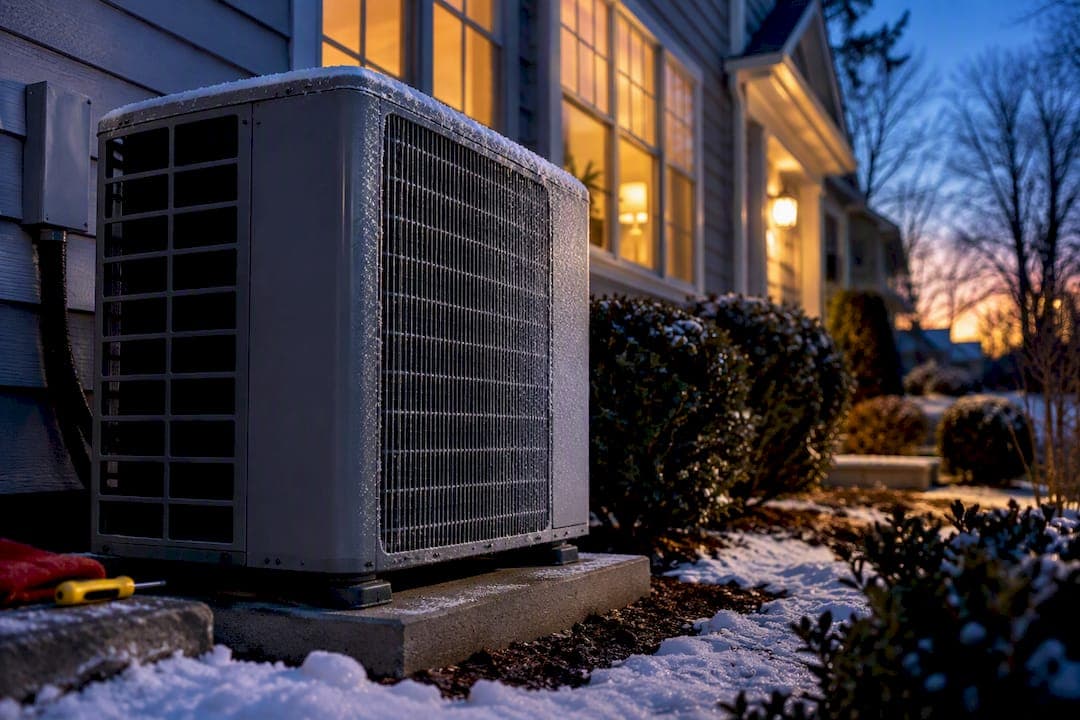
Most of the time, a heat pump that won't heat is stuck in the wrong mode, running its defrost cycle, or starved for airflow, not actually broken. Check that the thermostat is set to Heat with the fan on Auto, then give it 5 to 15 minutes if it's cold enough outside for the outdoor unit to be icing. If the outdoor unit shows zero activity, you smell refrigerant, or ice keeps building back up after it clears, stop troubleshooting and call for service.
TL;DR:
- Most heat pump issues stem from mode misconfiguration, airflow restrictions, or defrost cycles, not actual system failures.
- Repeated re-icing of the outdoor coil or inability to maintain temperature suggests defrost control or refrigerant problems requiring professional service.
- Restricted airflow from clogged filters or leaking ducts can make a functioning system feel inadequate, especially in colder conditions.
- Electrical faults, refrigerant leaks, or a stuck reversing valve are beyond DIY repair and typically necessitate technician intervention.
- Undersized systems or improper thermostat settings during cold weather cause poor heating performance despite the equipment being operational.
Table of Contents
- Step-by-Step Checklist for a Heat Pump Not Heating
- Why Is My Heat Pump Cold Outside? Ice, Defrost, and Airflow
- Airflow, Filters, and Ducts: The Hidden Cause of "No Heat"
- Refrigerant Leaks, Reversing Valve Faults, and Electrical Failures
- Why a Working Heat Pump Can Still Fail to Keep Up
- When to Call an HVAC Technician
- Maintenance That Prevents "No Heat" Calls
- Mystic Valley's Four-Check Field Order
- Matt's Note to Homeowners
- How Mystic Valley Home Services Can Help
- Sources
- FAQ
Step-by-Step Checklist for a Heat Pump Not Heating
Work through these in order. Each one takes a minute or two, and together they resolve the majority of "no heat" calls without a technician ever showing up.
- Check the thermostat mode and setpoint. Confirm it reads Heat, not Cool or Auto, and that the setpoint is a few degrees above room temperature. If you replaced the thermostat recently, a miswired O/B terminal is a common culprit. Older heat pump thermostats and newer smart models reverse the logic on this terminal, so a heat call can trigger the reversing valve into cooling mode instead.
- Confirm the fan setting is on Auto, not On. Running the fan constantly can make air feel cooler than it is, since it pulls in air between heating cycles.
- Check power at three points: the indoor unit's power switch, the 240V breaker in your electrical panel, and the outdoor disconnect box near the unit. If a breaker tripped, reset it once. If it trips again, don't reset it a second time, that's an electrical fault, not a fluke.
- Pull the filter and look at it. A clogged filter chokes airflow and can trigger the system to protect itself by cutting heat output. Replace it if you can't see light through it.
- Walk your vents. Make sure supply and return vents aren't blocked by furniture, rugs, or closed dampers.
- If it's cold outside, wait. A normal defrost cycle runs 5 to 15 minutes and temporarily blows cool air. That's expected, not a fault.
- Note what you're seeing. Write down the outdoor temperature, how the supply air feels compared to the return air, any error codes on the thermostat display, and any unusual sounds.
Pro Tip: Feel the air coming out of a supply vent, then feel the air going into a return vent. A gap of roughly 25 to 40 degrees Fahrenheit is healthy for heating mode. Anything under 20 degrees is worth reporting to a technician before they even arrive.
Why Is My Heat Pump Cold Outside? Ice, Defrost, and Airflow
Outdoor units ice up in cold, humid weather. That's not a malfunction, it's physics. The system periodically reverses briefly to melt frost off the coil, and you'll often hear a thunk as the reversing valve shifts, then see steam rising off the unit. During that window, indoor supply air runs cool. This is why so many "heat pump blowing cold air" calls turn out to be nothing.
What you can safely do:
- Clear snow, leaves, or mulch away from the base and sides of the outdoor unit, aiming for roughly 24 inches of open space.
- If the coil is heavily iced and the unit isn't cycling through defrost on its own, switch the thermostat to Fan Only and let it run 30 to 60 minutes to thaw naturally.
- Never chip, scrape, or hammer ice off the coil. The fins bend easily, and a damaged coil is a far more expensive problem than the ice itself.
If the unit re-ices within an hour or two of thawing, or the ice never fully clears, that points to a failing defrost control board, a stuck reversing valve, or low refrigerant. That's a service call, not a weekend project.
Airflow, Filters, and Ducts: The Hidden Cause of "No Heat"
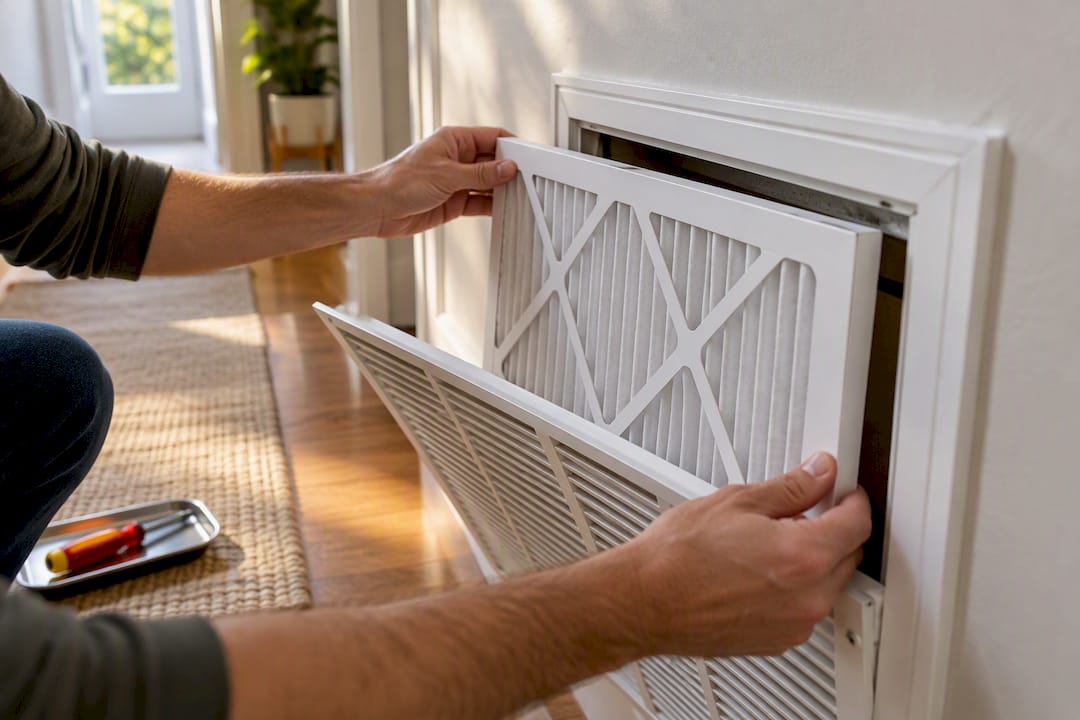
A heat pump's supply air normally runs 90 to 110 degrees Fahrenheit, noticeably cooler than the 130+ degrees you'd feel from a gas furnace. That's expected behavior, not a broken system, but restricted airflow makes it feel far worse than it should.
Quick checks:
- Compare supply air to return air with your hand. A wide gap means the system is heating, just not distributing it well.
- Look for cold rooms far from the air handler. That pattern usually means duct leakage or poor insulation, not an equipment fault.
- Watch the blower. If it runs but airflow feels weak everywhere, suspect a clogged filter or a collapsed duct section.
Leaky, uninsulated ductwork in an attic or crawlspace lets heated air escape before it reaches the room, which can make a perfectly healthy heat pump feel like it's failing.
Pro Tip: If one specific room is always cold while the rest of the house is fine, that's almost always a duct or vent issue, not a heat pump problem. Mention the exact room and how long it's been happening when you call for service.
Refrigerant Leaks, Reversing Valve Faults, and Electrical Failures
Some causes are beyond safe DIY territory, and knowing where that line sits saves you time and money.
- Low refrigerant: listen for hissing near the lines, look for frost on the refrigerant line where there shouldn't be any, and watch for a shrinking supply/return temperature gap. Refrigerant work legally requires EPA-certified technicians, so this is never a homeowner fix.
- Stuck reversing valve: if the outdoor unit runs but your house blows cold air even in Heat mode, the valve may be physically stuck in cooling position. You can't diagnose this beyond noting the symptom.
- Electrical failures: a silent, motionless outdoor unit during an active heat call often means a failed capacitor or contactor, both common wear parts in heat pumps. A tripped breaker that resets fine once is normal; one that trips repeatedly signals a short or a failing compressor.
Any of these three means it's time to stop testing and start dialing.
Why a Working Heat Pump Can Still Fail to Keep Up
Sometimes nothing is broken. The system is simply undersized, or it's hit its balance point, the outdoor temperature below which the compressor alone can't match your home's heat loss. Below that point, the system needs auxiliary or emergency heat strips to make up the difference.
Two things go wrong here in practice:
- The system was never sized to your home's actual heat loss (a proper Manual J load calculation prevents this), so it's chasing a setpoint it was never built to hit.
- Auxiliary heat is locked out or misconfigured in the thermostat settings, so the backup heat strips never kick in when the compressor falls behind.
A properly sized cold-climate heat pump should hold 68 to 70 degrees Fahrenheit even in a New England winter. If yours can't, and the AUX indicator on your thermostat never lights up during a cold snap, that's a configuration or sizing issue worth flagging to a technician.
When to Call an HVAC Technician
Some symptoms mean you're done troubleshooting.
- The outdoor unit shows no activity at all during an active heat call.
- You smell refrigerant or hear hissing near the lines.
- A breaker trips more than once, or ice keeps returning after thawing.
- The house never reaches setpoint even with AUX heat running.
Before you call, gather the outdoor temperature, your supply and return air temperatures, the thermostat's error readout, how long the last defrost cycle ran, and a photo or two of the outdoor unit and any frost. Handing a technician real numbers on arrival, instead of "it's just not heating," often cuts an hour off the visit.
Pro Tip: When scheduling, say exactly what you observed: "Outdoor unit isn't running during a heat call, breaker hasn't tripped, no ice on the coil." That single sentence tells a dispatcher which technician and parts to send.
Maintenance That Prevents "No Heat" Calls
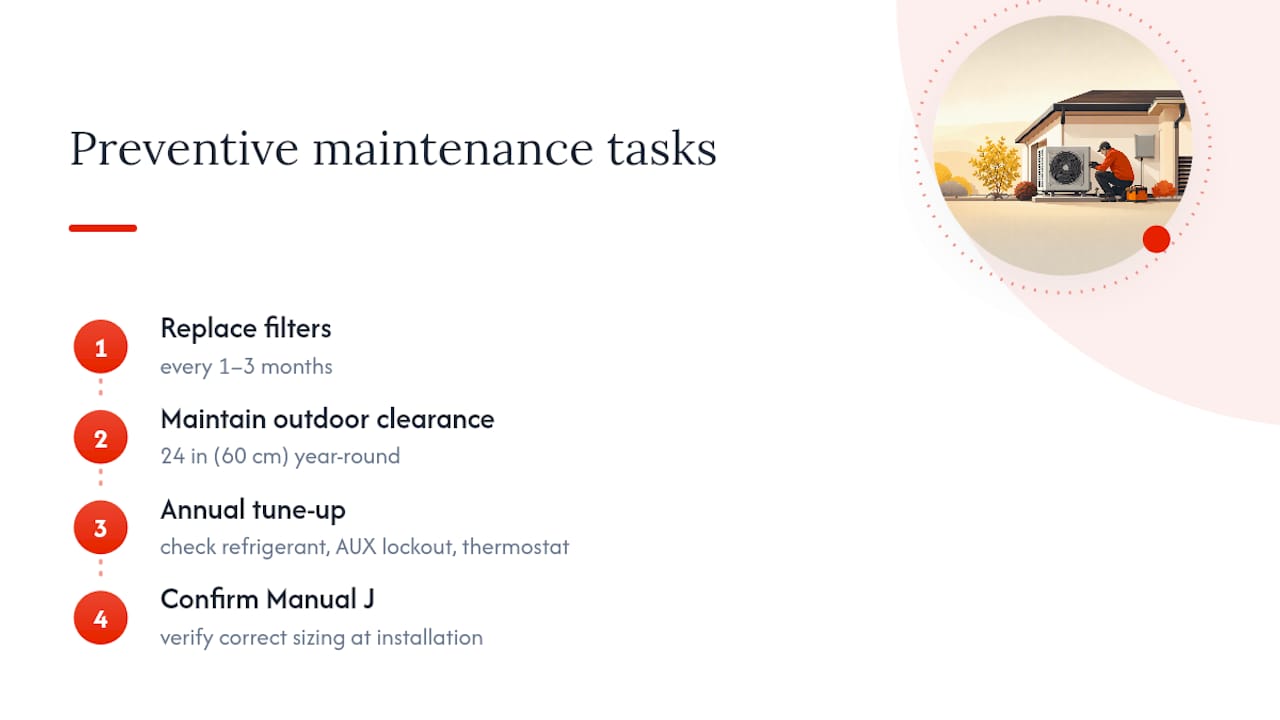
Replace filters every 1 to 3 months, keep 24 inches of clearance around the outdoor unit year round, and schedule an annual tune-up that checks refrigerant charge, AUX lockout settings, and thermostat configuration. Confirming Manual J sizing was done correctly at installation heads off the chronic underperformance that no amount of filter changes will fix.
Mystic Valley's Four-Check Field Order
- Clear debris and snow from around the outdoor unit.
- Confirm the thermostat shows an active heat call with the fan on Auto.
- Swap the filter if dirty, then check the supply-to-return temperature gap.
- Verify the outdoor fan and compressor are actually running.
This order catches the cheap fixes before you pay for a diagnostic. If step four fails, that's exactly what a technician needs to hear first.
Matt's Note to Homeowners
Most "no heat" calls I hear about turn out to be a thermostat setting or a defrost cycle running its course. Refrigerant and electrical faults are real, but they're not yours to fix. Writing down what you saw before I arrive gets your heat back faster.
— Matt
How Mystic Valley Home Services Can Help
No-heat emergency diagnostics cover situations such as an outdoor unit that won't kick on, a reversing valve stuck in the wrong mode, or a system that's simply undersized for your home. Technicians can handle heat pump repair, ductless mini-split service, thermostat and zone valve work, and annual tune-ups that catch AUX lockout issues before they cost you a cold week.

When we show up for a heat pump repair call, we start with the same checks outlined above, thermostat configuration, filter condition, supply/return delta, and outdoor unit operation, then move straight to the equipment-level diagnosis if those come back clean. Licensed and insured technicians working in Massachusetts offer same-day and next-day scheduling with upfront pricing, so you know the cost before any work starts. If your heat pump still isn't heating after running through the checklist above, book a visit through our heating services page and we'll get a technician out to finish the diagnosis.
Sources
The homeowner checks above draw on guidance from ENERGY STAR, MassHVAC, Thermostating, Energy Vanguard, and Trane.
- Heat Pump Not Heating? Here's the Checklist (Including Defrost Mode) - Thermostat & HVAC Helpers
- Is heat pump supply air too cold for heating? — Energy Vanguard
FAQ
Why Is My Heat Pump Blowing Cold Air When the Heat Is On?
It's usually a defrost cycle, which runs 5 to 15 minutes and temporarily produces cool air while the outdoor coil clears frost. It can also mean the thermostat's O/B terminal is miswired, sending the reversing valve into cooling mode during a heat call.
How Do You Reset a Heat Pump?
Turn the thermostat off, flip the indoor power switch and the outdoor breaker off for about 60 seconds, then turn everything back on. If a breaker trips again immediately after reset, stop and call a technician instead of resetting it repeatedly.
Why Is My Heat Pump Fan Running but No Heat?
This often points to a stuck reversing valve, a failed compressor contactor, or low refrigerant, all technician-level repairs. Check the supply-to-return air temperature gap first; anything under 20 degrees Fahrenheit signals one of these faults rather than a simple settings issue.
What Is the Most Common Problem With Heat Pumps?
Restricted airflow from a dirty filter or blocked vents is one of the most frequent causes of poor heating performance, alongside normal defrost cycling being mistaken for a fault. Undersized systems that hit their balance point in cold weather are another common source of persistent underheating.
How Do I Know if My Heat Pump Is the Wrong Size for My Home?
If the house never reaches setpoint on cold days even with auxiliary heat running, and this happens repeatedly rather than during one unusual cold snap, sizing is worth investigating. A technician can verify whether the original Manual J calculation matched your home's actual heat loss.