Yes. Modern cold-climate heat pumps can serve as a home's primary heating source even through a Massachusetts winter, and they do it efficiently. The catch is that the result depends entirely on three things: choosing a certified cold-climate model, sizing it with a real load calculation instead of a guess, and matching it to a house that isn't leaking heat out every wall.
TL;DR:
- Choosing a certified cold-climate heat pump with technologies like variable-speed compressors and vapor injection ensures reliable performance at temperatures as low as negative 22°F.
- Proper sizing based on a detailed load calculation, not rough estimates, prevents short-cycling and increases equipment longevity, especially when matching capacity to actual heat loss.
- Placement of the outdoor unit should account for snow depth, airflow, and obstructions to prevent service issues and maintain efficiency throughout winter.
- The total cost of installation varies widely, but higher savings come from operating efficiency, with a COP of 2.5 or higher delivering significantly lower electricity costs than resistance heating.
- Regular maintenance such as clearing snow, checking refrigerant levels, and monitoring defrost cycles help ensure continued performance and prevent common winter failures.
Table of Contents
- What Makes a Heat Pump "Cold-Climate" in the First Place
- COP, HSPF2, and the Certifications Worth Checking
- Getting the Size Right: Manual J, Manual S, and Avoiding Oversized Equipment
- Installing and Placing the Outdoor Unit So Winter Doesn't Break It
- What Installation Actually Costs and Where the Savings Show Up
- Keeping It Running: Homeowner Checks and Annual Maintenance
- Why Sizing Discipline Beats Bigger Equipment Every Time
- Ready for a Site Survey and Manual J Calculation?
- Sources
- FAQ
What Makes a Heat Pump "Cold-Climate" in the First Place
Cold air still holds usable heat, even at 5°F, and a heat pump's job is to pull that heat inside rather than burn fuel to create it. What separates a cold-climate model from a standard one is how well it keeps doing that as temperatures drop.
A few technologies make the difference:
- Variable-speed (inverter) compressors ramp output up or down instead of switching on and off, holding capacity steady in deep cold.
- Vapor injection (sometimes called flash injection) boosts refrigerant flow at low temperatures, which is what lets a unit keep working well below 0°F.
- Smarter defrost controls clear ice off the outdoor coil more precisely, so the system spends less time defrosting and more time heating.
- Ground-source (geothermal) systems sidestep the cold-air problem entirely by pulling heat from the ground, which stays a stable 50°F or so year round.
There's no single industry-wide legal definition of "cold-climate," which is why the certifications in the next section matter more than the marketing label on the box.
COP, HSPF2, and the Certifications Worth Checking
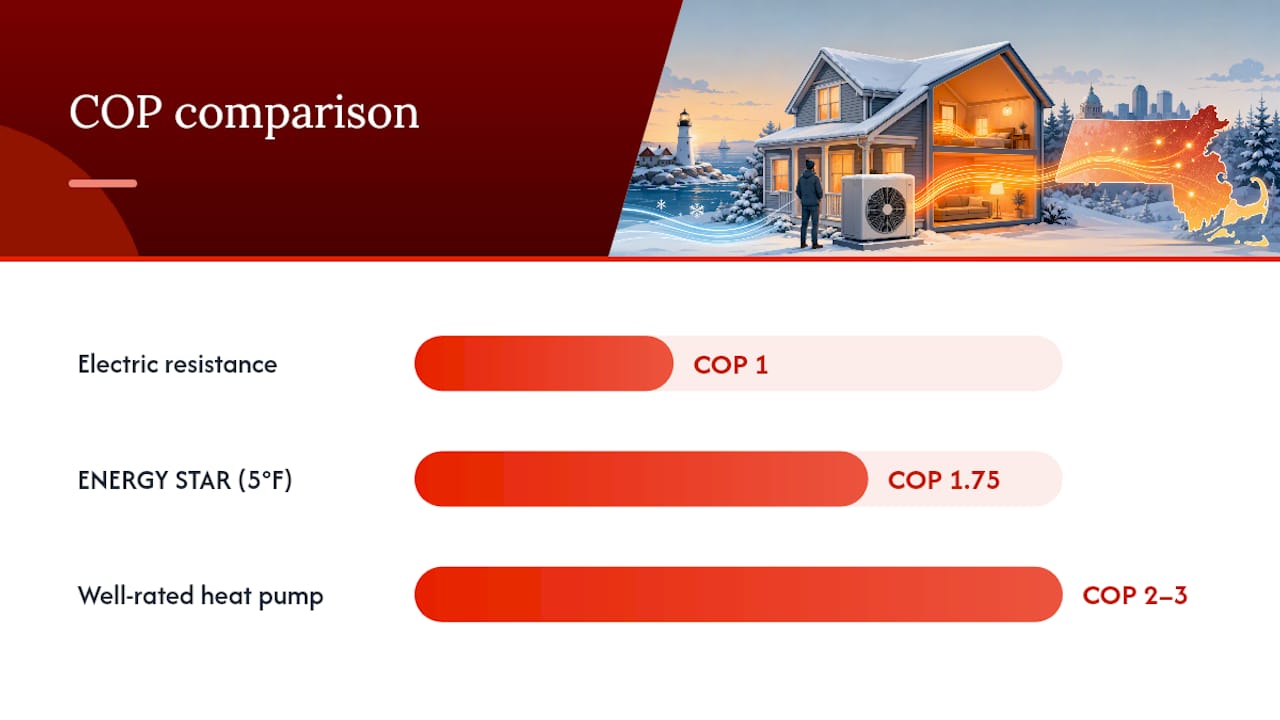
The number that actually predicts your winter comfort is the coefficient of performance, or COP: how many units of heat the system delivers for every unit of electricity it consumes. ENERGY STAR's product criteria require cold-climate-qualified units to hit a COP of at least 1.75 at 5°F, and most well-rated systems land closer to 2 to 3 at 30°F to 40°F.
Quick benchmark: a COP of 2 means the heat pump delivers twice the heat energy of the electricity it draws. Electric resistance heat, by contrast, tops out at a COP of 1.
Beyond ENERGY STAR's cold-climate designation, look for the equipment on the NEEP cold-climate air-source heat pump list, which tracks models tested for low-temperature performance, and check whether it was evaluated under the Department of Energy's Cold-Climate Heat Pump Challenge. DOE testing shows many of these units hold usable heating capacity down to roughly negative 15°F to negative 22°F, and can supply up to 100% of a home's heating load when sized correctly. That "100%" figure isn't automatic. It depends on matching rated capacity at your design temperature to your actual heat loss, which is exactly what the next section covers.
Getting the Size Right: Manual J, Manual S, and Avoiding Oversized Equipment
Sizing is the single biggest factor separating a heat pump that performs well for 20 years from one that runs constantly and still leaves rooms cold. The starting point has to be a room-by-room Manual J load calculation, not a rule of thumb based on square footage. A PNNL/Building America Solution Center sizing guide pairs that load number with ACCA Manual S equipment-selection guidance to pick a unit that matches your home's real heat loss, not a bigger one "just in case."
Homeowners generally face three sizing paths:
- Full replacement, sized for heating. The heat pump alone covers the coldest day of the year. This costs more upfront but removes the need for backup fuel.
- Dual-fuel hybrid. The heat pump handles most of the season, and an existing furnace or boiler kicks in only on the harshest days. This is often the most cost-effective route for older housing stock.
- Zoned or partial coverage. Multiple smaller outdoor units serve specific zones, which PNNL's guide notes improves part-load performance and lets one zone keep running if another needs service. This mirrors the multi-zone system design approach used in larger homes and light-commercial buildings.
Oversizing is the most common mistake. A unit that's too big for the load short-cycles, meaning it turns on and off rapidly instead of running steadily, which wastes energy and wears out components faster. Variable-speed equipment with strong minimum steady-state capacity avoids this.
Pro Tip: Before you sign a contract, ask the installer for the manufacturer's rated capacity at 5°F and at your local design temperature, not just the "nominal" tonnage. Also ask about minimum turn-down capacity, defrost cycle length, and what the warranty covers for commissioning errors. If any of those answers are vague, that's a real warning sign.
Installing and Placing the Outdoor Unit So Winter Doesn't Break It
Most winter service calls trace back to placement, not the equipment itself. Get the mounting and airflow right and the unit will run for years without drama.
- Mount the outdoor unit 12 to 24 inches above your area's expected snow depth, using a wall bracket or raised stand rather than a low pad.
- Keep it clear of roof drip lines and drift paths. A unit buried by shoveled snow or sliding roof ice is a preventable failure, not a design flaw.
- Leave open airflow on all sides. Fences, shrubs, and stacked firewood block the coil and cut capacity exactly when you need it most.
- For ducted systems, keep supply runs out of unconditioned attics, where heat loss undercuts everything the equipment is doing.
- Set the thermostat to allow gradual, wide-swing setbacks rather than sharp temperature changes, and make sure backup heat is configured to temper the brief cool draft that comes during a defrost cycle, rather than fighting it.
What Installation Actually Costs and Where the Savings Show Up
Installed cost for a cold-climate heat pump varies widely based on ductwork, the number of zones, electrical panel capacity, and labor. A single ductless zone costs far less than a whole-home ducted system serving multiple floors, so get a quote scoped to your actual house rather than a national average.
Where the payback shows up is the operating side. A heat pump running at a COP of 2.5 delivers two and a half times the heat per dollar of electricity compared with resistance heat, and it often beats propane or oil on a cost-per-BTU basis, though the exact math depends on local utility and fuel prices.
- Check ENERGY STAR's cold-climate product list before buying. Many rebate programs require it for eligibility.
- Look at your state energy office and utility company for heat pump rebates. Massachusetts programs frequently stack with federal incentives.
- Consumer Reports' testing confirms that a tighter building envelope meaningfully improves real-world outcomes. Air sealing and insulation upgrades often pay for themselves through better heat pump performance.
Keeping It Running: Homeowner Checks and Annual Maintenance
Most winter heat pump failures are preventable with a few habits. Clear snow and ice from around the outdoor unit after every storm, and watch for short-cycling. That's the compressor turning on and off every few minutes, which usually signals a sizing or refrigerant problem rather than something you can fix yourself. Check and replace filters on the schedule the manufacturer lists, since airflow restriction is one of the fastest ways to lose capacity.
Once a year, a technician should check refrigerant charge, airflow across the coils, control calibration, and defrost cycle behavior, along with condensate drainage so nothing freezes and cracks a line.
- If the system runs but the house feels cold, check that backup heat hasn't silently taken over. Rewiring America's cold-weather heat pump guide notes this is a frequent, easily missed issue.
- If you hear excessive cycling or the outdoor fan struggling under ice, shut down the unit and call a licensed technician before ice damages the coil.
- If heat stops entirely during a storm, restoring heat safely in the first ten minutes matters more than diagnosing the root cause yourself.
Pro Tip: Keep a simple log of outdoor temperature versus indoor comfort for your first winter with a new system. It gives your technician real data instead of a vague "it felt cold sometimes" when something needs adjusting.
Why Sizing Discipline Beats Bigger Equipment Every Time
The biggest misconception homeowners bring to cold-climate heat pumps is that bigger is safer. It isn't. An oversized unit short-cycles, wears out faster, and often delivers worse comfort than a correctly sized one running steadily at partial load. The homeowners who end up happiest are the ones who insisted on a real Manual J calculation and picked equipment matched to that number, even when a contractor pushed a larger, "safer" unit.
A dependable cold-climate installation follows the same sequence every time: a site survey to understand the building's actual heat loss and outdoor unit placement constraints, a Manual J calculation to size the equipment correctly, equipment selection based on rated capacity at your design temperature rather than nameplate tonnage, and a professional installation with real commissioning, not just a system that powers on. Skip any one of those steps and you're relying on luck to get through January.
— Matt
Ready for a Site Survey and Manual J Calculation?
If you're weighing a cold-climate heat pump for a Massachusetts home, the fastest way to get real answers instead of guesses is a proper site visit. Technicians can run the room-by-room load calculation, walk the outdoor unit placement for snow and airflow issues, and size the system to your actual house instead of a generic rule of thumb.

We handle ductless mini-split installation and multi-zone system design for homes that need targeted coverage, and full heating system installation and annual tune-ups for homes going all-in on a heat pump or keeping a dual-fuel backup in place. If you're not sure which path fits your house, request a site survey and we'll walk you through the Manual J numbers before you commit to anything.
Sources
- Guide To Sizing & Selecting Air-Source Heat Pumps in Cold Climates (Building America Solution Center / PNNL)
- Heat pumps cold weather - Rewiring America
- Can heat pumps actually work in cold climates? - Consumer Reports
FAQ
What Temperature Is Too Cold for a Heat Pump?
Most cold-climate certified models keep working down to negative 15°F to negative 22°F, according to DOE testing, though actual performance depends on the specific model's rated capacity at that temperature.
Are Heat Pumps Worth It in Cold Climates?
Yes, for most homes, especially when the equipment is ENERGY STAR cold-climate certified and sized with a Manual J calculation. Cold-climate models can reach a COP of 1.75 or higher at 5°F, meaning they still deliver more heat energy than the electricity they consume even in harsh conditions.
Should a Heat Pump Run Constantly in Cold Weather?
A correctly sized variable-speed heat pump running for long, steady stretches at partial load in cold weather is normal and efficient. Frequent short cycling, where it turns fully on and off every few minutes, usually points to an oversizing or refrigerant problem worth a technician visit.
Which Heat Pump Is Best for Extreme Cold Weather?
Look for a model on the NEEP cold-climate air-source heat pump list with a variable-speed compressor and vapor injection technology, rated for capacity at your local design temperature rather than just nameplate tonnage. Equipment options can be matched to your home's actual heat loss during a site survey.