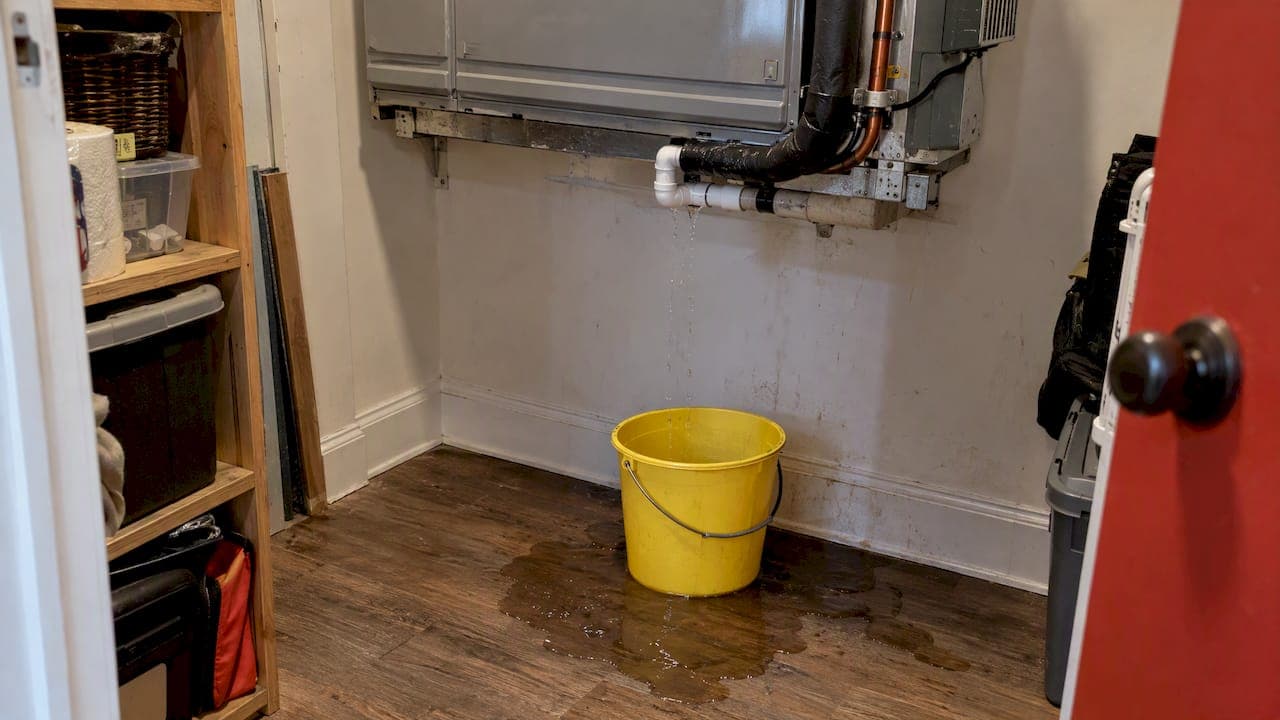
If your AC is leaking water inside, turn the system off at the thermostat, put a towel and bucket under the drip, and check the air filter and the drain line. Most indoor leaks come from condensation that can't leave the house the way it should: a clogged condensate line, a cracked or rusted drain pan, or a coil that froze and is now melting. Some of these are a ten-minute fix. Others involve refrigerant or electrical parts, and those belong to a licensed technician.
This guide explains why the water shows up, how to tell which cause you have, what is safe to do yourself, and how to keep it from happening again. We're a family-owned plumbing and heating company serving Massachusetts, and we see these calls every cooling season, especially in older homes where the air handler sits in an attic, a closet or above a finished ceiling.
TL;DR
- Turn the AC off right away. Running a leaking system can worsen water damage or harm the equipment.
- The usual suspects are a clogged condensate drain line, a dirty filter, a frozen evaporator coil and a damaged drain pan.
- Replacing the filter and clearing a minor clog at the drain outlet are reasonable homeowner steps. Ice, refrigerant and wiring are not.
- Refrigerant work requires an EPA Section 608-certified technician, and a leak should be repaired, not topped off.
- A yearly drain and coil cleaning, a monthly filter check and a float switch are the cheapest protection for your ceilings.
Table of Contents
- Why an air conditioner makes water in the first place
- The most common causes of AC water leaks indoors
- How to tell which cause you have
- What to do right now
- Is an AC water leak an emergency?
- What a professional does for a leaking AC
- Perspective: what we see in Massachusetts homes
- How to prevent AC condensate leaks
- Get a leaking AC fixed by a licensed Massachusetts team
- FAQ
- Sources
Why an air conditioner makes water in the first place
An air conditioner doesn't just cool air. It also pulls moisture out of it. Warm, humid indoor air passes over the cold evaporator coil, the water vapor condenses into droplets, and those drip into a drain pan. From the pan, a condensate line carries the water outside or to a household drain.
So water is a normal byproduct. Trane's residential guide makes the same point: indoor AC water normally comes from condensation that should drain away, which means a puddle inside points to a drainage or equipment problem. A little moisture on the outdoor unit or a drip at the drain outlet outside is normal. Water on your floor, ceiling or around the indoor unit is not.
The most common causes of AC water leaks indoors
Manufacturers' troubleshooting guides agree on a short list. Trane names a damaged drain pan, a clogged condensate line, a frozen evaporator coil or a damaged condenser. Carrier lists a clogged condensate drain, a frozen evaporator coil caused by restricted airflow or low refrigerant, and a damaged drain pan as the most common.
Here is how each one tends to show up in a real house.
A clogged condensate drain line
This is the one we see most. The line is narrow, damp and dark, which is exactly where algae, mold, dust and even spider webs build up. Trane notes that mold, mildew, dust or spider webs can clog the line, and that a puddle or water damage near the indoor unit and a musty smell can point to a clog.

What you'll notice: water pooling around the air handler or dripping from a ceiling below it, a damp smell, and sometimes a safety switch shutting the system off before the pan overflows.
A dirty air filter and a frozen evaporator coil
A clogged filter restricts airflow. With too little warm air crossing the coil, the coil gets too cold and the moisture on it freezes. When the unit cycles off or the ice melts, far more water than the pan can handle comes down at once. Carrier also lists low refrigerant as a cause of coil freeze-up, which is why a frozen coil that returns after you change the filter should be checked by a professional.
What you'll notice: weak airflow from the vents, ice on the copper lines or coil, warm air despite the system running, then a flood when it thaws. If your home isn't cooling well in general, our AC not cooling troubleshooting guide walks through checks by time commitment.
A cracked, rusted or misaligned drain pan
Older air handlers often have metal pans that rust through, or plastic pans that crack with age. The pan can also shift out of position. In that case the drain line may be perfectly clear, yet water still finds a way to the floor.
What you'll notice: water that appears even when the line is flowing freely, rust streaks under the unit, or a pan that visibly sags or has a hairline crack.
Drain line problems from installation
LG's guidance on air conditioner dripping lists loose or damaged drain hoses, blocked hoses, submerged hose ends and bent hoses as contributors, along with excessive humidity, restricted airflow and low refrigerant. A line with too little slope, a sag where water sits, or a disconnected fitting will leak even when nothing is clogged.
High humidity and cooling that fights the house
On muggy days a system moves a lot of water. If the home has moisture problems of its own, such as a damp basement or crawlspace feeding humid air into the return, the AC works harder and produces more condensate. Controlling moisture at the source helps, and these basement moisture control fixes are a sensible weekend project alongside any AC repair.
Window and wall units
A room unit has a different layout. GE Appliances says a room air conditioner should be level or tilted slightly outward, about one-quarter inch, so condensate drains outside, and that a dirty filter can also cause indoor dripping. GE adds that spitting, spraying or dripping indoors is not normal and may come from a dirty filter, incorrect inward tilt or a unit that needs cleaning.
How to tell which cause you have
Start with where the water is and what else is happening.
| What you see | Likely cause | First step |
|---|---|---|
| Water around the indoor unit, musty smell | Clogged condensate line | Shut off, check the pan, look at the drain outlet |
| Ice on coil or refrigerant lines, weak airflow | Dirty filter or restricted airflow, possibly low refrigerant | Shut off, replace filter, let it thaw fully |
| Water despite a clear drain | Cracked or rusted pan, loose fitting | Shut off, call a technician |
| Oily residue, hissing, ice that keeps returning | Possible refrigerant leak | Shut off, call a certified technician |
| Window unit dripping into the room | Wrong tilt, dirty filter | Level the unit slightly outward, clean the filter |
| Wet ceiling below an attic or closet unit | Overflowing pan or line | Shut off, protect the area, call promptly |
One common mix-up is water versus refrigerant. Condensate is plain water. Refrigerant doesn't drip like a faucet: signs include ice buildup, a hissing sound and cooling that gradually fades. Our guide to refrigerant leak signs homeowners can spot safely explains what to look for without opening anything up.
What to do right now
Work through these in order. Stop as soon as one of them solves the problem or you reach something you're not comfortable handling.
- Turn the system off. Set the thermostat to off. Bryant recommends shutting off the AC at the thermostat and, when appropriate, at the disconnect or breaker before troubleshooting. If you can't reach the power safely, for example because the electrical panel or disconnect is wet, call a qualified professional rather than working around it.
- Contain the water. Put towels and a bucket under the drip. If water is coming through a ceiling, move belongings and avoid standing beneath a bulging, stained patch.
- Check the filter. If it's gray and furred with dust, replace it. A dirty filter is the simplest cause and the cheapest fix.
- Look at the drain pan. If it's full, it's a sign the line is blocked. If you can safely remove standing water with a wet/dry vacuum or towels, do. Note any rust or cracks.
- Find the drain outlet. On many homes, the condensate line ends in a PVC pipe near the outdoor unit or at a floor drain or sink. If no water comes out when the pan is full, the clog is somewhere in between.
- Clear a minor clog only if you can do it safely. The usual homeowner method is to run a wet/dry vacuum on the outdoor end of the line. Bryant's guidance says to do this only if you can safely identify the line and its connection. Today's Homeowner also describes a vacuum-and-vinegar process for the exterior outlet, and notes that persistent clogs, frozen coils, water damage, pan rust or float-switch trouble warrant a professional.
- Let ice thaw naturally. Don't scrape or chip it. Coils and refrigerant lines are easy to damage.
What not to do: don't keep running the AC "just until the weekend." Trane's advice is to turn the AC off and arrange repair, because running a leaking system can worsen water damage or damage the equipment. Don't pour harsh chemicals into the line or open refrigerant fittings.
Is an AC water leak an emergency?
Treat it as urgent, not a casual to-do. Water in a ceiling can turn into stained drywall, wet insulation and mold quickly, and a compressor can be damaged by running with a frozen coil. It's an emergency if water is near electrical equipment, a ceiling is sagging, or you see signs of refrigerant loss.
Bryant's guidance is to turn off the system and contact a professional if water or refrigerant is leaking, noting that water can damage ceilings and floors and refrigerant leaks need immediate attention.
If there's already ceiling damage, our guide on emergency steps for a leaking pipe in the ceiling covers how to limit the damage while you wait for help.
Refrigerant: leave it to certified technicians
Low refrigerant can freeze a coil and cause the water you're seeing. That's not a DIY problem. Bryant notes that refrigerant work requires an EPA Section 608-certified technician. The EPA tells homeowners to use certified technicians, ask them to find and fix leaks rather than just add refrigerant, and never use unapproved flammable substitutes such as propane in equipment not designed for them.
The EPA's service practice rules also require specific recovery steps: leaking components must be isolated where possible and evacuated to the lowest attainable level. In plain terms, a technician shouldn't vent refrigerant or simply keep topping off a system that leaks. The EPA's own position is that repairing leaks reduces emissions, operating costs and repeat service calls.

What a professional does for a leaking AC
A proper repair goes beyond "mop and hope." Carrier describes professional drain-line clearing as powering down, checking and emptying the pan, using suction or pressure or snake methods, flushing to verify flow, and confirming drainage after reassembly. That last step matters: a line that looks clear can still be sagging or partly blocked.
In a visit for a leaking AC, we also look at:
- The pan's condition, level and any rust
- The slope and connections of the drain line
- The coil and blower for dirt and ice damage
- Airflow, including the filter, return and ductwork
- Whether refrigerant charge or a leak is behind a frozen coil
- Whether a float switch or secondary pan is installed and working
The goal is to find why the water couldn't leave, not just to clear this week's clog.
Perspective: what we see in Massachusetts homes
Most of the leak calls we get aren't dramatic equipment failures. They're small neglected things that become expensive because the water lands somewhere nobody looks. A drain line clogs in July, the air handler sits in an attic over a bedroom, and the first sign is a brown spot on the ceiling.
Our biggest piece of advice is to know where your drain line ends and where your air handler sits. In Arlington and other towns with older housing stock, we regularly find air handlers tucked into places that were never designed for them, with long drain runs that have settled over decades. Those homes benefit most from a float switch and a secondary pan, because the cost of a failed primary drain is a repaired ceiling.
We also push back on the idea that a leaking AC is either a plumbing job or an HVAC job. It's both. The drain is plumbing, the coil and refrigerant are HVAC, and our technicians handle both sides, which saves you from being passed between trades. We're family-owned, the owner stays involved in how jobs are done, and we offer same-day or next-day service so a leak doesn't sit.
— Matt
How to prevent AC condensate leaks
Prevention is cheap compared with a ceiling repair.
- Check the filter monthly, replace it as needed. Carrier recommends checking the filter monthly and replacing it roughly every one to three months, depending on conditions. Homes with pets, renovation dust or heavy use are on the short end.
- Have the coil and drain cleaned at least yearly. Carrier says coils and the condensate drain should be cleaned and inspected at least annually, more often in dusty or humid settings. Our post on how often to service your HVAC system covers timing.
- Add backup protection. The U.S. Department of Energy's guidance for ventilated crawlspaces recommends routing condensate to an approved sealed drain point and adding an auxiliary drain pan with a separate drain beneath cooling coils as protection if the primary drain fails. A float switch that cuts power when the pan fills works the same way. These are backups, though. They don't replace keeping the main drain clean.
- Keep the outdoor drain end clear. Make sure the outlet isn't buried in mulch, soil or standing water.
- Watch the humidity. If the house stays damp, fix the moisture source as well as the AC.
- Add it to your routine. A drain and pan check fits neatly into a seasonal plumbing and mechanical routine. Our home plumbing maintenance checklist is a good start.
For business owners and property managers
In offices, shops and multi-tenant buildings, a failed condensate drain over a drop ceiling can damage inventory, equipment and neighboring tenants. Put drain-pan and float-switch checks on your spring startup list, record what you find, and keep repair invoices. Our guide on how to document plumbing repairs on business property explains the paper trail that helps with insurance and landlord disputes.
Get a leaking AC fixed by a licensed Massachusetts team
If you can't find the cause, the water keeps coming back, or you see ice or signs of refrigerant loss, book a diagnosis. Our licensed and insured technicians handle AC diagnostics and repair, drain line clearing and ductless mini-split service, and we can look at the plumbing side of the drain at the same visit. Details are on our cooling services page.

If the drain connects into your home's plumbing, such as a floor drain or a sink trap, our plumbing team can clear and check those sections too. We give upfront pricing before work begins.
FAQ
Can I still run my AC if it's leaking water?
No. Turn it off and arrange repair. Running a leaking system can increase water damage to ceilings and floors and can damage the equipment, particularly if a coil is frozen. Run the fan only if a technician tells you it's safe.
How do I stop my AC from leaking water inside?
Shut the system off, replace a dirty filter, empty the pan if you can do so safely, and check that the drain outlet is flowing. A wet/dry vacuum at the outdoor end of the line can clear a minor clog. If the leak returns, ice forms or you suspect refrigerant or electrical issues, have a technician diagnose it.
Why is my air conditioner leaking water inside the room?
The condensation isn't draining properly. The usual reasons are a clogged drain line, a dirty filter leading to a frozen coil, or a damaged drain pan. With a window unit, a unit tilted toward the room or a dirty filter is also common.
Is a clogged AC drain line an emergency?
It's urgent rather than a lights-out emergency. Turn the AC off to stop more water from accumulating, and get it cleared quickly, especially if the air handler is above a finished ceiling. Treat it as an emergency if water is near electrical components or a ceiling is sagging.
Can I use bleach or harsh chemicals in the condensate line?
We advise against it. Aggressive chemicals can damage fittings and metal parts. A technician can flush and treat the line with products and methods designed for it.
Sources
- AC Leaking Water? Find Out Why and What to Do, Trane
- Why Is My AC Leaking Water? Troubleshooting and Repair, Carrier
- How to Clean AC Drain Line, Carrier
- Why Is My AC Leaking Water? Causes and Fixes, Bryant
- Why is water dripping or condensation forming on the air conditioner, LG USA
- Air Conditioner, Water Dripping Inside Room, GE Appliances
- Air Conditioner, Spitting or Spraying Water, GE Appliances
- Homeowners and Consumers: Frequently Asked Questions, US EPA
- Stationary Refrigeration Service Practice Requirements, US EPA
- Guide to Closing and Conditioning Ventilated Crawlspaces, US Department of Energy
- AC Drain Line Clogged? Here's How To Fix It, Today's Homeowner