For most Massachusetts homes, the answer is once a year for each system, timed ahead of its busy season: heating in early fall, cooling in spring. If one system heats and cools your home, such as a heat pump, book it twice a year. Commercial buildings need a tighter rhythm, with some tasks done every quarter.
The rest of this guide covers what changes that baseline: fuel type, system age, how hard the equipment runs, and whether you own a house or a building. It also covers what a real tune-up includes, so you can tell one from a sales call.
TL;DR
- Service heating once a year in the fall and cooling once a year in the spring. A heat pump that does both should be checked twice.
- Oil-fired boilers and furnaces need an annual cleaning and tuning. Some gas equipment may follow a different interval, so check the owner's manual.
- Check air filters monthly and replace them at least every three months. Homes with pets or allergy sufferers may need new ones every 30 to 60 days.
- Commercial systems need quarterly preventive tasks such as belt and filter checks, guided by ANSI/ASHRAE/ACCA Standard 180.
- A real tune-up produces a written report with measurements. A bargain flyer visit often doesn't.
Table of Contents
- The short answer by system type
- Furnaces and boilers: why fall is the deadline
- Air conditioning and heat pumps: spring, not July
- The "time change" rule, and why it works
- Filters: the part you do every month
- What a real tune-up includes
- Tune-up or maintenance plan?
- Commercial buildings: quarterly, not annual
- Our perspective: what we see in older New England homes
- Book your tune-up before the rush
- A simple yearly schedule
- FAQ
- Sources
The short answer by system type
The one-line rule hides real differences. This table gives the schedule we'd put on a Massachusetts homeowner's calendar.
| System | Recommended service | Best timing |
|---|---|---|
| Oil-fired boiler or furnace | Once a year, cleaning and tuning | Late summer to early fall |
| Gas boiler or furnace | Once a year (check manual for interval) | Early fall |
| Central AC or ductless mini-split | Once a year | Spring, before the first heat wave |
| Heat pump (heating and cooling) | Twice a year | Spring and fall |
| Older system near end of life | Twice a year | Spring and fall |
| Commercial rooftop or packaged units | Quarterly tasks plus a full seasonal service | Every quarter |
The national guidance agrees on the core idea. ENERGY STAR recommends annual pre-season check-ups by a contractor, and it notes that contractors get busy once summer and winter arrive. Its homeowner manual puts it in terms of two visits: a tune-up in the spring ahead of a hot summer and another in the fall before a cold winter.
Those two statements fit together. Each piece of equipment needs a visit before the season it works hardest. If a single system covers both seasons, it gets both visits.
Furnaces and boilers: why fall is the deadline
New England heating systems run for months, often from October into April. A neglected burner doesn't fail gracefully. It fails on the first below-freezing night, when every other homeowner is calling too.
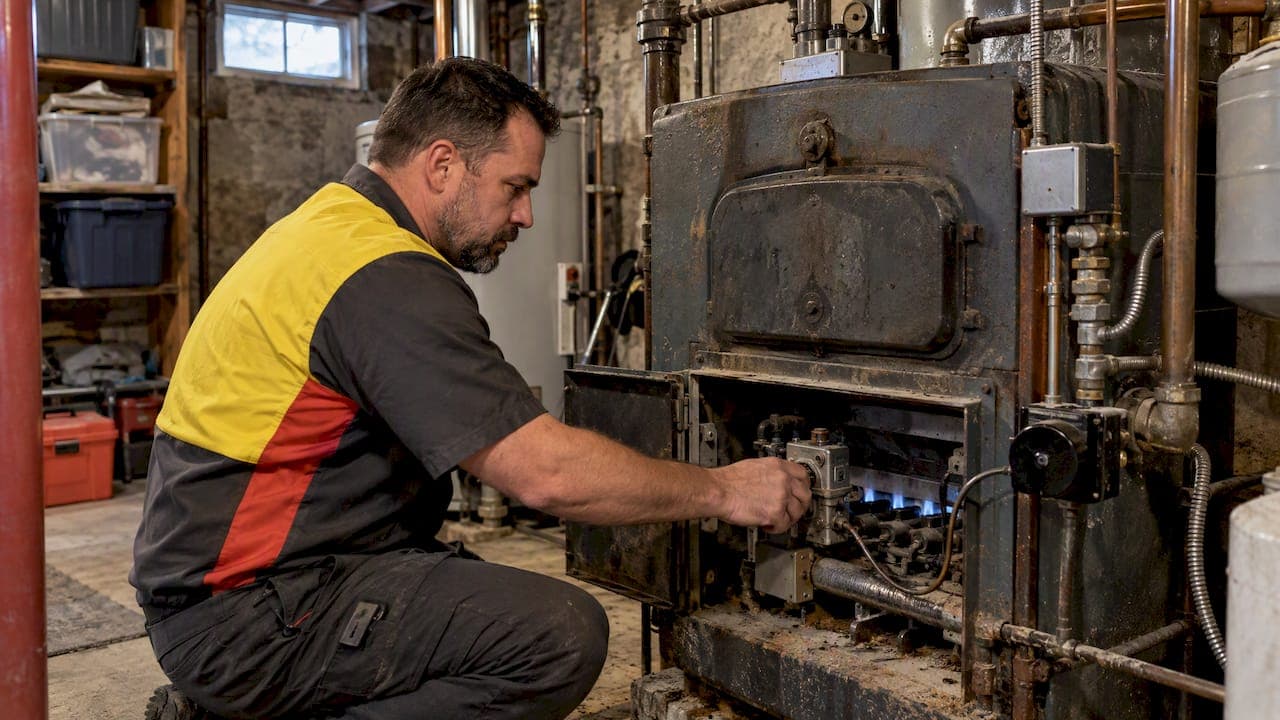
The Massachusetts Office of Consumer Affairs and Business Regulation's oil heat tip sheet says an oil burner should have an annual tune-up and cleaning, and that the best time is before the heating season begins. It adds that a tune-up reduces the risk of system failure and can warn you early that a system needs replacing, which gives you time to shop before winter. Natural Resources Canada's guidance says the same about oil-fired furnaces and boilers, which need annual cleaning and tuning.
Gas equipment and the "every two years" exception
Some gas-fired equipment and certain manufacturers specify longer intervals, such as every two years. That is why we always tell people to read the owner's manual first. Skipping the manual cuts both ways. Following a blanket twice-a-year schedule can mean paying for service you don't need. Following a blanket every-two-years schedule on equipment that wants a yearly look can mean a failure you could have prevented.
Our advice for gas systems in Massachusetts: unless your manual clearly says otherwise, treat once a year as the default. Gas appliances also involve combustion and venting, and those are safety items, not comfort items. If you want to see how a seasonal heating visit runs, read our homeowner's guide to annual boiler service.
Steam and hot-water radiator systems
Older Massachusetts homes often have steam or hot-water radiators, zone valves and decades-old piping. These systems don't have a filter to clog, but they have their own wear points: vents, valves, water levels and controls. They still earn an annual visit, and the older the system, the more that visit is worth, because it can flag a failing component before it strands you in January.
Air conditioning and heat pumps: spring, not July
Cooling equipment sits idle for months, then runs hard through the hottest weeks. Spring service catches refrigerant, electrical and airflow problems while there is still time to fix them.
Several top-ranked pages say twice a year for AC. That is a safe ceiling, not a requirement. For a central AC or mini-split used only for cooling, once a year before summer is the standard, and we see no reason to sell more. Two visits make sense in a few cases:
- The system is a heat pump that heats in winter and cools in summer.
- The unit is old and near the end of its service life.
- It runs heavily, for example in a home office, a server closet or a shop.
- Pets, dust or nearby construction load the filters and coils faster than normal.
If you already have a ductless system or are weighing one, our cooling services cover installation, multi-zone design, diagnostics and seasonal tune-ups.
If a heat pump stops heating between visits, run through these quick checks before you call. A furnace that only blows cold air has its own short list of fixes.
The "time change" rule, and why it works
The easiest scheduling habit is to tie service to the clocks. When they go forward in spring, book cooling. When they fall back in fall, book heating. ENERGY STAR's checklist points out that contractors get overwhelmed by the first heat wave or cold snap, and a fixed calendar cue keeps you ahead of that rush.
In practice, that means:
- March to April: book AC, heat pump and mini-split service.
- September to October: book furnace, boiler and radiator service.
- Every month: look at the filter.
- Every season change: check your carbon monoxide and smoke alarms while you're at it.
If you're reading this in the middle of fall and haven't had your heating serviced, don't wait for a better moment. Book it now. The cost of a visit in October is small next to a no-heat call in December.
Filters: the part you do every month
A contractor can't do your filter work for you between visits. ENERGY STAR advises inspecting air filters monthly, especially in heavy-use seasons, and cleaning or replacing a dirty one. At a minimum, replace filters every three months. Restricted airflow reduces efficiency and can lead to early equipment failure.
A workable rule:
- Standard home, no pets: check monthly, replace about every 90 days.
- Pets or allergy sufferers: replace every 30 to 60 days.
- Heavy-use months (deep winter, peak summer): check every few weeks.
This single habit can matter more than the contractor visit, because it happens twelve times as often.
What a real tune-up includes
When homeowners search for tune-up frequency, they usually also want to know what they're paying for. A real tune-up is a set of measurements and adjustments, and it ends with a written record.
For cooling, a thorough visit should include:
- Cleaning the indoor and outdoor coils
- Checking refrigerant performance, including superheat and subcooling readings
- Measuring amperage on motors and compressors
- Inspecting electrical connections and the condensate drain
- Confirming airflow and thermostat operation
For heating, a thorough visit should include:
- Cleaning and adjusting the burner
- Inspecting the heat exchanger or boiler sections, venting and flue
- Testing safety controls, zone valves and the thermostat
- Checking combustion readings where the equipment calls for them
- Looking for leaks, corrosion and water-level problems on boilers
Ask for the numbers in writing. The ENERGY STAR material describes a quality tune-up as one with technical steps like those, so if a technician can't hand you readings, you may not have received the main benefit of the visit.
Watch out for the bargain flyer
A mailer offering a full "tune-up" at a very low price is usually a way to get a technician into your basement, not a full service. The risk is that the visit becomes a sales call, with the real work left undone. Judge any offer by what it lists: the steps, the measurements, and the written report. If those are missing, it isn't the service you meant to buy.
Tune-up or maintenance plan?
A single tune-up checks your system at one moment. A maintenance plan is a year-round arrangement, and industry commentary generally finds it more cost-effective for the average homeowner than ordering one-off visits. Plans typically add priority scheduling, discounted parts and deeper cleaning, though terms vary by company, so read the fine print.
A plan is most useful when you have more than one system, an older system, or a rental or second property you can't watch closely. A single tune-up suits a newer, simple system that you monitor yourself. We break down typical costs in our post on HVAC maintenance contract pricing, and our piece on preventive plumbing contracts shows how the same logic applies on the plumbing side.
Commercial buildings: quarterly, not annual
If you own or manage a business property, annual service isn't enough. ANSI/ASHRAE/ACCA Standard 180 sets minimum inspection and maintenance requirements for commercial HVAC systems, with the goal of keeping thermal comfort, air quality and energy efficiency up. Preventive tasks such as checking belts and filters are generally done quarterly. Actual schedules vary by building and equipment.
A practical commercial checklist looks like this:
| Interval | Tasks |
|---|---|
| Monthly | Visual filter check, thermostat and schedule review, walk-through for unusual noise or odor |
| Quarterly | Belts, filters, drain pans and lines, damper and economizer operation, record review |
| Twice a year (spring and fall) | Full cooling and heating service, coil cleaning, combustion and safety controls, electrical connections |
| Annually | Review of equipment age and repair history, replacement planning, ventilation assessment |
Keep a log. Records show a pattern, such as one rooftop unit that needs a new part each summer, before it becomes a failure during business hours. The same habit protects you on the plumbing side, and our guide to documenting plumbing repairs on business property explains how. To see what goes wrong when maintenance slips, read about common commercial HVAC failures and how to catch them early.
For larger facilities, the Department of Energy's Operations and Maintenance Best Practices Guide also covers re-commissioning, which brings an existing building back toward its original design intent and efficiency.
Our perspective: what we see in older New England homes
We're a family-owned team, and much of our work is in older homes, including Arlington's. Those houses have a mix that new construction doesn't: an old boiler with newer controls, a radiator system that has been patched over decades, and a mini-split added to a room the ducts never reached.
Here is what we tell customers.
Don't pay for more visits than your system needs. One annual visit per system, timed before its busy season, is the right default. We would rather explain why a newer gas unit is fine on its manual's schedule than sell a second visit that adds nothing.
Do pay for the visit that matters. The fall heating check is the one we'd never skip in Massachusetts. A burner that was cleaned and tested in October rarely surprises you in January.

Let age change the answer. Once equipment is past mid-life, a second visit and closer attention to small changes (longer run times, new noises, uneven rooms) pay off. A tune-up also tells you honestly how much life is left, which lets you plan a high-efficiency replacement on your timeline instead of during an emergency.
Ask for proof. You should get a clear explanation of what was done and what was measured. If something needs repair, you should hear what it is and why, with pricing upfront before work starts.
— Matt
Book your tune-up before the rush
We handle annual heating tune-ups, boiler and furnace repair, radiator service and no-heat diagnostics, along with seasonal AC service and safety checks. Our technicians are licensed and insured in Massachusetts, and we offer same-day or next-day service. If you're not sure which schedule fits your equipment, get in touch through our site and we'll help you set it up.
A simple yearly schedule
Put this on your calendar once and you won't have to think about it again.
- Spring (March to April): AC, heat pump or mini-split service. Replace the filter.
- Early summer: Check the outdoor unit for debris and growth, and keep the area around it clear.
- Fall (September to October): Furnace, boiler or radiator service, ideally before the first cold nights. Replace the filter.
- Deep winter: Check filters monthly and keep vents and the flue area clear of snow.
- Any season: Call sooner if you notice short cycling, strange smells, rising bills or uneven temperatures.
Before winter, our heating upgrade checklist is a good companion to this schedule, and our home plumbing maintenance checklist covers the pipes and water heater side of the same seasonal routine.
FAQ
How often should I have my HVAC serviced?
Once a year for each system is the standard baseline, scheduled before that system's busy season. A system that both heats and cools, such as a heat pump, benefits from two visits. Older or heavily used equipment also warrants two.
How often should a furnace get a tune-up?
Once a year, in the fall before the heating season. Oil-fired furnaces and boilers need annual cleaning and tuning. Some gas equipment may specify a longer interval, so check your owner's manual.
Is twice a year necessary for air conditioning?
Usually not. A cooling-only system is fine with one spring visit if it's relatively new and you change filters on time. Twice a year makes sense for older units, heat pumps and equipment that runs constantly.
What should a commercial HVAC maintenance checklist include?
It should include monthly visual checks, quarterly belt, filter, drain and damper tasks, and a full service in spring and fall. Add an annual review of equipment age and repair history. ANSI/ASHRAE/ACCA Standard 180 is the reference for commercial inspection and maintenance.
Can I skip tune-ups if my system seems to work fine?
A working system can still be losing efficiency or developing a fault you can't see or hear. Skipping service also means you won't get an early warning that replacement is coming. At a minimum, keep up with filter changes and read your manufacturer's guidance on service intervals.
Sources
- ENERGY STAR: Maintenance Checklist
- ENERGY STAR: Certified Homes Maintenance Guide
- Massachusetts consumer tip sheet: oil heat maintenance
- Natural Resources Canada: Keeping the Heat In, Section 9
- ANSI/ASHRAE/ACCA Standard 180 summary, Better Buildings
- DOE FEMP Operations and Maintenance Best Practices Guide