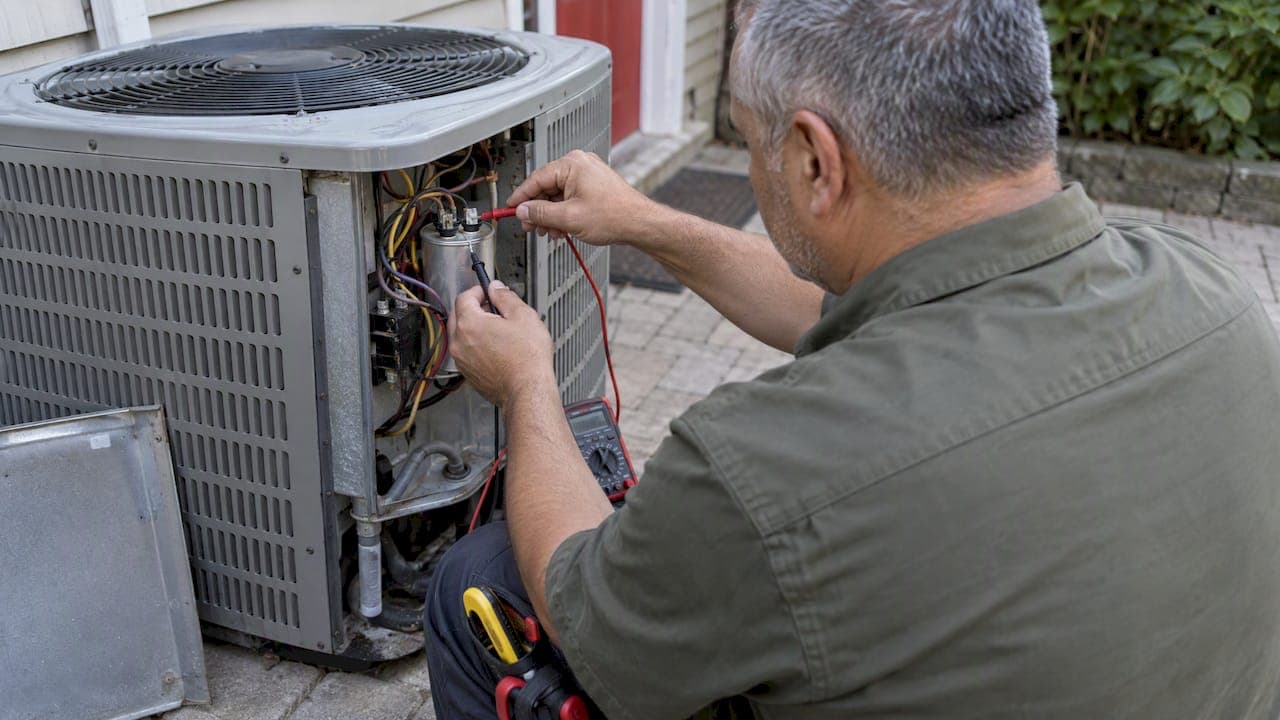
A bad AC capacitor usually shows up as an outdoor unit that hums but won't start, an air conditioner that blows warm air, or a system that cycles on and off. The capacitor gives the compressor and fan motors the electrical boost they need to start, so when it weakens, those motors struggle or stop. Replacement is a routine repair for a licensed technician, and the sooner it is done, the less strain your system takes.
TL;DR
- The most common signs are humming from the outdoor unit, reduced cooling, frequent cycling and higher energy use.
- Heat, voltage swings, power surges, vibration and age all wear capacitors out.
- Don't keep running the system. A struggling capacitor can damage the compressor and fan motors, which costs far more than the part.
- A capacitor holds a dangerous charge, so leave testing and replacement to a professional. Typical replacement runs $200 to $400 in the US, part and labor included.
- Several other faults mimic capacitor symptoms, so a measured diagnosis matters before you pay for any repair.
Table of Contents
- What an AC capacitor actually does
- Signs of a bad AC capacitor
- Why AC capacitors fail
- Is it safe to keep running the AC with a bad capacitor?
- Why you shouldn't open the unit yourself
- How a technician confirms a bad capacitor
- What you can safely check before you call
- How much does it cost to replace an AC capacitor?
- How long does an AC capacitor last, and how do you prevent failure?
- Our perspective
- Need AC service in Massachusetts?
- FAQ
- Sources
What an AC capacitor actually does
Think of the capacitor as a small rechargeable battery inside your outdoor condensing unit. According to Carrier's guide to AC capacitors, it stores electrical energy to give the compressor and fan motors the jolt they need to start, then helps regulate current so they run efficiently.
That start-up jolt is the key. An electric motor needs far more push to begin turning than to keep turning. Without a healthy capacitor, the motor may hum and fail to spin, spin slowly, or start only after several tries. Many outdoor units have a single capacitor serving both the compressor and the condenser fan; others have separate ones. Either way, the job is the same: deliver a clean, well-timed boost every time the thermostat calls for cooling.
Because the part is small, inexpensive and works hard every cooling cycle, it is one of the components that wears out first. That is good news in one sense: the fix is usually quick and affordable, provided you catch it before the motors take damage.

Signs of a bad AC capacitor
No single symptom proves a capacitor is the problem, but this cluster of signs points strongly toward it. Carrier lists reduced cooling, frequent cycling, higher energy use and humming from the outdoor unit as the common indicators. Here is what each looks like at home.
The outdoor unit hums but nothing spins
Stand near the condenser when the system is calling for cooling. If you hear a steady hum or buzz but the fan blades aren't turning, the motor is getting power without the boost to start. This is the classic capacitor complaint. Don't poke at the fan blades to get them going. Turn the system off at the thermostat and call a technician.
The air from the vents is warm
If the indoor blower runs but the air never gets cold, the compressor or condenser fan may not be running. A weak capacitor can leave one of them dead while the rest of the system carries on as if nothing is wrong. That is why the thermostat can look fine and the house still warms up.
The system won't start, or starts late
A noticeable delay between the thermostat calling for cooling and the outdoor unit kicking in is an early warning. As the capacitor drifts out of its rated range, starts get harder and eventually fail.
The AC turns on and off repeatedly
Short cycling can have several causes, from a dirty coil to a refrigerant problem, but a failing capacitor is one of them. If your system keeps shutting off minutes after it starts, read our guide to AC short cycling causes and fixes to see what else could be at play.
Your electric bill creeps up
Motors that struggle draw more current and run longer to deliver the same cooling. If your summer electric bill climbs without a change in your habits, a weakening capacitor is one possible reason, and so are many other things.
A burning smell or a bulging part
A hot, electrical smell near the unit is a reason to shut the system off at the breaker and call for service. Technicians also look for a swollen or leaking capacitor casing, which is a visible sign of failure. You shouldn't open the electrical panel to look for it yourself, for reasons covered below.
Why AC capacitors fail
Capacitors rarely fail for dramatic reasons. Bryant's replacement guide names prolonged heat, voltage fluctuations, power surges and age as the main causes. Carrier adds that heat and vibration can shorten a capacitor's life.
Here is how that plays out in a real system:
- Heat. The condensing unit sits outdoors, often in direct sun, and its electrical compartment gets hot on top of that. HVAC School notes that run capacitors contain oil to keep them cool and that sustained high ambient temperatures can cause premature failure. ServiceMag reports that the run capacitor is the most common component to fail on outdoor HVAC equipment, especially where long, hot summers add thermal stress.
- Power surges and voltage swings. Lightning storms and utility disturbances send abnormal voltage through the unit. A capacitor can be damaged by one big event or worn down by many small ones.
- Vibration. Years of the compressor and fan running shake connections and internal parts.
- Age. Even with no abuse, the internal materials degrade and capacitance drops.
Massachusetts summers are shorter than in the Sun Belt, but the pattern is familiar to us: a heat wave arrives, every system in the neighborhood runs hard for days, and the weakest capacitors give out. Units that sit idle all winter and then run flat out in July are also under stress at that first start of the season.
Is it safe to keep running the AC with a bad capacitor?
No. Carrier is direct on this point: running an AC with a failing capacitor can permanently damage the compressor and fan motors by forcing them to work harder than intended. A compressor replacement is one of the most expensive repairs in residential cooling, and it can push a homeowner toward replacing the whole system.
So the practical rule is simple:
- If the outdoor unit hums but the fan isn't spinning, switch the thermostat to off.
- If you smell something burning, turn off the AC's breaker too.
- Schedule a diagnosis rather than resetting the system again and again hoping it catches.
Repeatedly cycling the breaker to coax a unit to start puts more stress on exactly the parts you are trying to protect.
Why you shouldn't open the unit yourself
Videos make this look like a 15-minute job, and for a trained technician it often is. The risk is the stored charge. Carrier notes that technicians disconnect power and discharge the stored electrical charge before measuring, and describes that charge as potentially lethal. Turning off the breaker is not enough, because the capacitor can still hold energy afterward.
On top of the shock risk, a wrong replacement part (the wrong microfarad rating or voltage) can cause new problems. If you are a homeowner who wants to help, the useful move is to observe and report symptoms, then let a licensed technician handle the electrical work.
How a technician confirms a bad capacitor
A proper diagnosis goes in order. Per Carrier, the technician shuts off power, discharges the capacitor and measures its capacitance with a multimeter, then compares the reading with the range printed on the part. A capacitor that reads well below its rating is weak, even if it looks fine on the outside.

The measurement matters because symptoms overlap. The U.S. Department of Energy's guideline on air conditioner diagnostics stresses accurate measurements such as temperature split, airflow, superheat and subcooling, because multiple faults can produce similar symptoms and guessing from behavior alone can lead to the wrong repair.
That is worth taking seriously. Warm air can come from low refrigerant, a failed contactor, a dirty coil, a thermostat problem or a restricted airflow path. If you want to understand the airflow side, this overview of reasons for HVAC airflow loss shows why symptoms alone can't confirm a bad capacitor. A related component, the metering device, can also cause cooling trouble, and we explain it in our piece on TXV in HVAC systems.
A good technician will therefore do three things: test the capacitor, check the other electrical parts it works with, and confirm the system's cooling performance after the repair. If someone quotes a capacitor replacement over the phone without ever looking at the unit, ask what they will measure on arrival.
What you can safely check before you call
There are a few low-risk checks that save time and sometimes solve the problem outright:
- Thermostat settings. Make sure it is set to cool, the set point is below room temperature, and the display isn't blank. Our guide to thermostat not working checks walks through them.
- Air filter. A clogged filter restricts airflow and can make a system underperform.
- Breaker and disconnect. Confirm the breaker hasn't tripped. If it trips again right away, stop and call for service.
- What you see and hear. Note whether the indoor blower runs, whether the outdoor fan spins, and whether you hear humming or clicking. Tell the technician exactly that.
For a wider checklist organized by how much time you have, see AC not cooling: homeowner troubleshooting. Keep your hands out of the outdoor unit's electrical compartment throughout.
How much does it cost to replace an AC capacitor?
In the United States, Carrier puts AC capacitor replacement at roughly $200 to $400 including the part and professional installation, with accessibility and local market rates affecting the final number. The part itself is inexpensive; most of what you pay for is the trained labor, the diagnostic work and the correct specification.
A few things push the price up or down:
- Single versus dual capacitor. Some units use one part for both motors.
- Emergency or after-hours calls. Heat-wave weekends are the busiest times.
- Other findings. If the technician discovers a worn contactor or a failing fan motor, those add to the job.
We don't publish a flat price for this repair, because the right quote depends on your unit and what the diagnosis finds. What you can expect from us is a clear price before work begins.
Compare the repair bill with the alternative. Carrying on with a weak capacitor risks a compressor failure, and that is a much bigger invoice than a capacitor swap.
How long does an AC capacitor last, and how do you prevent failure?
Carrier says a capacitor typically lasts 10 to 20 years, depending on usage patterns and heat exposure. Plenty fail sooner, particularly in hot, hard-working systems.
You can't make a capacitor immortal, but you can improve your odds:
- Schedule an annual tune-up before cooling season. A tune-up includes cleaning and tightening connections, checking airflow and spotting a capacitor that is drifting out of range, as Carrier notes. Catching a weak part in May beats finding it during a July heat wave.
- Keep the outdoor unit clear. Trim plants back, keep leaves and debris off the cabinet and don't stack items against it, so the unit sheds heat.
- Protect against surges. Ask a licensed electrician or your HVAC contractor about surge protection for the condenser, since surges are a known cause of failure.
- Don't ignore early symptoms. A slow start or a faint hum is information. Acting on it keeps a $200 to $400 repair from becoming a motor replacement.
Our perspective
We see capacitor failures every cooling season, and the pattern is consistent. The homeowner noticed something a few days earlier, a hum, a slow start, a house that never quite cooled, and kept hoping it would pass. By the time we arrive, a cheap part has sometimes taken a motor with it.
Our advice is to treat a humming outdoor unit as a service call, not a mystery to solve at the breaker panel. Shut the system off, tell us what you heard, and let a licensed technician test it properly. We would rather confirm a capacitor with a meter than guess, because the same warm-air complaint can come from a half dozen different faults.
We are a family-owned team, and the owner stays involved in how jobs are handled. Many of the homes we work in are older, with equipment that has been through decades of New England weather, so we look at the whole system and not just the part in front of us. If your AC is only a few seasons from retirement, we will tell you what we find and explain your options in plain terms before any work begins.
The best money you can spend on cooling is a pre-season tune-up. It is where weak capacitors, loose connections and airflow problems get caught while they are still small.
Matt
Need AC service in Massachusetts?
If your outdoor unit is humming, the air is warm or the system keeps cycling, our licensed and insured technicians can diagnose the cause and fix it. We offer same-day or next-day service, AC diagnostics and repair, and seasonal AC tune-ups for homes and businesses across Massachusetts.

See our AC diagnostics and repair services or visit Mystic Valley Home Services to book a visit. If you manage a commercial property, our overview of common commercial HVAC system failures shows what to catch early.
FAQ
Can a bad capacitor make my whole AC stop working?
Yes. A failing capacitor can stop the outdoor unit from starting at all, even though the thermostat has power and the indoor blower still runs. You may hear humming from the outdoor unit while the air from the vents stays warm. Because other faults cause the same picture, have a technician measure before replacing parts.
What are the first signs of a failing AC capacitor?
Early signs are slower starts, a humming sound from the outdoor unit, weaker cooling and an AC that cycles on and off. Some homeowners also notice a higher electric bill. A burning smell or a swollen capacitor is a more advanced sign, and the system should be shut off until it is checked.
Can I replace an AC capacitor myself?
We don't recommend it. A capacitor stores a dangerous electrical charge even after the power is off, and the replacement must match the correct rating for your unit. A licensed technician discharges the part safely, tests it and installs the right one in a short visit.
How much does it cost to fix a bad AC capacitor?
In the US, replacement typically runs $200 to $400 with the part and installation, according to Carrier. Your price depends on access to the unit, the type of capacitor and local rates. If the technician finds additional worn parts, the total will reflect that.
How long does a capacitor last?
Typically 10 to 20 years, though heat, vibration and surges can shorten that. An annual tune-up lets a technician spot a capacitor that is drifting out of range before it fails on a hot day.
Sources
- Carrier: What is an AC capacitor? Cost, signs of failure and more
- Bryant: AC capacitor replacement guide
- ServiceMag: Common HVAC electrical failures
- HVAC School: Why do capacitors fail?
- U.S. Department of Energy: Measure Guideline, Air Conditioner Diagnostics
- Reasons for HVAC airflow loss: a homeowner's diagnostic guide