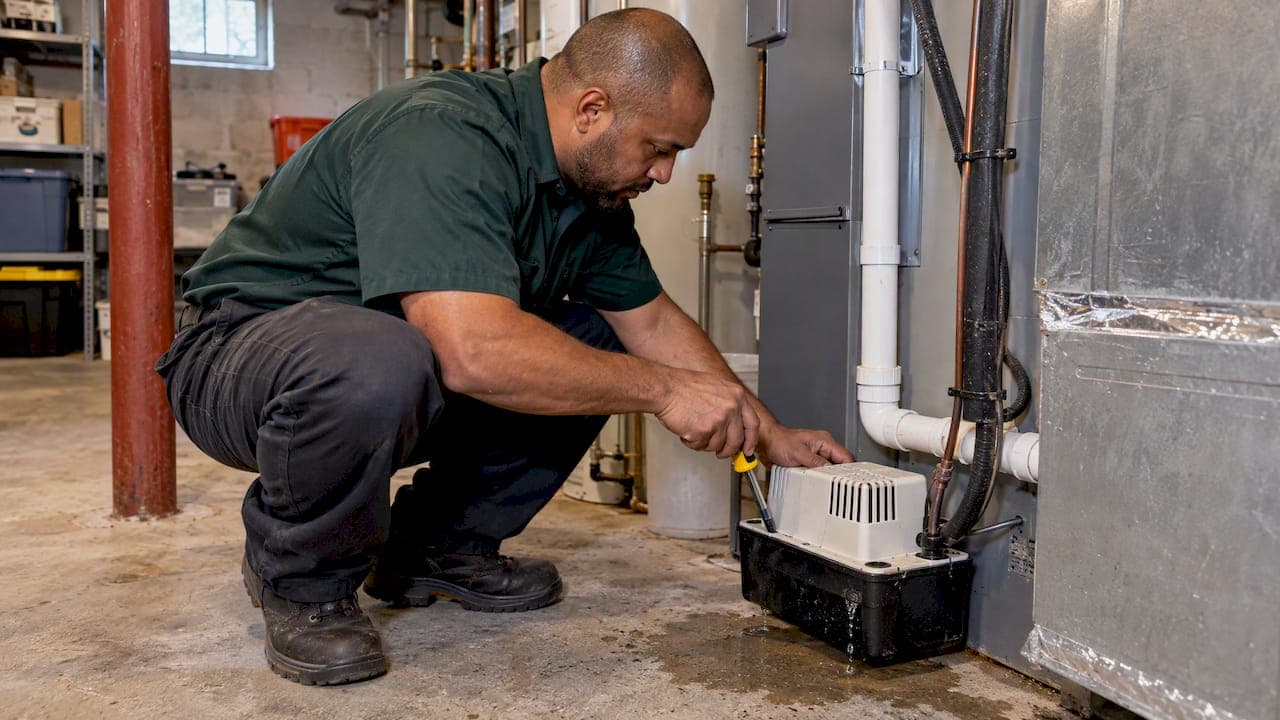
A leaking condensate pump is almost always one of four things: a clogged drain line or trap, a dirty reservoir with a stuck float, a blocked or over-tightened check valve, or a pump that has simply worn out. The first move is the same every time. Shut the AC or furnace off at the thermostat, unplug the pump only if the floor around it is dry, and stop the water before it reaches drywall, flooring or your equipment.
This guide walks through how to tell which problem you have, what a careful homeowner can safely check, where the line is between a quick fix and a job for a licensed technician, and how to keep the pump from failing again. We are a family-owned plumbing and heating company in Massachusetts, and condensate leaks in basements, utility closets and attics are a regular part of our service calls.
TL;DR
- Most leaks and overflows trace back to a clogged drain line, a dirty reservoir, a stuck float, or a blocked check valve, not a pump that is "just broken."
- Turn the system off at the thermostat first. Never touch the pump or its plug with wet hands or while standing in water.
- Clearing algae and sludge from a reservoir is often simple. Electrical work, replacement and anything involving the drain line routing belong with a qualified technician.
- A pump with no overflow alarm or safety switch is a flood waiting to happen. Adding one is cheap compared with water damage.
- If the pump is leaking from the body or shaft, or the same problem keeps returning, replacement is usually smarter than repeated repair.
Table of Contents
- What a condensate pump does, and why a leak matters
- Step one: stop the water safely
- Why a condensate pump leaks: the common causes
- How to read the symptoms
- What you can check yourself
- Why the "quick fix" often fails
- Should you repair or replace the pump?
- Protecting your home from water damage
- Perspective: what we see in Massachusetts homes
- Need help with a leaking condensate pump?
- FAQ
- Sources
What a condensate pump does, and why a leak matters
Air conditioners, heat pumps, high-efficiency furnaces and condensing boilers all produce water. When the equipment sits below the level of a floor drain, which is common in Massachusetts basements, gravity cannot carry that water away. A condensate pump collects it in a small reservoir and pushes it out through a discharge line when a float switch tells it the tank is full.
According to Beckett's guide to HVAC condensate pumps, these pumps remove condensate automatically, and if one becomes plugged or fails, water can overflow or leak and cause water damage. The same guide notes that condensate leaks can lead to mold growth, and that a safety switch can shut off the source equipment when the discharge line is blocked or the pump fails.
That last point is worth remembering. If your AC suddenly stops cooling and there is water near the pump, the safety switch may have done exactly what it was designed to do.

Step one: stop the water safely
Before you diagnose anything, deal with the water and the electricity.
- Turn the equipment off at the thermostat. If the pump is overflowing, the system is still feeding it water. Switching to "off" stops new condensate. If the thermostat does not seem to respond, use the breaker.
- Look at the floor before you step. Pentair's manual for its Hydromatic HCU condensate pumps says to disconnect furnace or AC power and unplug the pump before maintenance, and not to handle the pump or its plug with wet hands or while standing on a wet or damp surface.
- If the floor is wet around the outlet, do not go in. Shut off the breaker feeding that circuit, or call an electrician or us. Water and a plugged-in pump is not a situation to improvise.
- Contain the water. Towels, a wet-dry vacuum and a shallow pan under the pump buy you time. Move anything stored on the floor nearby.
- Photograph the damage before you clean up if water reached walls, flooring or stored belongings. Our guide on saving proof before cleanup for plumbing leak insurance claims explains why that matters.
The Pentair manual also warns that an inoperative or leaking pump can cause flooding and property damage, which is why it recommends a backup system or alarm wherever that risk exists. We come back to that in the prevention section.
Why a condensate pump leaks: the common causes
The water has to come from somewhere. Finding where it appears, and whether the pump is running, narrows the cause quickly.
A clogged drain line or trap
Condensate is warm, damp and slightly acidic, which is ideal for algae, slime and mineral scale. Over time that buildup narrows the drain line and the reservoir. Little Giant notes in its pump troubleshooting guidance that debris and deposits can obstruct flow, and Beckett lists a clogged or plugged drain as a leading reason pumps overflow. A clogged trap on the gravity side of the drain is another frequent culprit: water backs up into the reservoir faster than the pump can empty it.
A crimped or kinked discharge line causes the same symptom. The pump runs, but the water has nowhere to go, so it rises in the tank and spills out.
A stuck or dirty float switch
The float tells the pump when to start. If algae or debris keeps it from rising, the pump never turns on and the reservoir overflows. If the float sticks in the up position, the pump can run and run without ever shutting off properly. The Pentair manual lists a float stuck in the off or down position, a clogged inlet and an algae-fouled reservoir among the reasons a pump does not run.
A blocked or over-tightened check valve
The check valve keeps water in the discharge line from flowing back into the reservoir after the pump shuts off. When it sticks or plugs, the pump may run without moving water out. The Pentair manual also flags a leak clue that surprises people: an over-tightened check valve can distort its O-ring and leak. The valve should be inspected for obstruction or damage, then cleaned or replaced.
Inflow that exceeds pump capacity
Little Giant's owner's manual lists overflow causes that include inflow matching or exceeding the pump's capacity, an unlevel pump, debris restricting the float, a stuck or plugged check valve, blocked outlet tubing, an impeller that is not turning, a defective switch and a defective motor. A pump sized for a small air handler can be overwhelmed when someone adds a second unit or a humidifier drain to the same reservoir.
A failed motor, shaft seal or cracked reservoir
Pumps are mechanical parts and they wear out. A cracked reservoir, a worn shaft seal or a motor that hums without moving water points to a pump that is at the end of its life. Wet spots that appear on the body of the pump, rather than at a fitting or from the top of the tank, usually mean this.
A problem upstream of the pump
Sometimes the pump is blameless. Beckett notes that a cracked or corroded drain pan can leak, and a frozen or iced-over evaporator coil can send far more water than normal into the system when it thaws. If the water is pooling near the air handler rather than the pump, the pan or coil is the better suspect. Our AC not cooling troubleshooting guide covers frozen coils and airflow issues, and our piece on refrigerant leak signs helps if icing is part of the picture.
How to read the symptoms
Use this table to match what you see to the likely cause. It is a starting point, not a diagnosis.
| What you notice | Likely cause | Who should handle it |
|---|---|---|
| Reservoir full, pump silent | No power, stuck float, bad switch or dead motor | Check power; otherwise a technician |
| Pump runs but water does not leave | Clogged discharge line, stuck check valve, plugged impeller port | Technician for lines and valves |
| Water at the top of the tank | Inflow above capacity, blocked outlet, clogged inlet | Technician |
| Water at a hose connection | Loose clamp, cracked tubing, over-tightened check valve | Technician |
| Water on the pump body or shaft | Worn seal, cracked reservoir | Replacement by a technician |
| Water near the air handler, pump dry | Cracked drain pan, clogged trap, frozen coil | Technician |
| Pump cycles constantly | Check valve leaking back, float debris, high inflow | Technician |
Little Giant's manual draws a useful line between a malfunction and a blockage. If the pump is full but does not start, you test power, float movement and the condition of the switch and motor. If it runs without discharging, you inspect the check valve, the lift, the impeller inlet and the outlet tubing. Beckett's troubleshooting guidance is similar: check power, look for kinked or blocked discharge and intake tubing, confirm the motor moves freely and the switch is seated, and look for obstructions at the check-valve intake.
What you can check yourself
Some checks are low-risk. Do them only with the system off and the pump unplugged from a dry location.
- Power. Is the pump plugged in, and is the outlet live? A tripped GFCI is a common reason a pump "dies" overnight.
- Discharge tubing. Follow it from the pump to where it ends. A kink, a sag that holds water or a section pinched by a stored box can stop flow.
- Reservoir contents. If the tank is full of green or black slime, that is your answer. Beckett says condensate pump maintenance can often be simple, but it also states that pumps should only be installed and serviced by technically qualified personnel familiar with the appropriate tools, procedures and local codes. Treat cleaning the reservoir as light maintenance, and leave rewiring, replacing the motor or reworking the piping to a professional.
- Float movement. With the pump unplugged, you can see whether the float moves freely or is snagged on debris.
- Level. An unlevel pump can leave the float binding against the tank wall.
What you should not do: pour harsh chemicals into a pump reservoir, bypass a safety switch to get the AC running, or open a pump that is still plugged in. Trane advises that, for an AC that is not working, it is safest to have an HVAC professional fix the problem, and that do-it-yourself attempts could void a warranty or damage the system. Trane's drain-line guidance also says to turn the AC off at the thermostat or breaker, and notes that a technician may use a vacuum, wet-dry vacuum, garden hose or snake to clear a drain-line clog, then clean the line with AC drain-line cleaner and water.
Why the "quick fix" often fails
People commonly wipe out the reservoir, restart the pump, and think the problem is solved. Then the leak returns in two weeks. The usual reasons:
- The clog is further down the line, in the trap or at a joint, so the reservoir refills with sludge.
- A check valve that was never cleaned keeps letting water fall back into the tank.
- The pump was undersized or never had an overflow safety switch to begin with.
- Water has been wicking along tubing or the pump body, so the visible wet spot is not the real source.
A technician checks the whole path from the coil pan to the final discharge point, not just the pump. That is the difference between a repair and a repeat call.
Should you repair or replace the pump?
There is no honest flat answer to "how much does a condensate pump replacement cost," because price depends on the pump type, how the discharge line is routed, and how hard the pump is to reach. Rather than quote a national average that may not apply to a Massachusetts basement, we price each job after we see it, and we give you the number upfront before work starts.
Here is how we think about repair versus replacement:
- Repair makes sense when the pump is relatively new and the cause is a clog, a dirty float or a stuck check valve. Cleaning, a new check valve or a new float switch can restore it.
- Replace when the body, shaft seal or reservoir is leaking, the motor is failing, the pump has needed repeat service, or parts are no longer available. A leaking body cannot be sealed reliably.
- Replace and upgrade when the pump is the weak link. A properly sized pump with a built-in overflow safety switch and an alarm gives you protection the old pump never did.
Also consider the age of the system it serves. If your AC or boiler is near the end of its life, it may make sense to plan the pump replacement alongside bigger work. Local rules matter too: Beckett advises considering local condensate-handling and disposal regulations when selecting a pump. Condensate from high-efficiency condensing boilers and furnaces can be acidic, and where it goes and whether it needs neutralizing depends on the equipment instructions and local code. Our article on condensing boiler venting rules covers related points.
Protecting your home from water damage
The pump itself is cheap. The cost is in what a failed one does to a finished basement.
Add an overflow safety switch or alarm
Pentair says installations exposed to water damage should have a failure alarm, a water sensor or an auxiliary high-water safety shutoff, and its test procedure verifies that rising reservoir water shuts down the appliance or activates the alarm. A float switch wired to the AC control circuit stops the cooling before the pan overflows. A battery-powered water sensor on the floor costs little and texts or chirps when water appears.
Code points the same way. The InspectAPedia reference on condensate drains and piping describes code provisions that, where overflow could damage building components, offer auxiliary protection options including a water-level detection device that shuts off equipment when the primary drain is blocked. Massachusetts follows its own amended codes, so ask your installer what applies to your equipment.

Clean the line on a schedule
Trane recommends scheduling professional AC maintenance every spring to inspect and clean the condensate pan and drain line, keeping indoor and outdoor units free of debris, and asking a technician about distilled vinegar in the line if it keeps clogging. We do not recommend experimenting with chemicals around a pump. Ask us what is safe for your specific pump and drain materials. For how often a full service should happen, see our HVAC tune-up frequency guide.
Dry things out fast if water got out
A slow leak behind a pump can leave damp drywall and humid air for weeks. If water spread, dry it within a day or two and watch for musty smells. The same moisture logic applies in bathrooms, and these bathroom mold prevention steps show how quickly damp areas should be dealt with.
Commercial buildings need a plan too
Offices, restaurants and retail spaces often run several pumps serving rooftop or ceiling units. One failure over a drop ceiling can close a space. Our overview of common commercial HVAC failures explains what to catch early, and our guide to documenting plumbing repairs on business property helps with records.
Perspective: what we see in Massachusetts homes
We work in a lot of older homes in and around Arlington, and the pattern repeats. A pump was added when a basement was finished, a new AC or high-efficiency boiler went in years later, and nobody revisited the discharge routing or added an overflow switch. The pump runs for years without attention until one humid July week, the reservoir fills with slime, and the float sticks.
Our view is simple. The pump is not the problem to solve. Water leaving the building reliably is. So we trace the whole path, from the coil or boiler condensate outlet to the final drain, and we fix the weak point instead of just wiping out a tank. We tell you what we found and what it costs before we do the work, and where a cheap cleaning is enough, we say so rather than sell you a new pump.
Two habits prevent most of the calls we get: a spring tune-up that includes the condensate line, and a safety switch or water sensor on every pump that sits above finished space. If you only do one, do the switch.
— Matt
Need help with a leaking condensate pump?
If your pump is leaking, overflowing or tripping your AC off, our licensed and insured Massachusetts technicians offer same-day or next-day service. We can trace the leak, clear the line, replace the pump and add overflow protection in one visit where possible. Start with our AC diagnostics and repair page, or if the pump serves a boiler or furnace, see our heating services. Persistent drain trouble elsewhere in the house is covered under drain cleaning and clog removal.
FAQ
What causes a condensate pump to leak?
The most common causes are a clogged drain line or trap, a reservoir fouled with algae, a stuck float switch, and a blocked or over-tightened check valve. Water at the pump body or shaft usually means the pump itself is worn out. Water near the air handler with a dry pump points to the drain pan or coil instead.
How do I unclog a condensate pump line?
Turn the AC off at the thermostat or breaker first. A technician typically clears the line with a vacuum, wet-dry vacuum, garden hose or snake, then flushes it with drain-line cleaner and water. If the line clogs repeatedly, have the trap and routing checked, since a sag or poor slope will keep collecting sludge.
Are condensate pumps easy to replace?
The hardware is small, but the job involves electrical connections, drain routing and safety switch wiring. Beckett states that pumps should be installed and serviced by technically qualified personnel familiar with local codes. A professional replacement also lets you add an overflow shutoff at the same time.
Is a leaking or overflowing condensate pump an emergency?
Treat it as urgent, not as a crisis. Turn the system off to stop new water, keep clear of wet floors near any plugged-in pump, and get it serviced quickly, because standing water can damage flooring and encourage mold. If water is reaching electrical equipment or a finished ceiling, call right away.
Can I keep running the AC with a leaking pump?
We advise against it. The system keeps producing water, and a pump that is already leaking will only make more mess. If a safety switch has shut the AC off, do not bypass it. Have the cause fixed.
Sources
- The Ultimate Guide to HVAC Condensate Pumps, Beckett
- Basic Condensate Pump Maintenance & Troubleshooting, Beckett
- Hydromatic HCU Series Condensate Pumps Manual, Pentair
- Little Giant owner's manual
- AC Condensate Drain Line Clogged? Trane
- A/C System Condensate Drains, InspectApedia
- Little Giant