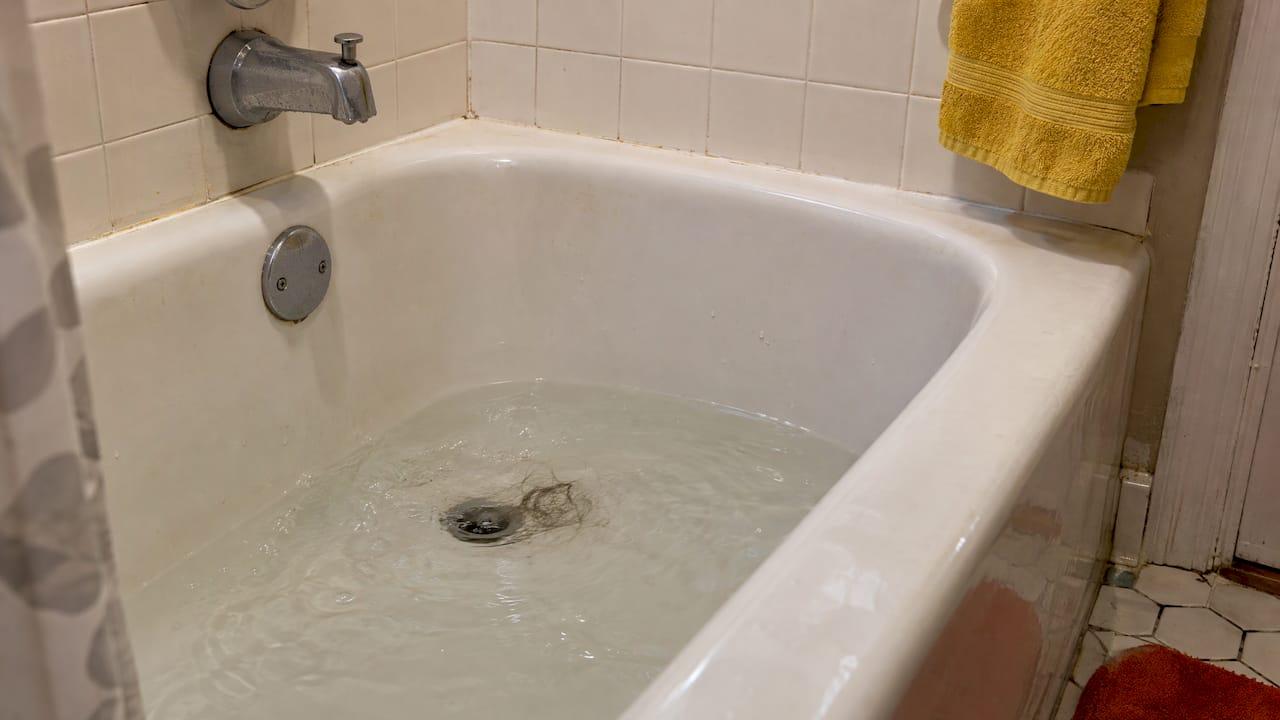
A clogged bathtub drain is almost always hair and soap scum packed into the first foot or two of pipe, and most of the time you can clear it in under an hour with a drain plunger, a hair-pulling tool or a small drain snake. Start with the stopper and the drain opening, move to plunging, then snake through the overflow if you need to. If the water still sits there, or other drains are slow too, the problem is deeper in the line and it is time for a plumber.
This guide walks through how to confirm it is a real clog, the fixes in the order that works best, what to keep out of your pipes, and the signs that a tub problem is bigger than a tub.
TL;DR
- Most tub clogs are hair and soap scum near the drain opening. Pull out what you can see first, then plunge, then snake.
- Use a dome-shaped drain plunger with the overflow plate covered. Snake through the overflow opening, not straight down the drain.
- Never mix drain cleaners or use one right after another. Hot water, mechanical clearing and enzyme products are gentler on your pipes than harsh chemicals.
- Slow drains in more than one fixture, sewage smells or old pipes mean you need a plumber, not another round of DIY.
- In Massachusetts, our team handles drain cleaning and clog removal, often same-day or next-day.
Table of Contents
- How to tell it is a clog, and what causes it
- Before you start: gather the right tools
- Step 1: Clear what you can see
- Step 2: Plunge the drain
- Step 3: Snake the drain through the overflow
- What to put down the drain, and what to leave out
- Quick reference: which fix for which problem
- When the tub still won't drain: call a plumber
- Keeping the tub drain clear
- Our perspective
- Need the tub fixed today?
- FAQ
- Sources
How to tell it is a clog, and what causes it
The classic signs are water pooling around your ankles during a shower, a slow trickle after you pull the stopper, or gurgling as the tub empties. Before you reach for tools, rule out the stopper. This Old House points out that a malfunctioning trip lever and plunger assembly can mimic a clog even when the pipes are clear. If your tub has a lever on the overflow plate, lift the stopper and see whether it is actually opening all the way.
If the stopper is fine, the usual suspects are:
- Hair and soap scum. The most common cause by far.
- Mineral buildup. Hard water leaves deposits that narrow the pipe over the years.
- Foreign objects. Jewelry, bath toys, the cap off a shampoo bottle.
The same source lists all three. Plumber Magazine adds useful detail on where hair collects in a tub drain: right at the opening, where the strainer hides a crossbar that catches strands, and further down where the tub's branch heads toward the stack. Soap also coats the pipe walls over time and traps dirt and slime, until the buildup can get as hard as concrete.
There is a third cause that has nothing to do with debris. The same article explains that a tub drain that is not properly vented backs up more often, because the drain cannot pull in air to displace the water, much like holding your thumb over the end of a straw. If you hear gurgling and the clog keeps returning, our guide to how plumbing vents work explains why, and our walkthrough on how to fix a gurgling drain at home covers the first checks.
Before you start: gather the right tools
You do not need much, and most of it is probably in your house already:
- A screwdriver (usually Phillips) for the overflow plate
- A dome-shaped drain plunger
- A wet rag or washcloth
- A bent wire hook or a Zip-It style barbed plastic strip
- A small hand-crank drain snake, also called a drain auger
- Rubber gloves and a flashlight
- A thick drop cloth or old towel for the tub floor
- A bucket and an old toothbrush for cleaning parts
That plunger detail matters. Family Handyman recommends a dome-shaped drain plunger, not a bell-shaped toilet plunger, because it seals flat against the tub floor around the drain.
Step 1: Clear what you can see
Remove the stopper. Depending on your tub, it may lift out, unscrew counterclockwise, or release with a small set screw. Look at the stopper itself and the drain opening. Hair often wraps around the stopper stem or sits against the crossbar just below the opening.
Pull out what you can with gloved fingers, a bent wire or a barbed plastic strip. Family Handyman recommends the strip or a bent wire hook for pulling hair out, with one caution from the plumber it quotes: the tool can catch or break off inside the drain if you use it too aggressively. Work gently, slide it down, twist, and pull straight back.
Wipe the stopper clean, run hot water and test. A surprising number of slow tubs are fixed right here.
Step 2: Plunge the drain
If the water is still standing, plunge. This Old House describes the method: fill the tub with a few inches of water, cover the overflow plate with a wet cloth, and plunge for about 30 seconds with steady, consistent strokes, then check the drainage.
Why cover the overflow? Because air will escape through that opening and the plunger will lose all its pressure. A tight seal on both openings forces the pressure down the drain line instead.
A few tips that make plunging work:
- Make sure the plunger head is fully covered by water so it seals.
- Press down slowly first to push out trapped air, then pump vigorously.
- Lift the plunger away after a round and see whether the water moves.
- Repeat two or three times before moving on.
If the water starts to drain but slowly, that usually means the blockage has loosened but not cleared. Follow with hot water and move to the snake.
Step 3: Snake the drain through the overflow
This is where the details matter, and where most tub damage happens. The Spruce is direct about it: never snake through the drain opening in the bottom of the tub, because the bend below is normally too sharp and you could damage the pipe. The same article suggests covering the tub bottom with a thick drop cloth so the metal cable does not scratch porcelain, acrylic or fiberglass.
So the standard route is through the overflow opening. This Old House gives a six-step approach that boils down to this:
- Unscrew the overflow plate with a screwdriver and pull it out, with the linkage attached. Set it aside.
- Feed the snake down through the overflow hole.
- Crank and push the cable down the pipe two or three times, then pull it out and see whether you have caught hair or gunk.
- Test the drainage.
- Run the snake again with the water running to flush loosened debris.
- Check the stopper and linkage, adjust if needed, then put everything back together and test again.
Be gentle. Family Handyman's plumber warns that with a levered or rocker-style stopper, a tee where the overflow tube meets the drain can send the snake upward instead of down, where it gets tied up in the overflow area. If the cable meets hard resistance right away, back it out and rotate it rather than forcing it.
NBC News reports expert advice that a drain snake can damage pipes if used improperly, yet it is much safer for your pipes than harsh or corrosive chemicals. Use a light touch and you are on the right side of that equation.
What to put down the drain, and what to leave out
Hot water and enzymes
A flush of hot water can soften soap and loosen some of the buildup, and it is a free first move. Be careful with boiling water if your tub has PVC pipes, since very hot water can stress the joints. Very hot tap water is the safer choice.
For a slow drain that is not fully blocked, Consumer Reports says enzymatic drain cleaners such as Green Gobbler or Bio-Clean are safer for pipes than chemical products. They work slowly, and need to sit in the drain for several hours or overnight, so pour them in at bedtime. They can also be a good fit for homes on septic systems, since they help replace lost bacteria.
Chemical drain cleaners
People ask what dissolves hair in a bathtub drain. Consumer Reports explains that caustic cleaners like Drano contain lye (sodium hydroxide), caustic potash and/or bleach, and that the lye's corrosiveness breaks down grease and organic material such as hair. Oxidizing cleaners like Liquid-Plumr work best on organic material like hair and food, and less well on grease.
They do work on hair, but they come with safety rules you cannot skip:
- Use one product, exactly as the label says.
- Never mix two drain cleaners, and never use one right after another. Good Housekeeping quotes a cleaning lab expert who warns that doing so could cause an explosion in your pipes, and who recommends calling a plumber if the product does not work.
- Wear gloves and eye protection, and keep the bathroom ventilated.
- Tell your plumber if you used a chemical cleaner. This Old House's Richard Trethewey notes that harsh chemicals can damage pipes and can be dangerous for a plumber who has to come in as backup, so reaching for the plunger or snake first is the better order.
If you already poured a chemical cleaner and the water is still standing in the tub, do not plunge or snake it. The water is caustic and can splash back. Call a plumber and mention exactly what you used.
Baking soda and vinegar
The fizzing home remedy is everywhere, so it is worth knowing what it does. Good Housekeeping explains that baking soda and vinegar mostly cancel each other out, leaving water and a little salt. The bubbles may lift some mess or get a slow drain moving, but the mixture itself does not clean anything. Poison Control notes the reaction produces carbon dioxide, but drains are not airtight, so the gas does not build enough pressure to push a clog out, and it is unlikely to melt oil and grease clogs.
In practice: treat it as a mild flush for a slightly slow drain, then follow with hot water. Do not count on it for a tub that will not drain.
Quick reference: which fix for which problem
| Situation | Best first move | Move up to |
|---|---|---|
| Slow drain, hair visible at the opening | Pull hair with a bent wire or barbed strip | Hot water flush |
| Water standing, drains in a few minutes after you tried the stopper | Drain plunger with the overflow covered | Snake through the overflow |
| Water standing, plunging does nothing | Snake through the overflow opening | Professional drain cleaning |
| Recurring slow tub every few weeks | Monthly overflow plate cleaning and enzyme treatment | Plumber to check venting and the line |
| Water rises in the tub when another fixture runs | Stop, do not keep running water | Plumber right away |
| Sewage smell or backup | Stop using fixtures | Plumber right away |
When the tub still won't drain: call a plumber
There is a point where more DIY just costs you an afternoon and risks your pipes. This Old House lists the signs that it is time for a plumber:
- DIY methods fail to improve drainage
- You suspect pipe damage or corrosion
- Multiple drains are slow
- You notice sewage odors or backups
- Your home has old or deteriorating pipes
Multiple slow drains are the big one. A tub, a sink and a toilet all draining slowly points to a blockage in a shared line, not in the tub. If water backs up into the tub when you flush or run the washer, read our piece on sewer backup causes, and if you have a basement bathroom or laundry, see how basement plumbing works.
Sometimes the answer is not a clearing at all. A corroded or damaged tub drain assembly that keeps catching debris can need bathtub drain replacement, and a plumber can tell you whether the shoe, the overflow or a section of pipe is the culprit.

If you have a lingering smell rather than a blockage, it may be a dry trap rather than a clog. Our guide on stopping sewer smell in the house shows the quick P-trap fix. And if the kitchen is the slow one, here is how to fix a slow kitchen sink drain.
Keeping the tub drain clear
Prevention is mostly about stopping hair before it gets into the pipe, and keeping soap from building up:
- Use a mesh or perforated hair catcher over the drain, and empty it after each shower.
- Brush hair before you bathe. Loose hair goes down the drain instead of into the trash.
- Flush with hot water weekly after the last use of the day.
- Pull and clean the stopper monthly. Remove the overflow plate while you are at it and wipe off the gunk you can reach.
- Use an enzyme-based cleaner now and then, following the label, for the film that soap leaves behind.
- Keep small items away from the drain, especially around kids' bath time.
If you have hard water, mineral buildup will narrow pipes over time regardless of habits. That is one more reason a recurring slow drain in an older house is worth having looked at.
Our perspective
In older Massachusetts homes, especially the kind we see around Arlington, a tub that keeps clogging is rarely just a tub problem. Decades of soap and hair on older pipe walls, tight bends and tubs that sit at the far end of the branch all make the same clog come back.
Our advice is simple. Clear the opening, plunge, and snake gently through the overflow. If you need more than one round, stop. Repeated rounds with chemicals and aggressive tools are how a cheap fix becomes a pipe repair.
What we want you to know is that calling a licensed plumber for a stubborn tub is not an overreaction. It is the quickest way to find out whether you have a clog, a venting issue or a pipe that is reaching the end of its life. Our drain cleaning and clog removal service is part of our plumbing work, and as a family-owned team with the owner overseeing the work, we aim for same-day or next-day appointments and upfront pricing.
Matt
Need the tub fixed today?
If you have worked through the steps above and the water is still standing, or you would rather not take the overflow plate off, our licensed and insured Massachusetts technicians handle drain cleaning and clog removal for homes and businesses, along with leak detection, pipe repair and fixture installs. We aim for same-day or next-day service and explain pricing before we start.

See everything we do on our plumbing services page, or book through Mystic Valley Home Services and tell us what the tub is doing so we arrive prepared.
FAQ
Why is my bathtub draining slowly even though I cleaned the stopper?
Hair and soap scum usually build up deeper in the pipe, where the strainer crossbar and the first bend catch them. Try plunging with the overflow covered, then snaking through the overflow opening. If other drains are slow too, the blockage is likely in a shared line and needs a plumber.
What dissolves hair in a bathtub drain?
Caustic cleaners containing lye break down hair, and oxidizing cleaners are also effective on it, according to Consumer Reports. Enzymatic cleaners are gentler but slower, working over several hours or overnight. Whatever you pick, use only one product at a time and follow the label, since mixing cleaners can be dangerous.
Does baking soda and vinegar unclog a tub drain?
Not reliably. The two mostly neutralize each other, and the fizz rarely builds enough pressure in an open drain to move a real clog. It may help a slightly slow drain, so follow it with hot water. For a tub that will not drain, use a plunger or snake.
Can I use a drain snake on any bathtub?
Yes, but feed it through the overflow opening, not straight down the drain, since the bend below is too sharp and the pipe can be damaged. Lay a thick cloth in the tub to protect the finish, and go gently. If the cable stops hard or keeps tangling, call a plumber.
When should I call a plumber for a clogged tub?
Call when DIY clearing does not improve the drain, when several fixtures are slow, when you smell sewage or see backups, or when you suspect pipe damage or have old pipes. Also call if you have already used a chemical cleaner and the tub is still full.
Sources
- How to Clear a Clogged Bathtub Drain, This Old House
- How To Fix a Slow-Draining Tub, This Old House
- A Look at Bathtub Drain Clogs, Plumber Magazine
- How To Unclog a Bathtub Drain Without Chemicals, Family Handyman
- How to Choose and Use a Drain Cleaner, Consumer Reports
- What's in drain cleaner, Poison Control
- Cleaning Products Pros Say You Should Never Mix, Good Housekeeping
- How to Unclog a Bathtub Drain Using a Snake, The Spruce
- How to use a drain snake, NBC News