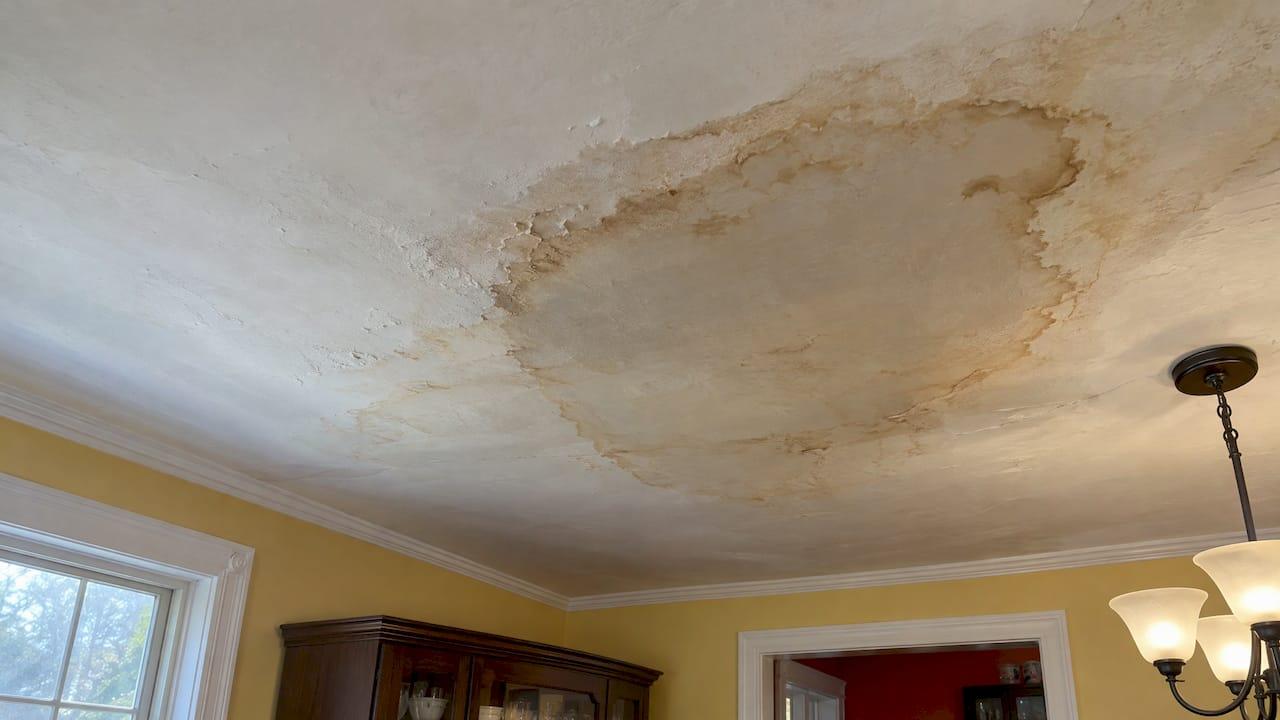
A water stain on a ceiling means moisture got into the drywall or plaster from above: a roof, a supply or drain line, an HVAC component or condensation. The stain tells you something got wet. It doesn't tell you whether the leak is still going. The job is to find the source, stop it, dry the material and only then clean and repaint. In older Massachusetts homes, the source is often a pipe or heating line hidden in the floor above, and our licensed technicians can trace it, fix it and give you the price before work starts.
TL;DR
- A spreading, darkening or bubbling stain means the leak is probably still active. A sagging or bowing ceiling means keep everyone out of the room and call for help now.
- Dry wet material within 24 to 48 hours. The EPA says mold usually won't grow if materials dry within that window.
- Painting over a stain does nothing until the source is fixed. Stain-blocking primer comes after the leak is repaired and the ceiling is fully dry.
- Stains under a bathroom, kitchen, laundry or radiator are often plumbing or heating leaks. Stains under a roofline or after rain point up to the roof.
- Call a professional if you can't find the source, if the ceiling sags, if mold covers more than 10 square feet, or if water is near wiring.
Table of Contents
- What a ceiling water stain is telling you
- Is a ceiling water stain serious?
- Safety steps before you do anything else
- Where the water is coming from
- Stop the leak first, then deal with the ceiling
- Cleaning and repainting the stain
- When to call a professional
- If it's a commercial property
- Why we trace the source before touching the ceiling
- Get the source found and fixed
- FAQ
- Sources
What a ceiling water stain is telling you
Water in a ceiling carries dust, tannins from wood framing and minerals from the material it passes through. As the moisture dries it leaves a yellow or brown ring, often with a darker edge. That ring is a record, not a live feed. A stain can sit unchanged for years after a one-time leak. It can also grow a little each time it rains or each time someone runs the shower upstairs.
That is why the first question isn't "how do I remove it?" It is "is it still getting wet?" Here is a practical way to read what you see:
| What you see | What it usually means | How fast to act |
|---|---|---|
| Small, dry, light-brown stain that hasn't changed | Past leak, possibly fixed or intermittent | Mark it, watch it, have the source confirmed before painting |
| Stain that is larger or darker than last month | Active or recurring leak | Within days |
| Bubbling or peeling paint, soft spot | Water pooling behind the paint or in the drywall | As soon as you can, ideally same day |
| Dripping, or stain that grows during rain or after showers | Active leak | Same day |
| Sagging, bulging or bowing ceiling | Saturated drywall that can fail | Emergency: leave the room, keep people and pets out, call |
| Musty smell or visible fuzzy growth | Moisture has been there long enough for mold | Prompt, with the precautions below |
A simple habit helps: trace the outline of the stain in pencil and write the date next to it. If the edge moves past the pencil line, the leak is live.
Is a ceiling water stain serious?
Sometimes it is minor and sometimes it is urgent. What matters is the combination of size, change over time and the condition of the material.
A small, dry, stable stain is usually low urgency. Even then, it is worth finding out what caused it, because the same joint or flashing that leaked once will usually leak again.
A stain that keeps spreading is more serious. So is drywall that feels soft or looks swollen. Wet drywall loses strength, and a ceiling that sags or bows can come down with little warning. If you see that, don't stand under it, don't poke it and don't try to drain it yourself. Move people and pets out of the room and call us or another emergency service.
Then there's the clock. The EPA states that water-damaged areas and items should be dried within 24 to 48 hours, and that if wet materials are dried in that window, mold usually won't grow. The CDC's guidance goes the other way: if a flooded home couldn't be dried within 24 to 48 hours, assume you have mold growth and plan to dry everything, clean up the mold and fix the moisture problem. For porous materials like drywall, insulation and ceiling tile, the EPA's worker guide says that if they've been wet for more than 48 hours, it is best to remove and replace them.
The 24 to 48 hour window is a guideline for preventing mold, not a guarantee, so the earlier you find and stop the water the better.

Safety steps before you do anything else
These come first, whatever the cause.
- Check for sag. If the ceiling bows or bulges, stay out from under it and keep everyone out of the room.
- Think electricity. If water is near a light fixture, ceiling fan or smoke alarm, switch off that circuit at the panel until the area is dry and an electrician has checked it. Don't touch wet fixtures.
- Catch the drip. Put a bucket under an active drip. For a bulge that's holding water, a pro should release it in a controlled way.
- Move belongings. Take furniture, rugs and electronics out of the wet zone.
- Photograph everything before you clean or open anything up. If insurance may be involved, our guide to saving proof before cleanup explains what to keep.
- Be careful with fans. Don't point fans at the area until you know the water is clean. EPA guidance says that contaminated or sewage water calls for protective equipment, containment and experienced professional help. A leak from a drain line is not clean water.
If anyone in the home has asthma, COPD, allergies or a weakened immune system, the CDC says those people shouldn't take part in mold cleanup and shouldn't be in the home while it is being cleaned if mold is present.
Where the water is coming from
Four source groups cause most ceiling stains: the roof, plumbing, HVAC and condensation or poor ventilation. Bob Vila's guide to ceiling stains lists the same categories and notes that water can travel along framing before it shows up, which means the stain is often not directly under the leak. Expect the real source to sit a few feet away, usually uphill along a joist.
Use location and timing as your clues.
Stain appears only when it rains
That points to the roof: shingles, flashing, chimneys, valleys, vents and other roof penetrations. Check the attic if you have access. Look for dark, wet wood, damp insulation or daylight where there shouldn't be any. Roof types behave differently; this walkthrough of metal roof leak repair shows how failures at fasteners and seams can turn into interior stains. Roof work is outside what we do, so for a roof-only leak you'll want a roofer after we've ruled out plumbing and heating.

Stain below a bathroom, kitchen or laundry
This is the classic plumbing pattern. In the Massachusetts homes we work in, the likely suspects are a failing shower pan or tub seal, a loose supply connection, a pinhole in an aging pipe, a bad drain joint or a wax ring failure at the toilet. Our article on toilet leaks at the base covers one of the most common, and our emergency steps for a leaking pipe in the ceiling walks through what to do while you wait for help.
If the stain is under a bathroom, note whether it grows after showers, after flushing or at random. Growth after one specific use usually narrows it to one fixture or drain.
Stain that appears in winter near a radiator, baseboard or boiler line
Hydronic heating lines and radiator valves can drip slowly for months. A stain on the ceiling below a room with radiators, or under a line running through the floor, is worth treating as a heating leak until proven otherwise. In winter, frozen and split pipes add another path, often showing up as a sudden wet patch once the thaw starts.
Stain below a water heater or air handler
A tank that is weeping or a clogged condensate line can drip through a floor. See our guides to a leaking water heater and an AC leaking water inside. Summer stains that follow hot, humid days and the air conditioner running often come from a blocked condensate drain.
A water-meter test for hidden plumbing leaks
If you suspect pressurized plumbing but can't see anything, this test separates a pipe leak from a roof or condensation problem:
- Turn off every fixture and appliance that uses water, including the ice maker and irrigation.
- Read your water meter or look at its small leak indicator and write the number down.
- Wait 30 to 60 minutes without using any water.
- Check again. If the meter or indicator moved, water is going somewhere in the system.
A moving meter confirms a leak but not where it is. Locating it without cutting open the ceiling is where leak detection earns its fee. Walls and ceilings you don't have to open are walls and ceilings you don't have to patch.
Stop the leak first, then deal with the ceiling
Every guide on removing ceiling stains agrees on one point, and it's the one most people skip: nothing you do to the surface lasts until the water stops. A fresh coat of paint over a live leak will brown through again, usually within a season.
Here is the sequence.
- Stop the water. For plumbing, shut off the water at the fixture valve or main. For roof leaks, a tarp or barrier keeps more water out until a permanent repair. The U.S. Department of Energy's guide to repairing roofs and ceilings recommends preventing further water damage and removing damaged materials so the structure can dry.
- Open and dry what's wet. Remove wet insulation. Wet drywall that is sagging, mildewed or has lost its smooth texture comes out. That guide also says to keep undamaged plaster but replace the part that has separated from its wood laths.
- Check the structure. If the damage affects structural soundness, the same guide says to consult a professional engineer before repair.
- Dry completely. Use ventilation and, once you know the water is clean, fans or a dehumidifier. Don't close up a ceiling you haven't confirmed is dry.
- Repair, prime, paint. Patch or replace the drywall, then follow the steps in the next section.
Cleaning and repainting the stain
Once the leak is fixed and the ceiling is bone dry, a light stain on sound drywall can usually be handled in an afternoon.
- Confirm the ceiling is dry and the repair has held through at least one more rain, shower cycle or heating cycle.
- Wipe the stained area with a mild detergent and water solution. Let it dry.
- Apply a stain-blocking primer. Ordinary paint alone lets tannin and mineral stains bleed through.
- Repaint, extending the coat to a natural edge such as a wall line or corner so you don't get a visible patch.
If there's mold, the rules change. The EPA says to clean mold promptly and fix the water problem, that moldy porous materials like ceiling tile may have to be thrown away, and that you shouldn't paint or caulk over mold because paint over it is likely to peel. If you do clean hard surfaces yourself, the CDC says to use no more than 1 cup of bleach per gallon of water and never to mix bleach with ammonia or any other cleaner, since that can create toxic vapors. Ventilate the room while you work.
Swollen, sagging or moldy drywall gets replaced, not covered. Covering it hides the problem and traps the moisture.
When to call a professional
You don't need to wait for a disaster. Call when any of these is true:
- You can't tell where the water is coming from, or the stain keeps returning after you've "fixed" it.
- The ceiling sags, bulges or feels soft. Stay out from underneath and call right away.
- The stain sits under a bathroom, kitchen, laundry, water heater, boiler or radiator and you suspect a plumbing or heating line.
- The water meter moves with everything off.
- Mold covers more than 10 square feet. The CDC says you should consider a professional for areas that size.
- Water has reached a light fixture, fan, smoke alarm or wiring. Shut off that circuit and have an electrician check it before you use it again.
- The water might not be clean, such as a drain or sewage line leak.
- You see signs of structural damage. Per the Department of Energy guide, a professional engineer should assess it.
For plumbing and heating sources, that call goes to us. Mystic Valley Home Services is a family-owned team of licensed and insured Massachusetts technicians, and our work includes leak detection and pipe repair, boiler and furnace repair, radiator service and frozen pipe repair and prevention.
If it's a commercial property
Business owners have a second job on top of the repair: keeping people safe and keeping records. Isolate the affected zone and keep staff and customers away from any ceiling that looks unstable. Look above suspended ceiling tiles, since water often pools there and hides the damage. Treat any water near lighting or electrical equipment as a hazard until it's been checked. Photograph and write down the affected area before demolition or restoration begins. Our article on documenting plumbing repairs on business property lays out what to keep for your records, your landlord or tenant and your insurer.
Why we trace the source before touching the ceiling
Most of the ceiling stains people call us about were never a ceiling problem. They were a pipe, a heating line, a fixture seal or a condensate drain a floor above, and the stain is just where the water finally showed itself.
That's why we don't start with a patch. We start with the question of where the water is coming from and whether it is still coming. In an older Massachusetts house, that means knowing how older plumbing and heating were laid out, where pipes run through framing and which connections tend to fail with age. Arlington's older homes are a big part of our experience, and that experience saves homeowners from opening up three walls to find one pinhole.
We're a family-owned team and the owner stays directly involved in the work. Our technicians are licensed and insured, we aim for same-day or next-day service, and we give you transparent upfront pricing so the repair cost isn't a surprise. If the leak is a plumbing or heating one, our job is to fix the cause so the stain never comes back after you've repainted.
If you've got a stain you're not sure about, don't wait for it to sag.
Matt
Get the source found and fixed
If the stain sits under a bathroom, a kitchen, a radiator line or a water heater, the fastest way to stop the damage is to have the leak located and repaired. We offer leak detection and pipe repair for homes and businesses across Massachusetts, along with boiler and furnace repair and AC diagnostics and repair when the water traces back to heating or cooling equipment. Same-day or next-day service is what we aim for, and you'll get upfront pricing before work begins.

If you're buying an older home and a ceiling stain turns up during the showing, our pre-purchase plumbing inspections are a way to learn what's behind it before closing.
FAQ
Is a water stain on the ceiling dangerous?
The stain itself isn't, but what caused it can be. A sagging ceiling can fall, wet material near wiring is an electrical hazard and damp drywall can grow mold. If the stain is small, dry and unchanged, it's usually low urgency, but it should still be traced to its source.
Can I just paint over a ceiling water stain?
Only after the leak is fixed and the ceiling is fully dry, and only with a stain-blocking primer first. Don't paint over mold: the EPA notes that paint over mold is likely to peel. Painting over an active leak just hides it until the stain comes through again.
How long does it take for mold to grow after a ceiling leak?
The EPA's guideline is to dry wet materials within 24 to 48 hours, in which case mold usually won't grow. That's a prevention guideline and not a promise, so the sooner you dry the area, the better. If a porous material like drywall or insulation has stayed wet more than 48 hours, the EPA says it is best to remove and replace it.
How do I know if the stain is from the roof or a pipe?
Timing is the biggest clue. Stains that grow during or after rain usually come from the roof. Stains under a bathroom, kitchen or radiator, or ones that grow after showers or when the heat runs, usually come from plumbing or heating lines. A water-meter test with everything switched off can confirm a pressurized plumbing leak if the meter moves.
Does homeowners insurance cover a ceiling leak?
That depends on your policy and on the cause of the leak, so check the policy or ask your insurer. Whatever the cause, photograph the damage before cleaning and keep receipts and repair records. Our guide to saving proof before cleanup covers what to document.
Sources
- EPA: Mold Information Slideshow
- CDC: Homeowner's and Renter's Guide to Mold Cleanup
- EPA: Mold Worker and Employer Guide
- EPA: Mold Remediation in Schools and Commercial Buildings, Chapter 4
- CDC: Mold Clean Up Guidelines and Recommendations
- CDC: Preventing Mold After Natural Disasters
- U.S. Department of Energy: Repairing Roofs and Ceilings
- Bob Vila: Water Stains on the Ceiling, Common Causes and Solutions
- Metal roof leak repair guide