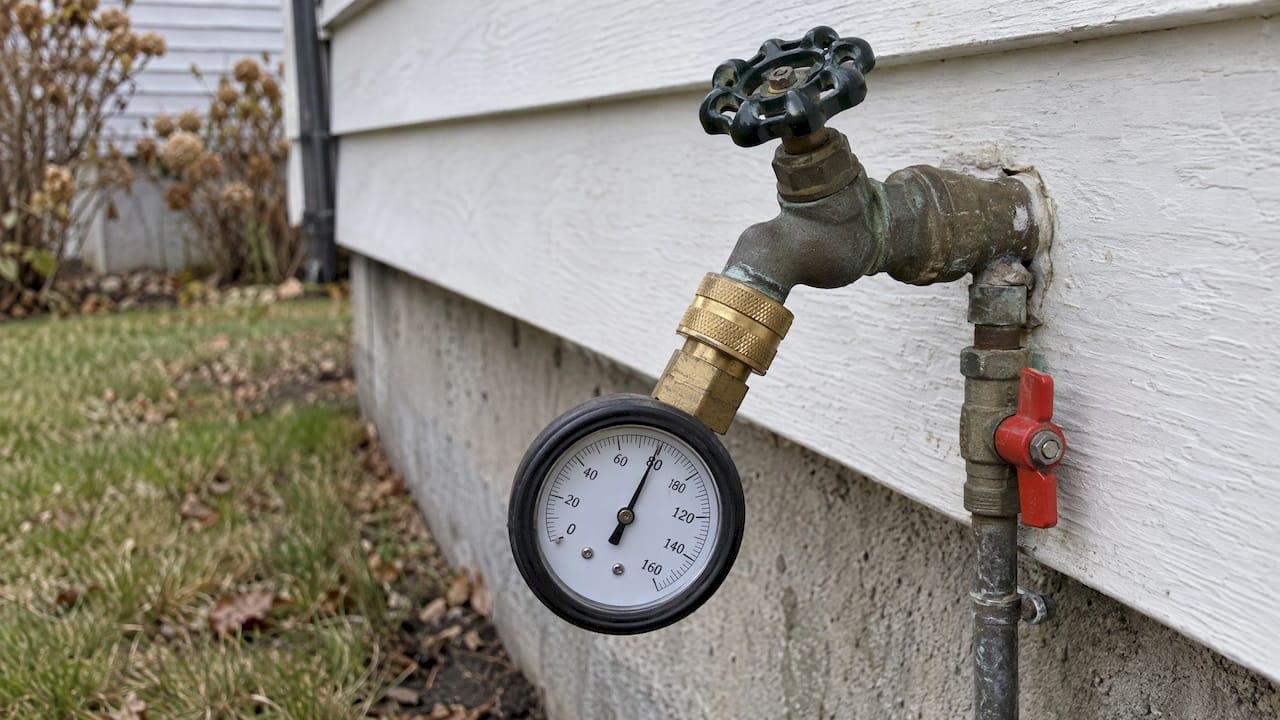
Water pressure is too high when it reads above 80 psi at your hose spigot. Most plumbing codes require a pressure-reducing valve (PRV) at that point. The fix is usually a PRV set to about 45 to 60 psi, installed where the water line enters the building. It is a small job compared with the cost of a burst supply line or a ruined water heater. Whether you own a house or a commercial building in Massachusetts, you can confirm the problem with a $10 gauge and an afternoon.
TL;DR
- Healthy household pressure is roughly 45 to 60 psi according to the EPA's WaterSense program. Above 80 psi is high, and a PRV is generally required there.
- Test with a screw-on pressure gauge at an outdoor hose bibb, with every fixture and appliance off. Take a reading at different times of day.
- Warning signs: banging pipes, running toilets, dripping faucets, spitting aerators, a water heater relief valve that discharges.
- If you already have a regulator and pressure is still high, the regulator has probably failed. A professional can test and replace it.
- Pressure that is high all the time is a plumbing job. Pressure that spikes only now and then may start at the water main, so the utility should hear about it too.
Table of Contents
- What counts as too high
- Why high pressure is a problem, not just a nuisance
- Signs your pressure is too high
- How to test your water pressure
- What causes high pressure or sudden spikes
- How to fix high water pressure
- High pressure and water heaters
- When to call, and what to expect
- Promo: high-pressure problems in Massachusetts homes and buildings
- Perspective
- FAQ
- Sources
What counts as too high
Water pressure is measured in pounds per square inch (psi). The EPA says fixtures work best when incoming pressure is between 45 and 60 psi. If it runs much higher, it recommends having a professional adjust or install a PRV to hold it near 60 psi.
The 80 psi line is the one that matters legally and mechanically. EPA's WaterSense technical sheet notes that most U.S. plumbing codes require PRVs on domestic systems when supplied pressure exceeds 80 psi. Moen's documentation says the same, citing the Universal Plumbing Code's 80 psi threshold for a required PRV.
Here is how the readings sort out in practice:
| Gauge reading | What it means |
|---|---|
| Under 40 psi | Low. Showers and appliances may underperform. |
| 45 to 60 psi | The target range for fixtures and appliances. |
| 60 to 80 psi | Workable, but harder on seals and valves over time. |
| Above 80 psi | High. A PRV is generally required, and damage risk climbs. |
| 90 psi and up | Well past the limit. This Old House says a reading above 80 psi calls for a pressure-reducing valve. |
So, to the common question: yes, 90 psi is too high for a house. It is above the code threshold and it is wearing on everything connected to your plumbing right now.
A note on the range of numbers you will see online. One municipal district says household plumbing should provide between 30 and 80 psi, while another puts normal at 50 to 75 psi. The ceiling is consistent at 80. The comfortable target is lower, and 45 to 60 psi is the figure to aim for.
Why high pressure is a problem, not just a nuisance
More pressure feels like better showers, but your plumbing was not built to carry it around the clock. The EPA's technical sheet warns that mains can reach 100 psi or more, and that high pressure can damage piping, fixtures and appliances, raise water use, shorten equipment life and increase the risk of leaks. A building-science resource from a national lab adds that in some places municipal pressure can exceed 200 psi, which is why a regulator at the entry point exists at all.
The damage tends to be slow and then sudden:
- Pinhole leaks. Moen's guidance says the most common effect of high pressure is leaks in the plumbing, including tiny pinhole leaks. In copper and older galvanized lines these often appear inside a wall.
- Worn fixtures. A utility district lists pressure above 80 psi as a cause of plumbing leaks, worn seals and damaged fixtures. Think washing machine hoses, toilet fill valves, faucet cartridges and outdoor spigots.
- Wasted water. The City of Fort Worth estimates that dropping pressure from 80 to 60 psi saves about 12,800 gallons per year per home, and more where irrigation is heavy. San Diego's program puts typical PRV savings at 30,000 to 40,000 gallons per year in an average home.
- Water heater stress. High pressure combined with heat expansion pushes on the tank and its relief valve. We cover that below.
For a commercial owner the stakes are higher. A failed supply line or flushometer in a occupied building means downtime, tenant complaints and a water bill that runs while you find the source.
Signs your pressure is too high
You do not need a gauge to suspect the problem. Look and listen for these:
- Banging or clanging pipes when a faucet, dishwasher or washing machine shuts off. San Jose Water lists this kind of high-pressure water hammer as a symptom. If this is your main complaint, our guide to water hammer checks homeowners can try walks through what else can cause it.
- Whistling or high-pitched sounds from pipes, and water that sprays harder than you expect. San Diego's guidance lists these among symptoms of a damaged PRV.
- Running toilets and dripping faucets that return after you replace the part.
- Water heater relief valve discharge. San Jose Water names a malfunctioning relief valve as a sign, and a district guide lists water discharged from the heater's relief valve as a symptom of regulator failure.
- Recurring leaks at fittings that were sound last year.
Any one of these can have other causes. A gauge reading settles it.
How to test your water pressure
The EPA describes the method: turn off fixtures and water-using systems, attach a pressure test gauge to a hose bibb, and turn the water on fully. A basic gauge costs about $10 at most hardware stores.
Step by step
- Shut everything off. No running faucets, no dishwasher, washer or ice maker cycles, no irrigation. Any flow will drag the reading down and hide the problem.
- Thread the gauge onto an outdoor spigot (or a laundry sink or water heater drain connection with a hose thread). Hand-tight is enough.
- Open the valve fully and read the needle. Many gauges include a second drag needle that holds the highest reading.
- Test more than once. Take a reading in the morning, midday and late at night. Municipal pressure often rises overnight when demand drops, so a house that looks fine at 6 p.m. can sit at 95 psi at 2 a.m.
- Write the numbers down. A log of readings tells a plumber, and your water utility, more than a single glance.
Where it goes wrong: testing at a spigot downstream of an existing regulator, using a gauge with a worn needle, or testing while a toilet is quietly refilling. If your reading is between 60 and 80 psi, you are not out of code, but you may still want it lowered to protect older fixtures.
If you would rather have the reading taken for you, our plumbers can do it as part of a service visit. Our plumbing services page lists what we cover.
What causes high pressure or sudden spikes
Pressure is mostly set before the water reaches your property. Charlotte Water explains that pressure largely comes down to the elevation of storage tanks relative to your home, which is why homes at low points get the most. In hilly parts of Massachusetts, a house at the bottom of a slope can see far more pressure than one at the top.
The common causes fall into two groups.
Constant high pressure
- No regulator at all. Many older homes, including the older housing stock around Arlington, were plumbed before regulators were routinely required. The house simply receives whatever the main delivers.
- A failed regulator. PRVs wear out. San Jose Water notes that existing homes with high pressure may have a malfunctioning regulator.
- A regulator set too high. Someone adjusted it, or it drifted over the years.
Spikes
- Problems in the distribution system. Portland Water says a temporary spike can occur when there is an issue in the water distribution system. If your pressure is within the expected range, the utility considers it normal and cannot change it for you, so a private regulator is your protection.
- Thermal expansion. In a closed system, a regulator or check valve keeps expanding hot water from flowing back into the main. Pressure inside the house then climbs each time the water heater fires. The fix is usually an expansion tank, and our 5-minute check for a water heater expansion tank shows how to tell if you need one.
- Demand swings. Pressure rises when neighbors, factories or irrigation systems shut off. This is the overnight effect described above.
If your log shows pressure swinging by 20 psi or more through the day, tell your water utility the readings, and also have a regulator installed. The utility can check the main. Only a regulator can protect your pipes from whatever the main does.
How to fix high water pressure
The standard fix is a PRV on the main line, just after the shutoff and meter. The EPA's guidance is to confirm service pressure with your supplier, install the PRV downstream of the connection, and set it to 45 to 60 psi. It also says to consult local plumbing codes about thermal expansion.
Why this is a licensed-plumber job
The valve is simple. The decisions around it are not.
- Diagnosis. The City of Fort Worth recommends consulting a licensed professional plumber to properly diagnose the pressure before installing a PRV and expansion tank. Putting a regulator on a system with another fault just hides it.
- Expansion tank. Once a PRV is in, the house becomes a closed system. Without an expansion tank, heating water can push pressure past safe limits and trip the water heater's relief valve.
- Setting. A PRV set too low starves upper-floor showers. Too high, and you have gained nothing.
- Sprinklers and special systems. The EPA also says to maintain fire sprinklers according to state and local codes, which matters in commercial buildings and some homes.
- Shutting down the main. Cutting into the main line means shutting off water to the whole building, a real problem for tenants, restaurants and offices. Planning the work around business hours is part of the job.
Adjusting an existing regulator is a smaller task: loosen the lock nut, turn the adjusting screw a little at a time while watching a gauge, then retighten. If turning the screw does not move the gauge, the regulator has failed and needs replacement.
How to tell if your regulator has failed
A district guide describes the cleanest test: install a gauge on each side of the regulator. If pressure upstream is higher than downstream, the regulator is probably working. If both sides read the same high number, it is not doing its job. The same guide lists the symptoms: bursts of unusually high pressure at faucets and showers, water discharged from the water heater relief valve, and sudden pressure loss.

Regulators do not last forever, and a failing one often gets worse gradually. If yours is more than a decade old and your readings are climbing, replacement is cheaper than the leak it prevents.
High pressure and water heaters
Your water heater is the first appliance to complain. Heating water makes it expand, and in a house with a regulator or backflow device, that extra volume has nowhere to go. The tank's temperature and pressure relief valve then opens, or drips constantly. If you see water at the discharge pipe, do not cap it. Get the pressure measured and the expansion tank checked.

If the heater is already old and leaking, it may be time for replacement. Our water heater page covers tank and tankless installation.
When to call, and what to expect
Call a licensed plumber promptly if you see any of these:
- A gauge reading above 80 psi.
- Water discharging from the water heater relief valve.
- A wet spot or stain on a wall or ceiling you cannot explain.
- A sudden jump in your water bill.
Contact your water utility if pressure spikes at times, or if neighbors report the same thing. Shut off the main valve if you find an active leak and cannot stop it.
If pressure problems have already caused damage, such as a burst pipe or flooded basement, one insurance resource advises calling your insurance company as well as a plumber. Document the damage and your gauge readings before repairs.
Promo: high-pressure problems in Massachusetts homes and buildings
We are a licensed and insured, family-owned plumbing and heating company serving Massachusetts homes and businesses. We offer same-day or next-day service, transparent upfront pricing and direct owner oversight, and we know the plumbing in Arlington's older homes well.
If your gauge reads high, your regulator is failing or your water heater relief valve keeps dripping, book a plumbing visit and we will take it from there.

If you are buying a property, our safety and pre-purchase inspections are a good moment to have the pressure and the water heater checked before closing.
Perspective
High pressure is one of the most overlooked problems in a house. Nothing looks wrong. The shower feels great. Then a washing machine hose lets go, or a pinhole opens behind a wall, and the owner learns the pressure had been too high for years.
What we want owners to take from the research is simple: a $10 gauge and ten minutes tell you what you need to know. A reading in the 45 to 60 psi range means you are fine. A reading above 80 psi means it is time to act, and the fix is far cheaper than the damage.
We would also say this plainly: the valve is the easy part. The value is in the diagnosis, getting the setting right, sizing the expansion tank, and making sure nothing else in the system is hiding behind the symptom. Older homes, like many we work in around Arlington, often have decades of mixed repairs, so we look at the whole system rather than swapping one part.
If your readings are high, call us. We will tell you what we find and what it costs before we start.
Matt
FAQ
Is 90 psi too high for house water pressure?
Yes. Most plumbing codes require a pressure-reducing valve above 80 psi, and the EPA's recommended range is 45 to 60 psi. At 90 psi, seals, hoses, fixtures and the water heater are all under extra stress. Have a plumber install or replace a PRV.
What is dangerously high water pressure?
Anything sustained above 80 psi is a risk to your plumbing. The EPA notes that supply mains can reach 100 psi or more, and in some places municipal pressure can go much higher. A building with no regulator is exposed to all of it.
Why would my water pressure suddenly be high?
The usual causes are a failed regulator, a change in the water main or distribution system, or thermal expansion in a closed system. Portland Water says a temporary spike can follow an issue in the distribution system. Log readings at several times of day and share them with your utility and plumber.
My pressure regulator is not working. What should I check?
Put a gauge on each side of it. If the two readings match and are high, the regulator has failed. Also look for water from the water heater relief valve and sudden pressure swings, which a district guide lists as signs of malfunction. A failed regulator should be replaced, not adjusted.
Is low pressure the same kind of problem?
No, the causes are different. If your water is weak rather than forceful, see our guide to gauge and meter tests for low water pressure.
Sources
- Home Maintenance, US EPA WaterSense
- WaterSense Labeled Homes Technical Sheet: Service Water Pressure, US EPA
- Water Pressure Regulator FAQs, Rainbow Municipal Water District
- Caring For Pipes, DrinkTap.org
- How to Install a Water Pressure Reducing Valve, This Old House
- Water Pressure Over Recommended Max, Moen
- Service Water Pressure, Building America Solution Center
- Water Pressure, Jurupa Community Services District
- High Plumbing Pressure, City of Fort Worth
- Residential PRV Guidelines, San Diego Water Conservation Program
- Water Pressure, San Jose Water
- Troubleshooting water pressure and flow, Portland Water
- Pressure Regulators, Anderson Springs Community Service District