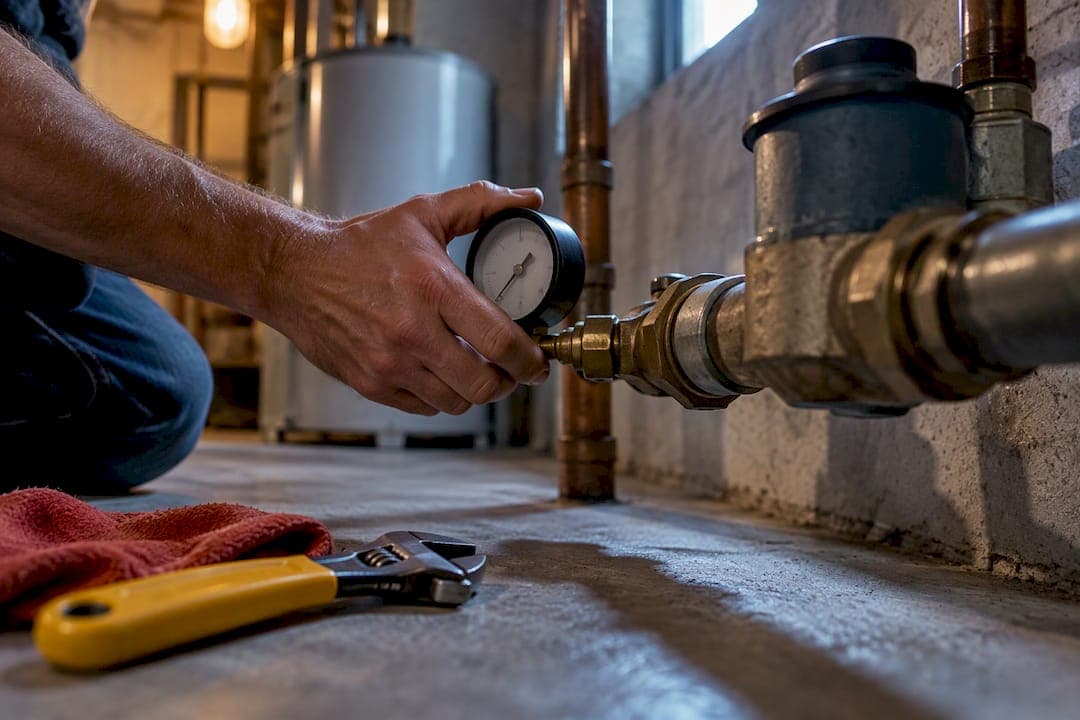
If your water pressure has dropped, start by checking whether it hits one fixture or the whole house, then attach a hose bib pressure gauge to see the actual number. Most causes, from a clogged aerator to a partly closed valve, are fixable without a plumber. A visible leak, a sudden drop near zero, or standing water in the yard means you need professional help now, not a weekend project.
TL;DR:
- If multiple fixtures experience low pressure, the issue likely stems from the main valve, PRV, or municipal supply problems rather than internal obstructions.
- Testing pressure with a hose bib gauge and monitoring the water meter over a few hours can confirm whether a hidden leak is causing the pressure drop.
- Cleaning mineral buildup from aerators and showerheads can restore flow at individual fixtures, but replacing worn valves or PRVs may be necessary for sustained improvement.
- Addressing older galvanized pipes or installing a booster pump are effective long-term solutions for persistent, system-wide low water pressure.
- Regular maintenance, including annual pressure checks and biannual aerator cleaning, helps prevent costly repairs and detects problems early.
Table of Contents
- Quick checklist: what to test first
- Common causes of low water pressure and diagnostic clues for each
- How to measure pressure and test for leaks
- DIY fixes and safe adjustments organized by cause
- Typical costs and clear rules for hiring a plumber now
- Matt's practical tips and Mystic Valley Services' maintenance advice
- Why early diagnosis saves money and prevents damage
- Get a professional pressure check from Mystic Valley Services
- Sources
- FAQ
Quick checklist: what to test first
Work through these steps in order before you touch a wrench. Each one narrows down whether the problem is local to a fixture, contained to your house, or coming from the street.
- Turn on a faucet in the kitchen, then one in a bathroom, running hot and cold at each. If only one fixture is weak, the problem is local; if all of them are weak, it's whole-house or supply-side.
- Locate your main shutoff and any isolation valves near fixtures, and confirm they're fully open. A valve that's even a quarter turn short of open can choke pressure.
- Unscrew an aerator or showerhead from the weak fixture and look for white or greenish mineral crust inside the screen.
- Ask a neighbor if their pressure is also low, or check your local water utility's website for outage or maintenance notices.
- Attach a hose bib pressure gauge to an outdoor spigot, open it fully, and record the PSI. If nothing in the house is using water, watch your meter for movement over the next couple of hours as a rough leak check.
Common causes of low water pressure and diagnostic clues for each
Once you know whether the issue is local or whole-house, the cause usually points to itself.
- Partially closed main or meter valve: a valve that's only three-quarters open restricts flow throughout the house; you'll confirm it by physically checking the valve handle and turning it fully counterclockwise.
- PRV failure or mis-setting: a bell-shaped pressure-reducing valve near the main shutoff wears out over years and can start delivering pressure that swings up and down instead of holding steady.
- Municipal supply problems: a drop that hits your whole street, not just your house, often traces to a main break, nearby hydrant use, or peak demand in your system.
- Leaks in the service line or inside the house: your water meter will keep moving even when every fixture is off, and you might notice soggy ground outside or a toilet that runs on its own.
- Clogged aerators and showerheads: flow feels weak at one fixture while the pipe pressure feeding it is actually fine.
- Corroded or scaled pipes: older galvanized steel plumbing narrows from the inside over decades, causing a slow, system-wide decline sometimes paired with discolored water. Corrosive water with low pH or alkalinity accelerates this breakdown and can also raise lead and copper levels in the water itself.
- Water heater issues for hot-only low pressure: sediment buildup in a tank unit or a clogged inlet screen on a tankless system restricts hot water specifically while cold flow stays normal.
Household leaks that go unnoticed can waste thousands of gallons of water per year. That's often the difference between a mysteriously high water bill and a pressure complaint that actually has the same root cause.
How to measure pressure and test for leaks
A gauge and a little patience will tell you more than guessing ever will.
- Screw a hose bib pressure gauge onto an outdoor spigot, open the valve fully, and read the dial. Normal household pressure runs about 40 to 60 PSI, and anything below 40 PSI is usually noticeable at the tap.
- Record your water meter reading, then avoid using any water for about two hours. If the meter has moved when you check again, you likely have a leak somewhere in the system.
- Find your PRV, usually a bell-shaped fitting near the main shutoff, and look for corrosion or a pressure gauge reading that jumps around instead of holding steady.
- Remove the aerator from a weak fixture and run the water directly from the spigot. If flow improves noticeably, you're dealing with a flow restriction, not a supply pressure problem.
Pro Tip: Buy a gauge with a built-in shutoff valve so you can test multiple outdoor spigots without disconnecting and reconnecting each time.
DIY fixes and safe adjustments organized by cause
Most of the fixes below take under an hour and cost less than a service call.
- Aerators and showerheads: unscrew the fixture, soak the screen in white vinegar for 30 minutes to dissolve mineral buildup, then rinse and reattach. Replace aerators every few years if buildup returns quickly.
- Valves: turn the main shutoff and any isolation valves fully counterclockwise to open them completely. A valve that's stiff, hard to turn, or leaking around the stem has likely corroded internally and should be replaced rather than forced.
- PRV adjustments: a small clockwise turn of the adjustment screw raises pressure. Test with your gauge between each quarter turn and never exceed 60 to 65 PSI. A valve older than 10 to 15 years, one that fluctuates constantly, or one showing visible corrosion is a replacement job, not an adjustment job.
- Hot water only: flush a tank-style water heater by draining a few gallons from the drain valve to clear sediment, or clean the inlet screen on a tankless unit following the manufacturer's steps.
- Longer-term fixes: if your neighborhood simply runs low pressure by design, a booster pump can raise it house-wide. If your pipes are old galvanized steel with a slow system-wide decline, a partial or whole-home repipe often solves the problem for good.
Pro Tip: Never force a stuck valve with pliers or a wrench extension. A cracked valve body under pressure can flood a basement in minutes.
Typical costs and clear rules for hiring a plumber now
Call a plumber immediately if you see a visible leak, your meter confirms one, pressure drops suddenly and stays down, or you notice ground ponding or water damage near a wall or ceiling. Those situations rarely get better on their own and often get worse fast.
For everything else, cost depends mostly on scope: how many fixtures are affected, how easy the pipes are to access, and whether a permit is required. For practical advice on growing your plumbing business alongside managing service calls, see Plumbing Business Growth Tips That Boost Revenue Fast.
| Job | Typical cost range |
|---|---|
| Inspection or diagnosis | Moderate cost |
| Minor repair (valve, aerator, fixture) | Moderate cost |
| PRV replacement | Generally moderate cost |
| Booster pump or major repipe | Can be substantially higher |
These bands come from national cost data on low water pressure repairs and shift depending on your home's age, pipe material, and how many fixtures need work. Get at least two quotes, ask whether the job needs a permit, and if your PRV is already past its typical service life, replacing it proactively is often cheaper than waiting for it to fail.
Matt's practical tips and Mystic Valley Services' maintenance advice
A simple maintenance rhythm prevents most of the surprises: clean aerators every 6 to 12 months, check pressure with a gauge once a year, and have a plumber inspect the PRV every 5 to 10 years. In older New England homes, we regularly find galvanized pipe corrosion and PRVs that have quietly started fluctuating years before anyone noticed a pressure complaint. A quick annual check catches both before they become expensive. For a fuller routine, see our home plumbing maintenance checklist.

Why early diagnosis saves money and prevents damage
I've seen small pressure complaints turn into flooded basements simply because nobody checked the numbers early. A five-minute gauge test once a year is cheap insurance. For anything involving a PRV, gas line, or hidden leak, bring in a licensed plumber before it becomes a bigger repair.
— Matt
Get a professional pressure check from Mystic Valley Services
Appointments can be scheduled promptly to avoid long waits to fix a stuck valve or aging PRV. Technicians handle leak detection and pipe repair, PRV replacement, water heater service, and whole-home repipes with upfront pricing before any work starts.

Schedule an inspection through our plumbing services page and get a straight answer on what's actually causing your low pressure.
Sources
- Corrosive Water Problems — Pennsylvania State University Extension
- Water pressure and flow troubleshooting — City of Portland
- WaterSense: Free-of-Leaks technical sheet — EPA
- Cost range for fixing low water pressure in homes — CurrentCost (2026-01-31)
FAQ
How do I fix sudden low water pressure in my house?
Check whether one fixture or the whole house is affected, then confirm the main shutoff and isolation valves are fully open. If pressure is still low, run the hose bib gauge test described above to see whether you're below the normal range before assuming a bigger problem.
How do you boost low water pressure in your house?
Clear the easy causes first: clean clogged aerators, fully open all valves, and check your PRV setting with a gauge. If pressure is still consistently low across the house after those checks, a booster pump or a partial repipe are the longer-term fixes worth discussing with a plumber.
How much does it cost to fix low water pressure in a house?
Diagnosis and minor repairs typically run several hundred dollars, PRV replacement usually costs in the same general range, and booster pumps or major repipes can be considerably more expensive depending on scope, according to national repair cost data. Fixture count, pipe access, and permit requirements all move the price within those ranges.
What are the symptoms of low water pressure in a house?
Weak flow at faucets or showers, a shower that trickles when someone flushes a toilet elsewhere, and hot water that seems weaker than cold are common signs. If the weak flow is isolated to one fixture, it often points to a clogged aerator rather than a true pressure problem.