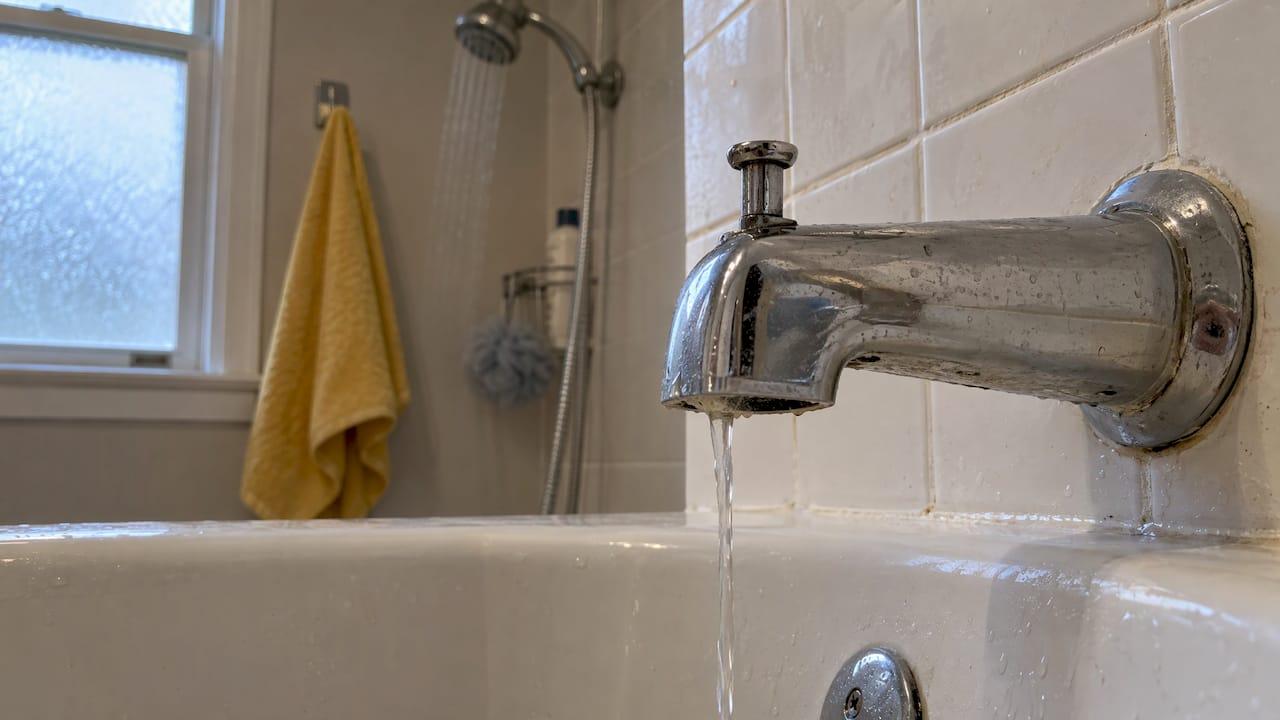
A stuck tub diverter is almost always a mineral, wear or corrosion problem inside the tub spout or the valve behind the wall. On a spout with a pull-up knob, you can often free it with a penetrating spray, a vinegar soak or a new spout in about 15 minutes. A diverter built into the wall valve is a different job. The fix depends on which type you have, so start there.
TL;DR
- Find your type first: a pull-up knob on the spout, a middle handle between two handles, or a single-handle valve with a selector.
- Hard-water scale, a worn washer, a swollen seal or a corroded gate cause most stuck diverters.
- For a spout diverter, shut off the water, remove the spout (counterclockwise, or by the set screw), then clean, grease with silicone or replace it.
- Use silicone plumber's grease on the moving parts, not petroleum products.
- A diverter in the wall, a stripped thread or a cracked stem is the point to call a licensed plumber.
Table of Contents
- Which diverter do you have?
- Signs your diverter is failing
- Quick fixes to try before taking anything apart
- How to remove a stuck tub spout
- Repairing the diverter once the spout is off
- Replace the spout or repair it?
- When the diverter is in the wall
- When to call a licensed plumber
- Stopping it from happening again
- Perspective
- Need a hand with your tub or shower?
- FAQ
- Sources
Which diverter do you have?
The control tells you what is behind it. Look at where the switch is:
| What you see | Diverter type | Where the problem usually is |
|---|---|---|
| A knob or ring that pulls up on top of the tub spout | Tub-spout (lift-gate) diverter | Inside the spout: gate, washer, lift rod |
| A middle handle between hot and cold handles | Three-valve (tee) diverter | In the wall valve behind the trim |
| A separate knob, or a selector on a single-handle trim | Cartridge-based diverter | Cartridge in the wall valve |
That breakdown follows a guide to diverter types and causes, which also ties sticking to hard-water scale and corrosion. A second guide describes the same three common setups.
Most homes with a stuck diverter have the first type. It is the easiest to fix, because the whole mechanism comes out when you remove the spout.
Signs your diverter is failing
A diverter that is on its way out rarely fails all at once. Common symptoms include water still running from the tub spout during a shower, weak pressure at the showerhead, a hard-to-switch knob, and leaks around the spout or wall.
Two patterns are worth separating:
- Hard to pull up or turn. This is commonly scale buildup and corrosion, especially in hard-water areas. The parts are dragging against each other.
- Stuck up or stuck down, or won't stay put. That points to mineral buildup, a swollen rubber seal or a worn gate. A worn washer or damaged stem can also make the knob refuse to hold its position.
If water pours from the spout and the showerhead at the same time, the gate is not sealing. If the knob will not move at all, something is seized.
Quick fixes to try before taking anything apart
Start with the least invasive steps.
Give the knob a gentle tap
One guide calls a gentle, well-placed tap on the handle the quickest fix for a blocked diverter. If you search for it, that is a small tap with the heel of your hand while lifting, not a hammer blow. Brass and chrome spouts crack if you force them.
Spray up the spout
Mineral deposits and corrosion are the usual culprits, and a penetrating spray can soften them. One guide explains that WD-40 can help because it softens calcium buildup, rust and limescale. The method it describes:
- Lift the diverter knob as far as it will go.
- Spray up into the spout with a flexible straw attachment to reach the diverter.
- Lower the knob, then respray.
- Repeat until it glides.
This answers the question many people ask: yes, a spray can loosen a stuck diverter. Treat it as a loosening step, not a lubricant. Petroleum-based sprays can swell some rubber O-rings, and the same source treats WD-40 as a penetrant rather than a lubricant. Another source notes it is too thin to replace plumber's grease for the long term. Once the diverter moves, plan to clean it and grease it properly (see below).
Soak out the scale
If you can get the spout off, white vinegar is the standard remedy. Soaking the spout overnight can make the buildup easier to clean and restore function. Another guide suggests soaking the parts for a few hours, then scrubbing with warm soapy water and a soft-bristled brush.

How to remove a stuck tub spout
The diverter on a spout-type tub lives inside the spout, so you have to take the spout off. Many people get stuck here, not at the diverter itself.
- Shut off the water. For a tub-only job, you generally just want the shower not running. If you are unsure whether your valve has stops, shut off the water to the house.
- Check the underside for a set screw. A spout with a crevice at the wall on the bottom has a set screw (slip-fit). A smooth bottom means it twists off (threaded).
- Loosen the set screw. One spout guide specifies a 5/32-inch hex key for a Kohler spout. Loosen it just enough to release its grip, then pull the spout straight off the pipe. Other brands vary, so check the size that fits snugly.
- Unscrew a threaded spout counterclockwise. Turn it counterclockwise. Wrap the spout in a rag to protect the finish before you use a wrench.
- If it is seized, give it time. Penetrating oil around the seam works best with a few hours, or overnight, to creep into the threads. Re-treat rather than forcing it.
Don't twist hard on the pipe stub behind the spout. That nipple connects to the wall, and a bent or cracked stub turns a 15-minute job into one that needs a plumber and wall access.
Repairing the diverter once the spout is off
Inside a pull-up spout you will find a diverter gate, a washer and a pull-up knob assembly. Look for wear, cracks, corrosion and scale.
- Scale on the housing: scrape it off or soak the parts in vinegar, as above.
- A flattened or cracked washer: one repair guide for pull-up gates says to pull up the lift rod and pry the tabs apart, check the washer, fit a new one with the flat side facing outward, and snap the tabs back on.
- A stem that does not move smoothly: replace it rather than reassembling a part that already drags.
For general inspection and replacement of worn fixture parts, this guide to checking and replacing faucet parts shows how the same wear patterns look on a faucet.
What to grease with
If the diverter is tight but intact, plumbing grease on the mechanism is the first thing to try. If that fails, replace the assembly. Use silicone: Danco's guide recommends generously lubricating each part with silicone grease before installation. One valve maker's instructions say to use only silicone-based lubricants and not petroleum-based ones, because those can harm seals and plastic parts.
Reinstall and test
Put the spout back on, tighten the set screw or thread it hand-snug, and turn the water on. Lift the diverter with the shower running. Water should leave the spout completely and go to the showerhead. Then lower it and confirm the spout flow is normal. Check around the wall seam for drips.
Replace the spout or repair it?
Often replacing is the faster path. One faucet retailer says a jammed tub spout diverter is almost always mineral buildup, worn internal parts or a corroded gate, and that a new spout takes about 15 minutes and costs $15 to $40. The same source puts a plumber's added labor at roughly $75 to $150. Those are general figures from one source, so confirm local pricing before you plan a budget.
A replacement makes sense when:
- The spout finish is pitted or corroded.
- The gate or lift rod is damaged and the maker does not sell parts.
- You have already cleaned it and it re-sticks within weeks.
Take the old spout to the store, or measure it, because slip-fit spouts come in different pipe sizes and threaded spouts need the right thread.
When the diverter is in the wall
If your diverter is a middle handle, a separate knob or a selector on a single-handle trim, the working part is a cartridge or stem inside the valve. The steps are different: shut off the water to the house, remove the handle and trim, and pull the cartridge. In older homes, the valve body may be corroded, the trim screws may be rusted in place, and there may be no access panel behind the wall.
Our article on getting a stuck shower cartridge out safely covers that side of the job in more detail. If the valve body itself has to be swapped, our Massachusetts shower valve cost breakdown shows why price depends on access.
One safety note for any valve work: valve makers recommend setting the water heater's temperature at or below 120°F (49°C) when installing a pressure-balancing valve, to lower scalding risk. If you are replacing a valve, follow the maker's instructions for that exact model.

When to call a licensed plumber
Stop and call if any of these apply. One plumbing resource advises getting help if basic fixes haven't freed the diverter or you're uncomfortable disassembling the faucet, and when you find cracked valve stems, stripped threads or disintegrated O-rings.
Add these situations:
- The spout turns but the pipe stub behind it moves, wobbles or leaks.
- You see water on the ceiling below, or the wall around the tub feels damp or soft.
- The shut-off valves do not close fully.
- The diverter is in the wall and the trim screws won't budge.
- The tub is the only one in the house, and you need it working by tonight.
In Massachusetts, only a master or journeyman plumber licensed by the state, with proper permits from the local plumbing inspector, can perform plumbing work at your home or business. That is worth checking before anyone opens a wall. If you're comparing contractors, our list of five questions that catch red flags is a good place to start.
If you notice banging pipes when you turn the shower on and off, that is a separate issue, covered in our water hammer checks.
Stopping it from happening again
- Operate the diverter regularly. Parts that never move seize first.
- Wipe scale off the spout when you clean the tub, and descale with vinegar every few months if your water is hard.
- Grease with silicone whenever you have the spout off.
- Replace worn washers early. A diverter that leaks a little during showers is telling you the seal is going.
- Keep the water heater at a safe temperature and have valves checked if the handle gets stiff.
Perspective
Most stuck diverters we see are not mysteries. They are scale and wear that built up over years, sometimes decades, in homes with older plumbing. In Arlington and the surrounding towns, we regularly work in houses where the tub valve predates the bathroom around it.
Our advice is simple. Try the gentle fixes: a spray, a soak, a fresh washer. If the spout is the problem, replace the spout. But once the issue moves into the wall, with a corroded valve body, a seized cartridge or a pipe stub that moves, it stops being a quick job and starts being a question of access and the right parts. A careful licensed technician saves you from a cracked pipe or a leak inside the wall.
We are a family-owned team with direct owner oversight, and we aim to give you transparent upfront pricing before we start. If your tub diverter is beyond a spout swap, we would rather look at it properly once than patch it three times.
Matt
Need a hand with your tub or shower?
Mystic Valley Home Services is a licensed and insured Massachusetts team that handles leak and pipe repair, fixture installs and bathroom plumbing for homes and businesses, with same-day or next-day service available. If your diverter, valve or spout needs more than a quick fix, see our plumbing services or book a visit.

We are experienced with the older homes common in Arlington, where we often find original valves, mixed pipe materials and tight access behind the tub.
FAQ
Can I use WD-40 on a shower diverter?
Yes, as a loosening step. Lift the diverter, spray up the spout, lower it and repeat until it moves. Because it is a penetrant and not a lasting lubricant, finish with a cleaning and silicone plumber's grease on the parts once the spout is off.
Why is my shower diverter hard to pull up?
The usual cause is scale and corrosion, especially with hard water. A worn washer or damaged stem can also make it stiff or keep it from holding position. Cleaning and greasing may fix it. If not, the assembly or spout needs replacing.
How do I remove a seized tub spout?
Turn off the water and check the underside for a set screw. If you find one, loosen it with a hex key and pull the spout off. If it is threaded, turn it counterclockwise, using a rag to protect the finish. Let penetrating oil sit for a few hours before trying again.
How long does it take to fix a stuck tub diverter?
A spout swap can take about 15 minutes when the spout comes off easily. Cleaning and re-greasing take longer if parts need soaking. A diverter in the wall depends on access to the valve.
Sources
- Shower Diverter Not Working? Causes and Fixes by Type
- Shower Diverter Stuck or Won't Switch Water to the Tub
- How to Repair a Tub Spout & Shower Diverter (Danco)
- How To Repair a Shower Diverter (This Old House)
- Loosen Your Tub's Stuck Faucet Diverter (House Digest)
- Best O-Ring Grease by Material
- The Best Substitute for Plumbers Grease
- How to Fix a Shower Diverter (Lowe's)
- How To Remove A Kohler Tub Spout (Hunker)
- How to Replace a Tub Spout Diverter Gate (House of Rohl)
- Kohler 11748-KS-NA Installation guide
- Tub Spout Diverter Jammed? (WOWOW Faucets)
- Stuck Shower Diverter? DIY Fixes & Expert Tips
- Plumbers and gas fitters consumer fact sheet (Mass.gov)