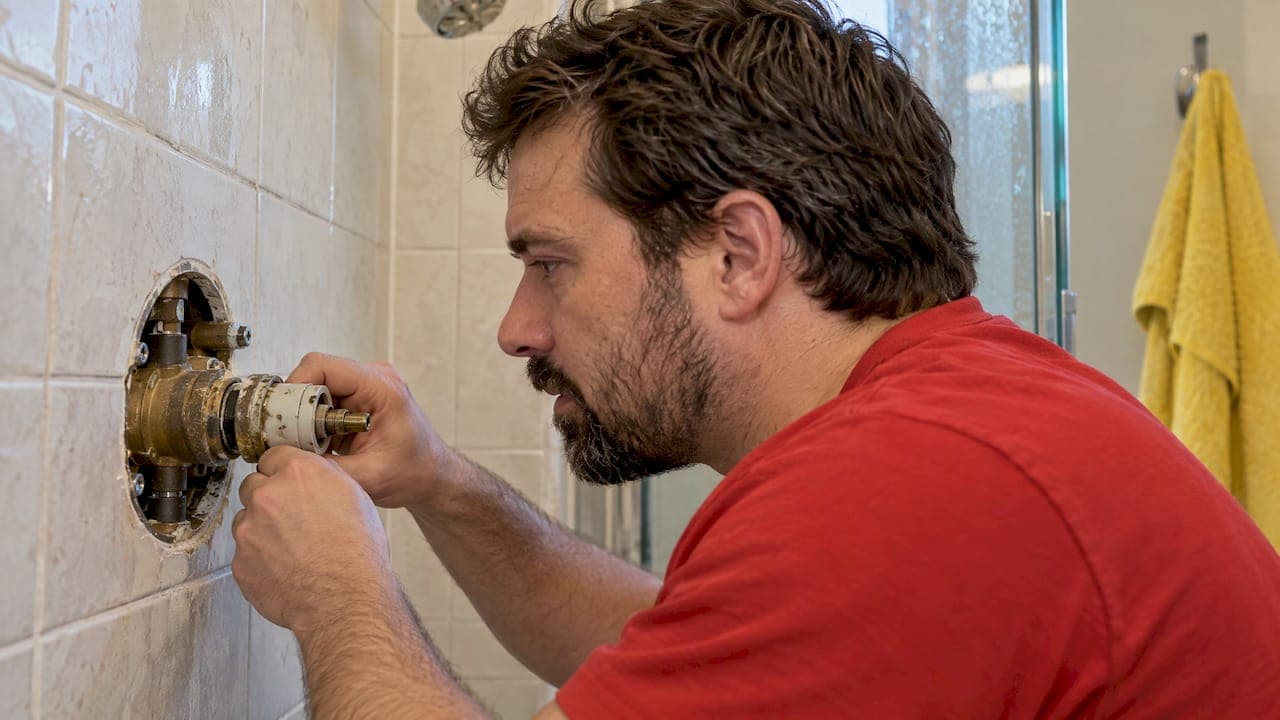
A stuck shower cartridge almost always comes out once you confirm nothing is still holding it, soften the mineral scale around it, and pull it straight out with a puller made for your brand. Prying against the valve body is the one move that turns a $30 part into a wall-opening repair. This guide walks through the order that works, how to tell a seized cartridge from a dead one, how to pick the right replacement, and the point where it makes sense to hand the job to a licensed plumber.
TL;DR
- Shut off the water first, then check for a retainer clip, nut, or sleeve still holding the cartridge. Most "stuck" cartridges are still pinned by one of these.
- Soften scale with white vinegar or a calcium and lime remover, work the stem back and forth, and pull straight out with a puller that bears against the valve body.
- Never pry against the valve body. A cracked or scored valve can mean opening the wall.
- Cartridges are proprietary by brand and series. Match the type, especially for pressure-balancing valves, which protect against scalding.
- If the cartridge shell spins, breaks apart, or the valve body is damaged, stop and call a plumber.
Table of Contents
- Why shower cartridges seize in the first place
- Before you pull: shut off water and identify what you have
- Step-by-step: removing a seized shower cartridge
- Stuck, or actually broken? How to tell
- Shower valve hard to turn? Check this before you force anything
- Shower valve types: figure out what you have
- Shower valve compatibility: matching the replacement
- Common mistakes that make a stuck cartridge worse
- What we do on a stuck-cartridge call
- Perspective: why we pull, not pry
- When to call a licensed plumber
- Get the valve handled without the wall damage
- FAQ
- Sources
Why shower cartridges seize in the first place
In most showers the valve is a cartridge made of plastic and brass, and The Spruce notes that it slips out for replacement when its rubber O-ring wears down over time. The trouble is the "slips out" part. Years of hot water deposit scale between the brass cartridge and the valve body, and the O-rings swell and bond to the walls. The cartridge becomes part of the valve.
Hard water makes this worse. Many Massachusetts homes, especially older houses with original valves, have mineral buildup that locks a cartridge in place after ten or fifteen years. If the handle has been getting stiffer, the cartridge has been telling you for a while.
Signs the cartridge itself is near the end of its life, per The Spruce: the handle is hard to open or close, and the water temperature is difficult to regulate.
Before you pull: shut off water and identify what you have
Start at the supply. Moen's instructions for stuck cartridges begin with closing the water supply shutoff valves. If your shower has no dedicated stops, shut off the main, then open a lower faucet to relieve pressure.
Next, photograph everything before you touch it. Note which way the handle sits, where the hot and cold sides are, and where any notch or mark on the stem points. FaucetClarity advises documenting orientation and markings before cleaning, because the cartridge has to go back in the same way.
Then remove the handle, trim, and any escutcheon so you can see the valve body. Take a good look at what is holding the cartridge in place. You are looking for one of these:
- A retainer clip (a small U-shaped metal clip in a slot on top of the valve)
- A bonnet or nut threaded over the cartridge
- A threaded retainer or a sleeve or stop tube around the stem
CartridgeID's guide puts this check first: confirm nothing is still holding the cartridge before you try to remove it. It is the most common reason people think a cartridge is seized when it is only pinned.
Step-by-step: removing a seized shower cartridge

1. Remove the clip, nut, or sleeve
Pull the retainer clip straight out with needle-nose pliers. If there is a nut or bonnet, back it off. Set the hardware aside in order so you can reinstall it.
2. Soften the scale
CartridgeID recommends white vinegar or a calcium and lime remover to soften scale. Soak a rag, wrap it around the stem and the gap where the cartridge meets the valve body, and give it time. Several hours, or overnight with the water off, does more than a few minutes.
3. Work the stem back and forth
With the handle adapter or a pair of pliers (padded with a rag so you don't chew the brass), gently rotate the stem through its range and tug lightly. The same guide suggests working the stem back and forth to break the bond. You are trying to loosen, not wrench. Small movements, repeated.
4. Use a puller
The cleanest method is a cartridge puller. Moen publishes the steps for its 104421 removal tool, which handles the 1200, 1225, and 1222 single-handle cartridges:
- Remove the retainer clip and position the stem as the instructions call for that cartridge.
- Set the tool's tabs between the cartridge tabs.
- Hand-screw the knurled screw into the stem.
- Screw the hex nut down to the valve.
- Twist the tee handle. If it won't budge, hold the handle and tighten the hex nut with a wrench to help draw the cartridge out.
The principle holds for other brands: use a puller made for your cartridge that bears against the valve body and pulls the cartridge straight out. CartridgeID warns against prying against the valve body. Levering a screwdriver against the brass or plastic is how valves get cracked.
5. When the outer shell is stuck
Sometimes the stem and inner parts come out and the outer housing stays behind. For stuck Moen 1200 and 1225 cartridges, Moen's method is to remove the retainer clip, thread a tap wrench into the inside of the cartridge shell to cut threads, then use a hardwood dowel to drive the shell back out. Moen also notes that holding the cartridge tabs with a small screwdriver can keep the shell from spinning in the valve.
This is the step where many homeowners stop, and it is a reasonable place to. Cutting threads in a shell inside a valve you can't see well leaves little room for error.
Stuck, or actually broken? How to tell
The two feel similar at the handle, so test the cartridge itself once it is out.
Delta's check: shake the removed cartridge vigorously. Delta's installation sheet says that if it rattles, it is functional and can be reinstalled. If it doesn't, confirm the RLS is in the "on" position, rap the lower housing in your palm, or replace the complete cartridge. The same sheet cautions against prying the cartridge out of the body.
Moen's symptom table: according to Moen's installation sheet, these patterns point to the cartridge:
| Symptom | Likely cause | Fix |
|---|---|---|
| Hot only or cold only | Balancing spool stuck | Replace cartridge |
| Handle hard to turn | Cartridge stem difficult to rotate | Replace or lubricate cartridge |
| Hot and cold reversed | Lines reversed, or cartridge upside down | Rotate stem 180° so the notch faces down toward the drain |
A restricted temperature range is a different problem. Moen notes it can be the temperature limit stop sitting in the wrong position. The fix is to remove the handle and reposition the stop, so check it before you buy a new cartridge.
Shower valve hard to turn? Check this before you force anything
A stiff handle is the early version of a stuck cartridge. If the handle still moves, you have options:
- Check the temperature limit stop, as above.
- Shut off the water, remove the handle, and see whether the stem turns freely by hand. Moen lists replacing or lubricating the cartridge as the remedy for a stem that is difficult to rotate.
- If the stem is gritty or rough, scale is the likely cause, and a replacement is the longer-lasting answer.
Forcing a stiff handle with a wrench on the stem can snap the stem or strip the splines, which turns a stiff cartridge into a stuck one. If the handle will not move at all and water is leaking at the valve, shut off the supply and call a plumber.
Shower valve types: figure out what you have
Before you buy anything, know which kind of valve you own. Today's Homeowner describes the main families:
- Pressure-balancing valves react to pressure changes in the supply lines to keep the temperature steadier.
- Thermostatic valves hold a set temperature.
- Older mixing valves blend hot and cold but cannot regulate sudden temperature changes.
- Diverters route water between the shower and the tub spout.
- Transfer valves can send water to multiple outlets.
Moen separates mixing valves from independent transfer valves by function. Per Moen's shower cartridge guide, an independent transfer valve diverts water to another device such as a showerhead or handheld and has to be plumbed to a second valve that does the mixing. So a "two-handle" shower may have two entirely different cartridges, and only one of them is the mixer.
Handle behavior is a clue too. Moen's Tub and Shower Systems page uses how the handle turns, pulls, or tilts to separate variants such as Moentrol, PosiTemp, and M-Core.
Older houses are where this gets tricky. In pre-war homes you may find a valve with a design nobody makes anymore, and the cartridge you need may be an adapter retrofit, not a direct swap.
Shower valve compatibility: matching the replacement
Once the old cartridge is out, take it with you or have its measurements and photos. SupplyHouse points out that cartridges are proprietary by brand and often by series: a Moen Posi-Temp cartridge will not fit a Delta Monitor valve body.
FaucetClarity's list of what has to match is a good checklist:
- The valve function and control layout
- The retention hardware (clip, bonnet, nut, or threaded retainer)
- The key geometry: ports, seals, tabs, and stem
It also cautions that looks alone are not enough. Two cartridges can look nearly identical and differ in a spline count or seal position.
Keep the anti-scald protection
This is the part not to compromise on. SupplyHouse warns that swapping a pressure-balancing cartridge for a standard single-handle cartridge can remove anti-scald protection, and says to replace it with the same type. It adds that ASSE 1016 calls for pressure-balanced or thermostatic protection in most U.S. building codes for new construction and renovation.
In Massachusetts, the residential code text is explicit: individual shower and tub/shower valves must be balanced-pressure, thermostatic, or a combination that conforms to ASSE 1016 or ASME A112.18.1. Replacing like for like keeps you inside that.
If you are replacing more than a cartridge, for example upgrading to a full steam shower, the control set matters as much as the cartridge. A complete steam shower control package is designed to be installed as a system, so plan the valve and the control together.

Install it right the first time
When you set the new cartridge, line up the notch or marking you photographed earlier. If hot and cold come out reversed, Moen's fix is to rotate the stem 180° so the notch faces down toward the drain. Lightly lubricate O-rings with plumber's silicone grease (not petroleum jelly, which can swell some rubber) and reinstall the clip fully seated.
Turn the water back on slowly with the handle in the off position, then check for drips at the valve before you put the trim back.
Common mistakes that make a stuck cartridge worse
- Prying against the valve body. It is the one thing both CartridgeID and Delta warn against, and it is the most common way a cartridge job escalates.
- Skipping the clip check. An unseen clip is behind more "seized" cartridges than corrosion is.
- Reaching for a torch. Heat near plastic valve bodies, wall framing, and PEX is a fire and damage risk.
- Using WD-40 as the whole answer. Penetrating oil can free a stem, but it is no substitute for scale dissolving, and it leaves residue you will want to rinse before reinstalling a rubber seal. A scale remover or vinegar addresses the actual cause.
- Buying by look. Matching by appearance is how you end up with a cartridge that almost fits.
What we do on a stuck-cartridge call
We start the same way you would: shut the water off, photograph the valve, and confirm what is holding the cartridge before anything gets pulled. Then we use a puller made for that cartridge, not leverage. If the shell is seized or the valve body is compromised, we can replace the valve itself, and if it is a stubborn old fixture in an older home, we take care to explain what is behind the wall before we cut.
If you want a sense of the cost side before you call, our Massachusetts shower valve cost guide explains why the range depends so heavily on access.
Perspective: why we pull, not pry
Most stuck-cartridge calls we see did not start as a plumbing emergency. They started as a $30 cartridge and an afternoon, and became a bigger job because someone reached for a pry bar. The brass valve body is the part you can't easily replace, so everything we do is aimed at protecting it.
Arlington and the towns around it are full of older homes, and older homes mean decades of mineral scale and valves that have been repaired more than once. We take the time to identify the valve before we touch it, because the right puller and the right replacement cartridge make the job a short one. When a valve is beyond saving, we would rather tell you early and replace it cleanly than have you fight it for a weekend.
Our technicians are licensed and insured, and the business is family-owned, with the owner involved in the work. We quote upfront and we match the cartridge type, including pressure-balancing protection, because a safe shower matters more than a fast one.
Matt
When to call a licensed plumber
Call in a professional when:
- The shell spins in the valve or the cartridge breaks apart on removal
- You cannot identify the valve or find a matching cartridge
- The valve body is cracked, scored, or leaking after your attempt
- The supply shutoffs don't hold, or there are no shutoffs
- The valve sits behind a tile wall you don't want to open without a plan
- You want to upgrade the valve instead of rebuilding it
In Massachusetts, plumbing work is regulated, and a licensed plumber knows the code requirements for shower valves and what the inspector expects.
Get the valve handled without the wall damage
If your shower cartridge is stuck, leaking, or leaving you with only hot or only cold water, we can diagnose it, pull it the right way, and replace it with the correct type, including pressure-balancing valves. Our plumbing services cover fixture installs, leak repair, and valve replacement across our Massachusetts service area, with same-day or next-day service available.

If the stuck cartridge is part of a larger bathroom problem, such as no hot water, see our quick troubleshooting guide for no hot water first.
FAQ
Can I use WD-40 on a stuck shower cartridge?
It can help free a stem, but scale is the real culprit, so a calcium and lime remover or white vinegar works on the cause. Wipe off any oil before reinstalling rubber seals. Whatever you use, finish by pulling with a puller, not by prying.
Is there a special tool to remove a shower cartridge?
Yes. Cartridge pullers are made for specific cartridge families. Moen's 104421 removes the 1200, 1225, and 1222 single-handle cartridges by gripping the stem and drawing the cartridge straight out. Check that the puller lists your cartridge before you buy.
How do I know if my shower cartridge is bad?
Common signs are a handle that is hard to turn, a temperature that is hard to control, only hot or only cold water, and drips from the spout when the shower is off. Once removed, Delta says to shake the cartridge: a rattle means it is functional, silence means replace it.
Can I swap in a different brand of cartridge?
Generally no. Cartridges are proprietary by brand and often by series, so a Moen cartridge will not fit a Delta valve body. Identify the valve first, then match the exact cartridge, keeping the same type (pressure-balancing for pressure-balancing).
What if the cartridge won't budge even with a puller?
Stop before you add force. A cartridge that resists a proper puller may have a seized shell or a damaged valve body. That is the point to call a plumber, who can extract it or replace the valve.
Sources
- Stuck Cartridge Won't Come Out? How to Remove a Seized Cartridge (CartridgeID)
- Removing a Stuck 1200 or 1225 Cartridge (Moen)
- Using a 104421 Cartridge Removal Tool (Moen)
- Delta RP19804 installation sheet
- Moen installation sheet INS2150C
- Moen installation sheet, temperature limit stop
- How to Replace a Shower Valve (The Spruce)
- Types of Shower Valves and Controls (Today's Homeowner)
- Tub and Shower Systems (Moen)
- Faucet Cartridges: Shower (Moen)
- How to Replace a Shower Cartridge (SupplyHouse)
- Identify a Shower Cartridge (FaucetClarity)
- Chapter 27 Plumbing Fixtures, Massachusetts Residential Code, 10th ed. (UpCodes)