The most common slab leak signs are a water bill that jumps for no reason, the sound of running water when every tap is off, a warm or damp patch on the floor, and a drop in water pressure. A musty smell, new cracks, and a water meter that keeps moving are the other clues. No single sign proves a slab leak, but two or three together are enough to test your meter and call a licensed plumber.
A slab leak is a leak in a water line that runs in or under the concrete floor slab of your home. You can't see it, so the house has to tell you about it. This guide covers what to look for, how to check safely yourself, what else can mimic a slab leak, and what to do next.
TL;DR
- The strongest slab leak signs are an unexplained spike in your water bill, running-water sounds with all fixtures off, warm spots on the floor, and a meter that moves when no one is using water.
- Damp flooring, musty odors, low pressure, and new cracks are supporting clues. They also have other causes, so confirm before you assume.
- A two-hour meter test and a toilet dye test cost nothing and rule out the most common look-alikes.
- Shut off the main water valve if you see water pooling or hear a hissing flow, then call a plumber to pinpoint the leak.
- Keep photos and records before any cleanup, because insurance claims depend on them.
Table of Contents
- What a slab leak is, and why it hides so well
- The nine signs to watch for
- How strong is each clue?
- How to check for a hidden leak yourself
- What else can look like a slab leak
- Is a slab leak an emergency?
- What to do if you suspect a slab leak
- How professionals find and fix slab leaks
- Get a slab leak checked by a licensed Massachusetts plumber
- Preventing slab leaks and catching the next one early
- FAQ
- Sources
What a slab leak is, and why it hides so well
Many homes carry their water lines through or beneath a concrete slab. When one of those pipes cracks, corrodes, or loosens at a joint, water escapes into the soil or gravel under the house. Nothing drips from a ceiling. Nothing stains a wall at first. The water just goes somewhere you can't see.
The EPA lists old piping, corrosion, cold temperatures, irregular water pressure, equipment malfunctions, and incorrectly installed fixtures among the causes of household leaks. Under a slab, age and corrosion are the usual suspects, and in New England, ground movement from freeze and thaw cycles can add stress to lines.
Slab foundations are less common in Massachusetts than basements, but slabs still turn up under additions, sunrooms, garage-to-living-space conversions, finished basement floors, ranch-style homes, and some condo units. If any part of your home sits on a slab with plumbing running through it, these signs apply to you.
The nine signs to watch for
Roundups from Forbes Home and plumbers across the country agree on the core list. Here it is in order of how reliable each clue tends to be, with what to do about each one.
1. An unexplained jump in your water bill
This is often the first sign, and the easiest to catch. If your household habits haven't changed (no guests, no new irrigation, no pool filling) and the bill climbs month after month, water is going somewhere.
The EPA gives you a benchmark. It suggests looking at your January or February water bills, when outdoor use is low. A family of four using more than 12,000 gallons (16 CCF) a month likely has a serious leak. Pull your last 12 bills and compare the same months year over year. A steady climb is more telling than one odd month.
2. The sound of running water when everything is off
Walk through the house on a quiet evening with the dishwasher, washer, ice maker, and all faucets off. A faint hiss, trickle, or rushing sound from the floor or walls is a classic clue. Put your ear near the floor, near the water heater, and near the spot where the main line enters the house. Noise from a pressurized pipe can carry through a slab surprisingly well.
3. A water meter that keeps moving
This is the most objective test, and it is covered step by step below. If the meter moves while everything is off, water is escaping somewhere between the meter and your fixtures.
4. Warm or hot spots on the floor
A patch of floor that feels warm underfoot, especially on a cold morning, can mean a hot water line is leaking beneath it. In a house with a hydronic heating system or radiant floor, that can be confusing. If the warm spot is not over a known heating loop, and it shows up in summer too, treat it as a real clue. Note exactly where it is and whether it moves or grows.
5. Damp, discolored, or lifting flooring
Water pushed up through a slab can soak carpet padding, make vinyl bubble, cup hardwood, or loosen tile and grout. Look for floors that feel cool and damp, baseboards that swell or stain, and carpet that stays wet in one spot after cleaning.

The EPA's WaterSense checklist notes that moisture or mold on walls, ceilings, or floors can point to a concealed leak that needs professional attention.
6. Low water pressure throughout the house
A leak in a main supply line can rob the house of pressure. If the drop affects every fixture and not just one showerhead or faucet aerator, a hidden leak is on the list. We walk through gauge and meter checks in our guide to fixing low water pressure, which will help you separate a leak from a clogged aerator or a failing pressure regulator.
7. Musty odors and mold
A damp smell that won't leave a room, especially near an exterior wall or in a closet, can mean moisture is wicking up through the slab. Musty odors alone could also be humidity or a past spill, so pair this sign with others before drawing a conclusion.
8. New cracks in walls, floors, or the foundation
Hairline cracks in a slab are normal. New, widening cracks, doors that suddenly stick, or tile that cracks along a line can mean the soil under the slab has shifted. A long-running leak can wash out or swell the soil under the concrete. Photograph cracks with a coin or ruler beside them and check again in a few weeks.
9. Wet or unusually green patches outside
If the leak is in a line near the outside wall, you may see soggy ground or a strip of lawn that grows faster and greener than the rest, next to the foundation. Forbes lists uneven lawn growth among the typical signs.
How strong is each clue?
Use this table to decide how urgently to act. These are practical rankings, not lab results.
| Sign | Easy to confirm yourself? | Other likely causes | What to do first |
|---|---|---|---|
| Higher water bill | Yes, compare 12 months of bills | Seasonal use, rate increase, running toilet | Run the meter test |
| Running-water sound | Yes, in a quiet house | Ice maker, humidifier, failing valve | Turn off appliances, listen again |
| Meter moves with all water off | Yes | Toilet leak, outdoor line, softener | Close the main valve and recheck |
| Warm floor spot | Partly | Radiant heat, heating pipes, sunlight | Check if it is over a heating loop |
| Damp flooring | Yes by touch and moisture meter | Spills, humidity, a leaking appliance | Check nearby appliances and walls |
| Low pressure | Yes with a gauge | Clogged aerator, regulator, municipal work | Test at several fixtures |
| Musty odor | Partly | Humidity, past water damage | Track where it is strongest |
| New cracks | Partly | Settling, frost, drying | Photograph and monitor |
| Green or soggy strip outside | Yes | Irrigation, drainage | Check sprinkler lines first |
How to check for a hidden leak yourself
These checks are safe, free, and take less than a day. They don't pinpoint a slab leak, but they tell you whether you have a leak at all, and roughly where.
The two-hour meter test
- Turn off every faucet, appliance, and irrigation system. Make sure no one flushes a toilet or runs the washer.
- Find your water meter. It is usually in the basement near where the line enters, or in a pit by the street.
- Write down the reading, or take a photo, and note the small leak-indicator dial if your meter has one.
- Wait two hours without using any water.
- Read the meter again. The EPA says that if the number changes after two hours of no use, you probably have a leak.
Narrow down where it is
Water utility guidance from the Arizona Municipal Water Users Association explains how to use your home's shutoff valve: after fixtures are off, if the meter still moves, close the supply valve to the house. If the meter stops moving, the leak is inside the home. If it keeps moving with the valve closed, the leak is between the meter and the house, which is often the service line.

Rule out the toilet
A leaking toilet flapper is the most common false alarm. Put a few drops of food coloring in the tank, don't flush, and wait 10 minutes. If color shows in the bowl, the flapper is leaking. Fix that, then run the meter test again.
Consider a moisture sensor
The EPA describes point-of-use moisture sensors with pronged electrodes that can be placed in leak-prone spots, for example behind a clothes washer or near a water heater. They alert you to unexpected dampness, and a few placed near suspect floor areas can help you track a slow leak.
What else can look like a slab leak
Before you assume the worst, rule out these look-alikes.
- Leaking toilet or faucet. Both drive up the bill and can keep the meter moving.
- Water heater problems. A leaking tank or relief valve can leave damp floors and hot spots nearby. Our guide to a leaking water heater covers the emergency steps for Massachusetts homes.
- Heating system leaks. In a house with a boiler, a leaking heating loop can cause warm floors, pressure swings, and a meter that moves because the boiler keeps refilling.
- Irrigation or outdoor spigot leaks. These show up as wet ground and higher bills.
- Ordinary humidity. Basements and slab-on-grade rooms often feel damp in summer without any leak.
If you find and fix a look-alike and the meter still runs, keep going. A real slab leak survives the process of elimination.
Is a slab leak an emergency?
It can be. Treat it as an emergency when you see water pooling or spreading across the floor, hear a loud hiss or rushing sound, notice the floor feeling hot, or find the meter spinning quickly. In those cases, shut off the main water valve right away and call a plumber the same day.
If the signs are subtle (a slightly higher bill, a slow meter creep), it isn't a middle-of-the-night emergency, but it is not something to leave for months either. Water under a slab keeps eroding soil and feeding moisture and mold, and the hidden nature of these leaks is why they can run for a long time before anyone notices. Schedule a diagnosis within days, not seasons.
In winter, add one more reason for speed. Cold can stress pipes, and the EPA lists cold temperatures among the causes of household leaks. A leak on a supply line near an exterior wall can get worse quickly during a hard freeze.
What to do if you suspect a slab leak
- Confirm with the meter test. Document the readings with photos and times.
- Shut off the water at the main if you see standing water, or at night if you can't get help right away.
- Photograph everything. Take pictures of wet spots, cracks, and meter readings before moving or drying anything.
- Check your policy and call your insurer. Before cleanup, review how to save proof for a plumbing leak claim. Coverage for the water damage and for the cost of reaching the pipe often differs, so ask your agent exactly what your policy covers.
- Call a licensed plumber to locate the leak with professional equipment, and have the repair options explained before work starts.
- Move valuables and rugs off damp floors, and run fans if the area is safe and dry from electrical hazards. If water is near outlets or appliances, keep away and call a licensed electrician.
How professionals find and fix slab leaks
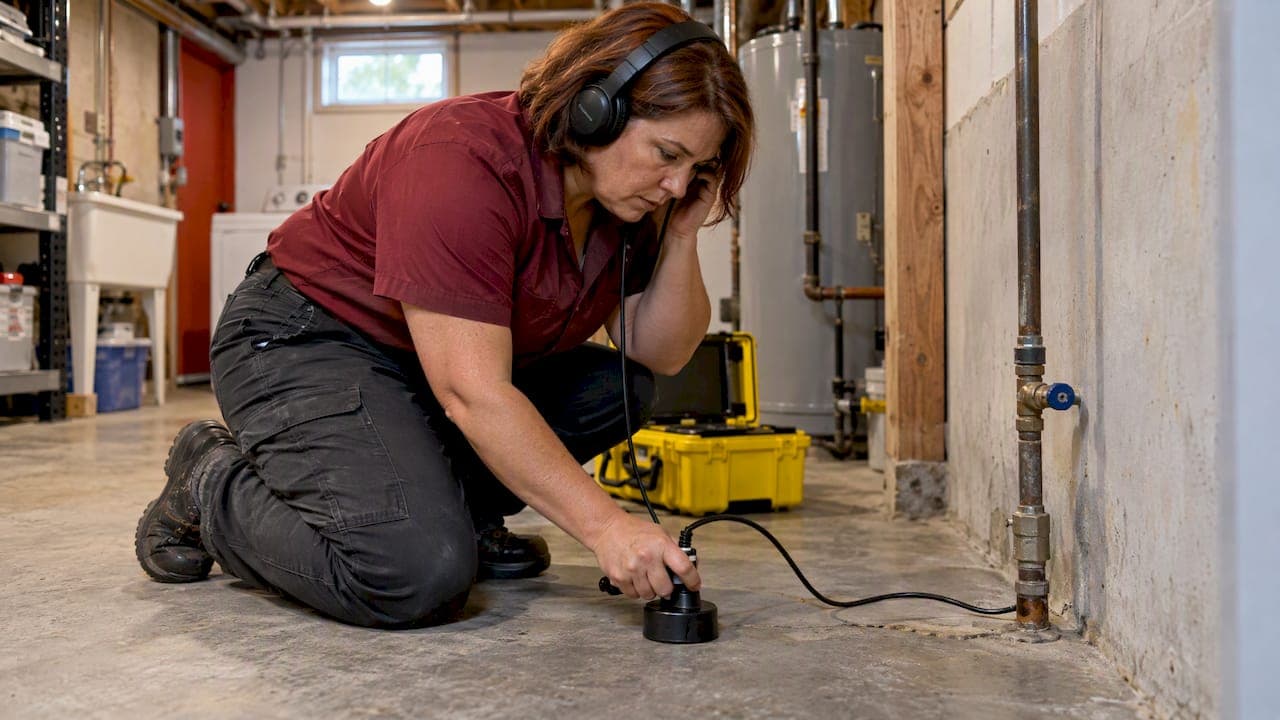
A plumber doesn't start by breaking up your floor. Detection typically combines a pressure test of the lines, listening equipment that picks up the sound of escaping water, and sometimes thermal imaging or a camera inspection to narrow down the spot. The goal is to open as small an area as possible.
Once the leak is located, the usual repair approaches include tunneling under the slab to reach the pipe, trenchless repair methods, re-routing the line through walls or the attic, or opening the concrete directly, according to SERVPRO's repair overview. Which one fits depends on where the pipe is, how old the plumbing is, and whether more than one section is failing.
When several leaks appear on aging lines, a repipe in copper or PEX often makes more sense than repairing one pinhole after another. A good plumber will show you the pressure test results, explain why a given option fits, and give you a price before beginning.
If you are thinking about selling and find leak damage in the process, it helps to know your options, including selling a house with water damage, before deciding between repairing first or selling as-is.
Our perspective on slab leaks
Most people we meet call about a slab leak after weeks or months of ignoring a small clue. The bill was a little high. The floor felt a bit warm. The water heater seemed to run all the time. None of those clues feel urgent alone, which is exactly why they get ignored.
Our advice is simple. Run the two-hour meter test the day you notice something odd. It costs nothing, and it tells you whether you are chasing a real leak or a running toilet. If the meter moves, stop guessing and get a licensed technician to locate the leak before it costs you flooring, drywall, and sleep.
We are a family-owned team, and the owner stays involved in the work. We know the older homes in Arlington and nearby towns, where mixed pipe materials and additions built over the years make hidden leaks harder to trace. We aim for transparent upfront pricing, so you know the plan and the cost before we start. Our leak detection and pipe repair service is built for exactly this situation: find it precisely, fix it properly, and avoid tearing up more than we need to.
Matt
Get a slab leak checked by a licensed Massachusetts plumber
If your meter moves with everything off, or two or three of the signs above sound familiar, don't wait for the damage to show itself. Mystic Valley Home Services is a licensed and insured Massachusetts team offering same-day or next-day service, with leak detection and pipe repair, whole-home repipes in copper and PEX, and frozen pipe repair and prevention.

See our plumbing services or book an appointment through Mystic Valley Home Services. Buying a home with a slab or an older addition? Our pre-purchase plumbing inspections can flag concerns before closing.
Preventing slab leaks and catching the next one early
You can't inspect pipes under concrete, but you can lower the odds and shorten the time to discovery.
- Read your meter monthly. A two-minute habit that shows a trend long before a bill arrives.
- Track your bills. Keep a simple log of gallons or CCF per month, and compare against the same month last year.
- Know your main shutoff. Everyone in the house should know where it is and how to close it.
- Watch your pressure. Irregular water pressure is one of the EPA's listed leak causes, so a gauge on an outdoor spigot is a cheap early warning.
- Replace aging lines proactively. Corrosion is a listed cause too. If your plumbing is old and leaks keep appearing, a planned repipe is usually less disruptive than repeated emergency repairs.
- Keep the heating system serviced. Annual tune-ups help you spot water loss on a boiler loop before it confuses a leak diagnosis.
- Install a few moisture sensors near the water heater, the washer, and any floor area you are watching.
A ceiling stain in a lower unit or a wet spot on a wall can also mean a hidden line is leaking elsewhere. Our guide on what to do about a leaking pipe in the ceiling lays out the emergency steps for Massachusetts homeowners.
FAQ
How long can a slab leak go undetected?
It can go unnoticed for weeks, months, or longer, because the water escapes below the floor and leaves few visible marks at first. Utility bills and structural changes are often the only early clues. That is why monthly meter checks and bill comparisons are worth the effort.
Is a slab leak a big deal?
Yes, it deserves prompt attention. Water under the slab can wear away soil, feed mold, and damage flooring and finishes, and the repair gets more involved the longer it runs. Caught early, a leak is usually simpler and less expensive to fix.
Does homeowners insurance cover a slab leak?
It depends on your policy. Many policies treat sudden water damage differently from long-term seepage, and the cost of accessing the pipe can be handled separately. Photograph the damage, avoid cleanup before documenting it, and ask your insurer and agent exactly what your policy covers.
How do I tell a slab leak from a running toilet?
Do the food coloring test first: if color reaches the bowl within 10 minutes without flushing, the toilet is leaking. Fix it, then run the two-hour meter test again. If the meter still moves with all fixtures off, a leak somewhere else is likely, and a plumber can locate it.
Can I find a slab leak myself?
You can confirm that you have a leak and often tell whether it is inside the house or in the service line, using the meter and main valve. Pinpointing a leak under concrete takes professional detection equipment. A licensed plumber can locate it without tearing up more of the floor than necessary.
Sources
- Slab Leak: Signs You Need A Plumber (Forbes Home)
- Detect and Chase Down Leaks Checklist (EPA WaterSense)
- Know Your Flow and Curb Water Waste: Leak Detection Guide (EPA WaterSense)
- Fix a Leak Week (US EPA)
- Leak Diagnosis Guidance (Arizona Municipal Water Users Association)
- Slab Leak Repair: Signs, Risks & Repair Options (SERVPRO)
- Sell a House With Water Damage for Cash