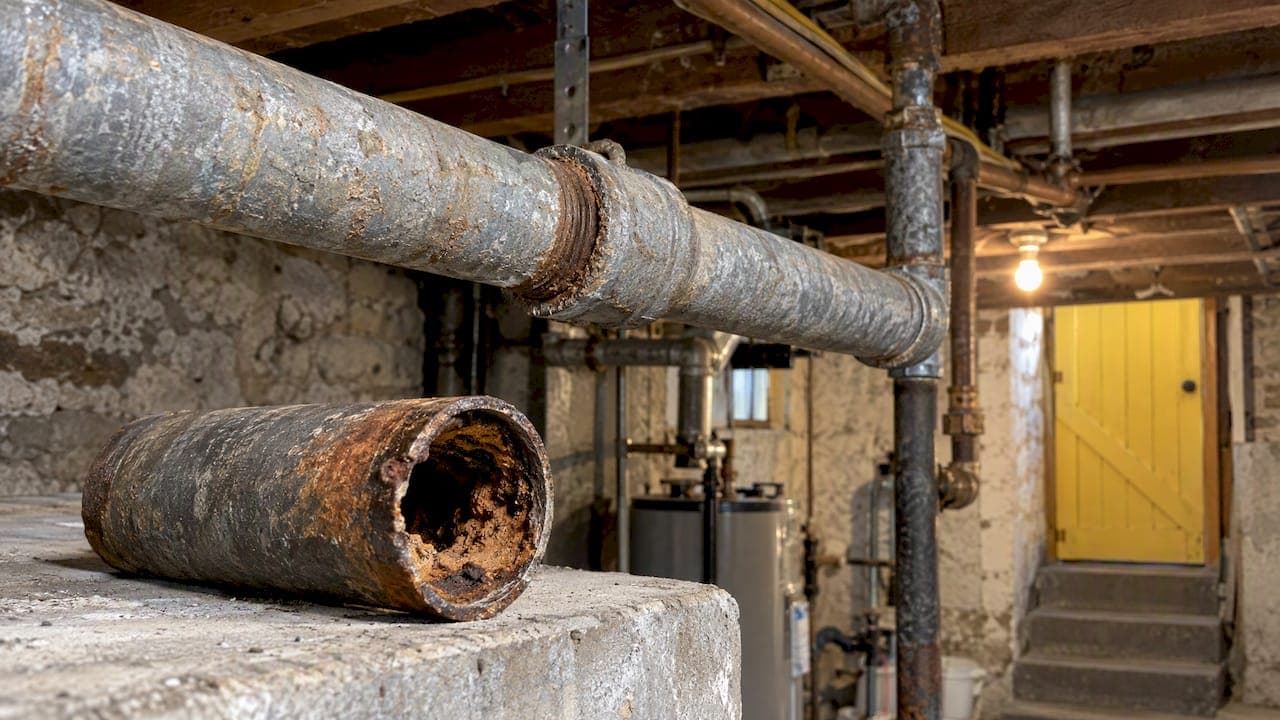
If your home has galvanized steel plumbing and it is leaking, clogging with rust or delivering weak, discolored water, replacing it is the lasting fix. Galvanized pipe rusts from the inside out, so patching one section rarely solves the problem. In Massachusetts, the work must be done by a licensed plumber under a permit. This guide covers how to confirm what you have, when to act, what to replace it with, what drives the price and how a repipe unfolds.
TL;DR
- Galvanized pipe is iron coated in zinc. The coating wears away and the pipe corrodes and narrows internally, which causes low pressure, rusty water and leaks.
- A magnet test and a scratch test tell you in a minute whether an exposed pipe is galvanized.
- PEX and copper are the usual replacements. The right choice depends on your house, your budget and local code.
- In Massachusetts, a licensed plumber must pull a permit from the local plumbing inspector before the work starts. Whole-house repipes are not a DIY job.
- Cost swings with house size, access to the pipes and wall repairs, so get a written, itemized quote after an in-person inspection.
Table of Contents
- What galvanized pipe is and why it fails
- How to tell if you have galvanized pipes
- Signs it is time to replace
- Repair, partial replacement or full repipe?
- What to replace galvanized pipe with
- What a galvanized repipe costs
- Massachusetts rules: licensing and permits
- How a whole-house repipe unfolds
- Our perspective
- Plan your repipe with Mystic Valley
- FAQ
- Sources
What galvanized pipe is and why it fails
Galvanized pipes are iron or steel pipes coated in zinc. They were common in homes built before the 1960s, and the coating eventually fails, leaving the pipe to corrode and rust internally. Because the damage happens on the inside, a pipe can look fine from the basement and still be badly narrowed.
That matters in New England. Our older housing stock, from triple-deckers and Victorians to mid-century capes, is exactly the age range when galvanized supply lines were installed. If you own an older home in Arlington, Medford, Malden or the surrounding towns, there is a real chance some or all of your supply plumbing is galvanized, even if a previous owner updated a bathroom or kitchen.
How to tell if you have galvanized pipes
You do not need tools beyond a magnet and a key or screwdriver. Look at exposed supply pipes in the basement, near the water meter, around the water heater and under sinks.
- Magnet test. A magnet sticks to iron and steel. It will not stick to copper, brass or plastic.
- Scratch test. Scratch the surface with a hard object. Per the East Bay Municipal Utility District, galvanized iron stays a dull gray underneath, while copper shows a bright copper color.
- Look at the fittings. Galvanized pipe is threaded and joined with screw-on fittings, often with visible rust bloom or white and orange crust at the joints.
- Check the diameter. Older galvanized lines are often narrow, and the interior can be much smaller than the outside suggests.
If the magnet sticks and the scratch looks gray, you have galvanized steel. Do not assume the whole house is the same: many homes have a mix of galvanized, copper and plastic from decades of partial repairs.
Signs it is time to replace
Corroded galvanized plumbing tends to announce itself. The East Bay utility notes that corroded pipes can develop deposits that block water flow, causing low pressure and discolored water, and can leak. In practice, watch for:
- Weak flow at fixtures, especially when two are running at once
- Brown or orange water, particularly first thing in the morning
- A metallic taste or particles in the water
- Recurring leaks at joints or pinhole leaks along the pipe
- Visible rust blooms, flaking or green-white crust at fittings
- Repeated plumbing repairs in the same part of the house
Each of these is a symptom of the same underlying condition, so the problem tends to spread rather than stay local. A leak in one spot often means the neighboring pipe is thinning too. Slow, hidden leaks can lead to structural damage, mold and costly repairs, which is why a failing system is worth addressing before it fails inside a wall.
Water quality and lead
Rust-colored water is mainly a nuisance and a sign of pipe decline. The more important question is lead. Galvanized coatings can contain lead and cadmium, and the same utility notes that scales formed when lead pipes connect to galvanized pipes can release lead into the water. If your service line or any older piping might include lead, ask a plumber to inspect it and consider testing your water through a certified laboratory.
The service line is a separate issue
The pipe from the street to your house is the service line. Under the EPA's Lead and Copper Rule Improvements, water systems must replace lead service lines and certain galvanized service lines under their control, typically within 10 years or less. The EPA's guidance also says that for a galvanized line that requires replacement, full replacement is required rather than leaving the galvanized segment in place. Ask your water utility about the status of the line serving your address, and coordinate any interior repipe with that work where you can.
The EPA also advises against partial replacement of lead lines and notes that galvanized pipe can be compromised when only part of it is replaced. That is a good reason to plan the whole job rather than patch.

Repair, partial replacement or full repipe?
The right scope depends on what the plumber finds when they open up the system.
| Situation | Usually makes sense |
|---|---|
| One failed section, rest of the system tested sound | Targeted replacement of that run |
| Low pressure throughout the house | Full repipe, since narrowing is system-wide |
| Repeated leaks in different spots | Full repipe |
| Planned kitchen or bath remodel with walls already open | Replace the lines in the open area, ideally as the first phase of a full repipe |
| Rusty water at every tap | Full repipe |
A caution on mixing metals: the EPA has studied how copper affects galvanized steel, and its testing found that increasing copper doses increased corrosion activity on galvanized pipe. When a plumber connects new metal to old galvanized, the transition fittings matter, and so does how much galvanized is left downstream. That is one more reason partial jobs tend to be stopgaps.
What to replace galvanized pipe with
For a residential repipe, the main options are PEX, copper and CPVC. A materials comparison suggests weighing the project, water conditions, climate and code: PEX suits retrofits, copper is durable but costly, and CPVC handles both hot and cold water.
| Material | Strengths | Watch for |
|---|---|---|
| PEX | Flexible, so it can be fished through finished walls with less demolition; generally less expensive | Sensitive to UV light, so it should not sit in sunlight |
| Copper | Long track record and a long theoretical lifespan | Higher material cost and more labor-intensive installation |
| CPVC | Handles hot and cold water | Vulnerable to freeze-thaw cycles, a real concern in unheated New England spaces |
One source calls PEX a good return on investment, with copper having a longer theoretical lifespan but a more labor-intensive install. Regardless of material, EPA research is a reminder that no single method predicts corrosion for every piping material and condition, so your water chemistry and the plumber's experience with local conditions count.
Also confirm that the products are certified for drinking water. NSF/ANSI 14 covers minimum physical, performance and health-effects requirements for plastic piping components, and NSF/ANSI/CAN 61 covers contaminants imparted to drinking water.
Which should you choose? For most older Massachusetts houses with finished plaster or drywall, PEX is the practical retrofit choice because it limits how many walls get opened. Copper makes sense when you want the longest-lived metal system, are already doing a gut renovation or prefer a rigid, exposed look in an unfinished basement. Your plumber should explain why they recommend one over the other for your house.
What a galvanized repipe costs
We do not publish fixed prices for repipes because every house is different, and a figure quoted without seeing the pipes is a guess. What the published ranges do agree on is what moves the number.
One newspaper guide reported that repiping a house with three bathrooms often costs $6,000 to $10,000 for the plumbing work, with copper or less expensive PEX as the choice, and with added cost for cutting into walls or ceilings and for plaster repair. Treat that as a ballpark from one national source, not a Massachusetts quote.
The main cost drivers:
- Size of the house. More fixtures and more linear feet of pipe.
- Number of bathrooms and floors. Each stacked bathroom adds runs.
- Access. Open basement ceilings are cheap to work in. Finished plaster walls are not.
- Material. PEX versus copper changes both materials and labor.
- Wall and ceiling repair. Often a separate line item or a separate trade.
- Permits and inspections. Required in Massachusetts and charged by the town.
- Extras. A repipe is a sensible time to replace old shutoff valves, water heater connections, hose bibs and pressure regulators.
For context on how permits and typical repair pricing work around here, see our guide to plumbing repair costs in Massachusetts.
Does insurance pay?
Standard homeowners policies generally treat gradual corrosion and wear as maintenance, not a covered loss, and coverage depends on the wording of your policy. Some insurers sell optional service line endorsements for underground, outside lines. Call your agent and ask two specific questions: whether sudden water damage from a burst pipe is covered, and whether a service line endorsement is available. Business owners should ask the same of their commercial property carrier, and should know that a business operated on residential property may be treated differently.
Massachusetts rules: licensing and permits
This is where DIY plans usually end. Massachusetts law says plumbing work must be performed by a licensed master or journeyman plumber. Minor repairs such as fixing a leaky faucet or clearing a blocked drain do not require a permit, but a repipe is far beyond that.
Under the state plumbing regulations, a licensed master plumber must file for a permit from the local plumbing inspector before work begins. Testing must be completed, and if the work is an emergency, the inspector has to be notified by the next working day. Your plumber pulls the permit, not you, and the inspection is your protection that the work meets code.
If a contractor suggests skipping the permit to save money, that is a red flag. Unpermitted plumbing can complicate a home sale or an insurance claim later. Our guide to Massachusetts plumbing code and permits explains what to expect, and our checklist for choosing a plumber covers questions to ask before you sign.

How a whole-house repipe unfolds
Every job differs, but the sequence is usually this:
- Inspection and quote. The plumber traces your supply lines, checks pressure and identifies access points, then gives you a written scope with material, number of fixtures and any repair work.
- Permit. The licensed master plumber files with the local plumbing inspector.
- Scheduling. Because water is off during the work, ask how long your house will be without it and whether temporary water is arranged for the end of each day.
- Rough-in. New lines are run, usually from the basement or crawlspace upward, with access holes cut where needed.
- Testing and inspection. The system is pressure tested and the inspector signs off.
- Patching and cleanup. Access holes are closed. Ask in advance whether finish repair and paint are included or handled separately.
Many repipes of average houses are completed in a few days, but your plumber should give you a schedule specific to your home.
Our perspective
We work in Arlington and the surrounding towns, where older homes are the norm, and galvanized pipe is one of the most common reasons homeowners call us after a leak or a trickle of rusty water.
Our view is simple: when galvanized plumbing is failing throughout the house, a full repipe by a licensed plumber is a better investment than a string of repairs. Each patch costs money and often exposes the next weak joint. Doing it once, under a permit, with the right material for your house, lets you stop worrying about the walls.
We believe in showing you what we find. Our approach is upfront pricing, direct owner oversight and a family-owned team that treats your older home with care. Ask us to walk the basement with you, show you the pipes and explain your options before any work starts.
Matt
Plan your repipe with Mystic Valley
If you suspect galvanized pipes in your home or building, we can inspect your plumbing, explain what we find and talk through your options. Our licensed and insured Massachusetts technicians offer same-day or next-day service, and our plumbing services include whole-home repipes in copper and PEX, leak detection and pipe repair.

Buying an older house? Our pre-purchase plumbing inspections can flag galvanized lines before you close, so you can plan the cost into your offer.
FAQ
Is it worth it to replace galvanized pipes?
In most cases, yes, once the pipes are leaking, restricting flow or discoloring your water. The interior corrosion does not reverse, and repeated repairs add up. If your pipes are old but performing well, a plumber can inspect a section and help you decide whether to replace now or plan for it.
Can I replace galvanized pipes myself?
In Massachusetts, plumbing work must be done by a licensed master or journeyman plumber, and permits are filed by the licensed plumber. Small repairs like a leaky faucet or a clogged drain are exceptions. A whole-house repipe is not a DIY project here.
What should I replace galvanized pipes with?
PEX and copper are the most common choices for homes, with CPVC as another option. PEX is often chosen for retrofits because it is flexible and less costly, while copper is durable but more expensive to install. Your plumber should recommend one based on your water, your house and local code.
Will insurance cover replacing galvanized pipes?
Usually not for gradual corrosion, which insurers tend to treat as wear and maintenance. Some policies cover sudden water damage, and some insurers offer service line endorsements for outside, underground lines. Read your policy and ask your agent before you plan your budget.
Do I have to replace my service line too?
Under the EPA's Lead and Copper Rule Improvements, water systems are responsible for replacing certain galvanized service lines under their control. Contact your water utility to find out the material and status of the line serving your property.
Sources
- Galvanized iron pipes, East Bay Municipal Utility District
- LCRI Questions and Answers, US EPA
- Final Lead and Copper Rule Improvements FAQ, US EPA
- Planning and Conducting Lead Service Line Replacement, US EPA
- Copper-induced Corrosion of Galvanized Steel Pipe, US EPA
- Relationships Between Water Quality and Corrosion, US EPA
- Plastic Materials Certification, NSF
- Copper vs. CPVC vs. PEX Tubing
- What is Galvanized Plumbing?, Moen
- Do I really need to replace all of my galvanized pipes?, The Seattle Times
- How Much Does It Cost to Replace Galvanized Plumbing?
- Massachusetts law about home improvement, Mass.gov
- 248 CMR 3.00, Mass.gov