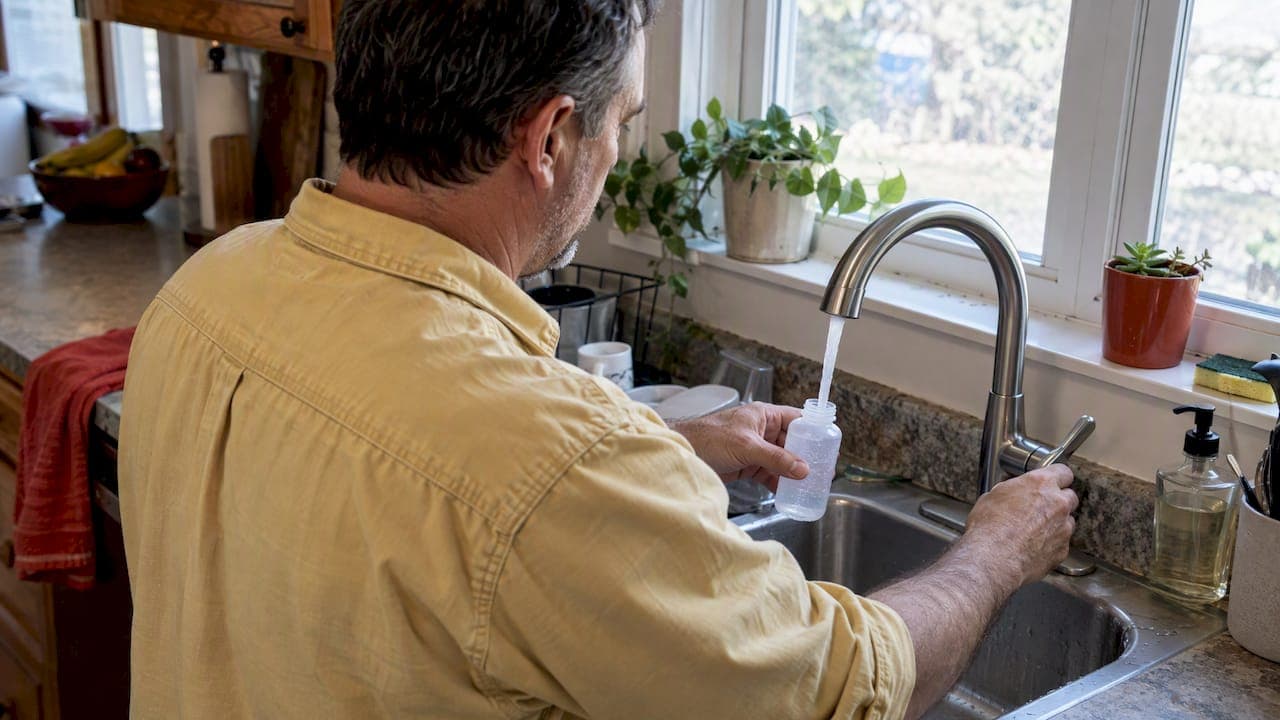
If you have a private well in Massachusetts, you are the one responsible for testing your water, and the test has to come from a MassDEP-certified laboratory. If you are on a public water system, your supplier does the testing and sends you the results each year. The rest of this guide covers which situation you are in, what to test for, how to find a lab, and what to do when a result comes back high.
TL;DR
- Public water customers generally do not need to test. Your supplier must report on water quality every year in a Consumer Confidence Report.
- Private well owners should test bacteria and nitrate/nitrite every year, and PFAS, arsenic and VOCs at least every ten years, according to MassDEP.
- Use a MassDEP-certified lab. Hardware-store kits can miss contaminants, and the state does not run tests for individuals.
- PFAS sampling has its own rules: ask the lab for its protocol before you collect anything.
- Your local Board of Health may set stricter local testing rules. Call it first.
Table of Contents
- First question: public water or private well?
- What to test for, and how often
- Why PFAS deserve extra attention
- How to find a MassDEP-certified lab
- Reading your results
- What happens after a bad result
- Buying a home with a well, or an older house
- Our perspective
- Need plumbing work after a water test?
- Businesses and commercial properties
- A simple checklist
- FAQ
- Sources
First question: public water or private well?
Everything else depends on this. Check your water bill. If you get one from a town or water district, you are on a public system. If you do not, you almost certainly have a private well.
If you are on public water
Massachusetts requires public water suppliers to test, and the state describes its drinking water as some of the highest quality in the country. Community systems must also send customers a Consumer Confidence Report. These reports are due every July 1 and cover the previous calendar year. They list detected contaminants and say whether the system met federal and state standards. If a system goes over a legal limit, it must notify its customers.
So for most people with town water, the best first step is to read your latest report. Your supplier usually posts it on its website or mails it.
There are still reasons to test at the tap, even on public water:
- You have an older home and want to know whether lead from plumbing is reaching your faucets. Lead typically comes from service lines, solder or fixtures inside the house, not from the treatment plant.
- Your water looks, smells or tastes different from usual.
- You have a baby on formula, or someone in the house with a health condition, and want extra confidence.
If you do test, use a certified lab for drinking water and name the contaminant you are worried about.
If you have a private well
No one tests a private well for you. Under state law, local Boards of Health have primary jurisdiction over private wells, and each can adopt its own well regulation. MassDEP says that private well owners carry the full responsibility for their own water safety. It also warns that clear, odorless, good-tasting water can still contain contaminants such as PFAS or arsenic.
What to test for, and how often
MassDEP's guidance for private wells, as summarized in its PFAS FAQ for private well supplies, recommends this:
| What | Suggested frequency | Why it matters |
|---|---|---|
| Coliform bacteria | At least annually | Signals possible contamination from surface water, septic systems or animals |
| Nitrate / nitrite | At least annually | Linked to fertilizer, septic systems and manure |
| PFAS | At least every 10 years | Industrial and firefighting-related "forever chemicals" |
| Arsenic | At least every 10 years | Can occur naturally in bedrock wells |
| VOCs | At least every 10 years | Solvents and fuels from past or nearby industrial use |
| Lead | Include in the initial broad test | Often comes from plumbing, not the source |
Treat these as a floor, not a ceiling. Test sooner when something changes:
- You are buying a house with a well. MassDEP strongly recommends testing before purchase.
- The well was repaired or the pump was replaced. After repair and flushing, a bacterial test is advised.
- The water's color, taste or smell changes.
- A nearby site, such as a former industrial property, a firefighting training area or an old airfield, may have affected groundwater.
How often the state suggests testing is not the same as what your town requires. Some municipalities have by-laws that demand more frequent or specific testing, so call your Board of Health before you order anything. The board may also know about local contamination history that you cannot easily find yourself.
Why PFAS deserve extra attention
Massachusetts set a public drinking water standard for PFAS in 2020: 20 parts per trillion (ng/L), individually or as the sum of six compounds (PFOS, PFOA, PFHxS, PFNA, PFHpA and PFDA). Legally, that limit applies to public water systems. It does not bind private wells. But MassDEP's FAQ treats it as the health-based reference point, so well owners can compare their own results against 20 ppt.
When you send a sample for PFAS, how you collect it matters as much as the lab:
- Request the lab's PFAS sampling protocol before you collect. Do not use a general-purpose kit.
- Avoid common PFAS sources before and during sampling. MassDEP lists items such as certain sunscreens, insect repellents, waterproof clothing and permanent markers.
- Expect special supplies. Labs typically supply plastic bottles (never glass) and ask for nitrile gloves. Many include a field reagent blank to check for cross-contamination.
- Ask which method the lab uses. MassDEP's lab guidance points to approved methods such as EPA Method 537.1 or 533 for PFAS.
A sunscreen-covered hand on a sample bottle can spoil a result that is measured in parts per trillion. Follow the protocol exactly, and if you are unsure, ask the lab.
How to find a MassDEP-certified lab
MassDEP does not test water for individuals. You hire a private, certified lab yourself. The state's certified laboratory finder is the place to start. A few tips for using it:
- Search by the specific contaminant you need, such as "PFAS" or "Lead".
- Set the matrix to Potable (Drinking Water). Otherwise you may end up with labs certified for wastewater or soil.
- Confirm the lab is certified for each parameter you are ordering, not just certified in general.
- Ask each lab how it supplies bottles, whether you drop off or ship, and how quickly samples must arrive. Bacteria samples in particular are time-sensitive.
Hardware-store kits are tempting, but MassDEP's guidance is that only certified labs using approved methods give results you can rely on. A non-certified method can return a false negative, which is worse than no test at all because it gives you false comfort. Certified results are also the ones that hold up in a home sale or a dispute.
What it costs
The state does not set lab prices. The private wells FAQ notes that the owner pays for analysis and that fees vary between labs, so it is worth comparing. As a rough guide, one lab-directory site lists about $25 to $60 for a single contaminant, $50 to $150 for a general panel and $250 to $450 or more for a comprehensive panel with PFAS and VOCs. Treat those numbers as ballparks and get written quotes before you decide.

Reading your results
Lab reports list each contaminant, the amount found and often a comparison limit. A few practical points:
- Compare with the right yardstick. For PFAS, the sum of the six regulated compounds is what you compare against 20 ppt.
- Do not panic on one number. Ask the lab to explain any flagged result, and consider a confirmation sample.
- Call your Board of Health if you are above a standard. It can advise on next steps and local rules.
- Keep the paperwork. Certified reports are useful for resale and for choosing and sizing treatment equipment later.
For health questions, such as how a particular contaminant affects a pregnant family member or an infant, talk to your doctor or the Board of Health. A plumber is the wrong person to interpret health risk.
What happens after a bad result
Testing tells you what is in the water. Fixing it is a separate job, and the right fix depends on the contaminant. A filter that improves taste does nothing for arsenic or PFAS, and a system designed for one contaminant may not handle another. Get the treatment matched to your lab report, and retest after installation to confirm it is working.
Typical routes include a whole-house system at the point where water enters the home, or a filter at a single drinking tap. This comparison of whole-house and drinking-water filters is a good primer on the trade-offs before you talk to an installer.
Some water problems are plumbing problems, not source problems:
- Rusty or discolored water can come from old galvanized or iron pipes, or from a failing water heater tank.
- Lead may come from older fixtures, solder or service lines. Replacing sections of pipe can address it.
- Low pressure and sediment can point to corroded or clogged lines. Our guide on fixing low water pressure with gauge and meter tests shows how to narrow down the cause.
- Water that is only a problem when hot often traces to the water heater. See our notes on no hot water troubleshooting.
Buying a home with a well, or an older house
If you are buying, schedule water testing early, during your inspection period, because lab turnaround can take days. Order a certified-lab panel that covers bacteria, nitrate, arsenic, lead, VOCs and PFAS, and ask the lab about the sampling protocol, since PFAS requires special handling. Keep in mind that testing the water and inspecting the plumbing are separate jobs. A lab report will not tell you whether the pipes are failing.
Our perspective
We are plumbers and heating technicians. We do not run laboratory analyses, and we would not want you to rely on a plumber's opinion when a certified lab can give you a defensible number. What we see is the other half of the picture: what the water does once it reaches the house.
Much of our work is in older Massachusetts homes, including Arlington's older housing stock. In those homes, a water complaint often has two causes: something in the supply, and something in the pipes, fixtures or water heater. We have seen how mixed old piping, aging tanks and sediment-clogged boilers can make perfectly fine water look and behave badly. That is why we suggest this order: call your Board of Health, get a certified lab test, and only then decide what equipment to buy.

Be wary of anyone who offers to sell you a treatment system before you have a lab report. The report should drive the equipment choice, not a sales pitch. If a technician tells you what is in your water from a quick tabletop test, ask to see certified results.
We publish our pricing upfront, and the owner stays involved in the work. If your lab results lead to plumbing work, we will tell you plainly what is needed and what is not.
— Matt
Need plumbing work after a water test?
When results point to old pipes, a worn-out water heater or an aging boiler, we can help. Our licensed and insured Massachusetts technicians handle leak detection, repairs and repiping in copper or PEX, tank and tankless water heater replacement and pre-purchase plumbing inspections. We offer same-day or next-day service. You can also see everything on our services page.
Before any plumbing work, remember that many jobs need permits in Massachusetts. Our overview of 248 CMR 10.00 and permits explains what to expect.
Businesses and commercial properties
The rules depend on how the building gets its water. A commercial building on a public supply relies on the supplier's testing. A building with its own well may face additional requirements as a public water system, depending on use and the number of people served, so ask MassDEP and your local Board of Health which rules apply. If your concern is cost rather than quality, see our tips on commercial building water conservation.
A simple checklist
- Confirm whether you are on public water or a private well.
- Public water: read the latest Consumer Confidence Report. Private well: call the Board of Health.
- Search the MassDEP database for certified labs by contaminant, matrix set to Potable (Drinking Water).
- Get at least two quotes and ask about sampling kits and delivery deadlines.
- For PFAS, request the lab's protocol and follow it to the letter.
- Compare results with the right standard and keep the report.
- Choose treatment or plumbing repairs only after you have results, then retest.
FAQ
Can I drink tap water in Massachusetts?
In most cases, yes, if you are on a public system. Suppliers must test their water and report annually, and MassDEP says the state has some of the highest-quality drinking water in the country. Read your Consumer Confidence Report for details about your own supply. If you have a private well, the answer depends entirely on your own testing.
How can I get my water tested for PFAS?
Hire a MassDEP-certified lab that offers PFAS analysis, and ask for its sampling protocol before you collect the sample. Plan on special bottles, gloves and care to avoid products that can contaminate the sample. Compare the results with the state's 20 ppt standard for the sum of six PFAS compounds.
How often should I test my well water?
MassDEP's recommendation is at least once a year for bacteria and nitrate/nitrite, and at least every ten years for PFAS, arsenic and VOCs. Test sooner after well repairs, a change in the water or before buying a home. Your town's Board of Health may require more.
Are home test kits from a hardware store good enough?
For a official or home-sale decision, no. MassDEP's guidance is to use certified labs with approved methods, since uncertified methods can give false negatives. A kit can be a rough screen at best, and it cannot replace a certified test for contaminants like PFAS or arsenic.
Sources
- Protect Your Family: A Guide to Water Quality Testing for Private Wells (Mass.gov)
- FAQs - Private Wells (Mass.gov)
- PFAS in Private Well Drinking Water Supplies FAQ (Mass.gov)
- Find a Certified Laboratory for Water Testing (Mass.gov)
- Consumer Confidence Reports (Mass.gov)
- What's in my drinking water? (Mass.gov)
- Water Testing in Massachusetts: How to Find a Certified Lab (Waterverge)