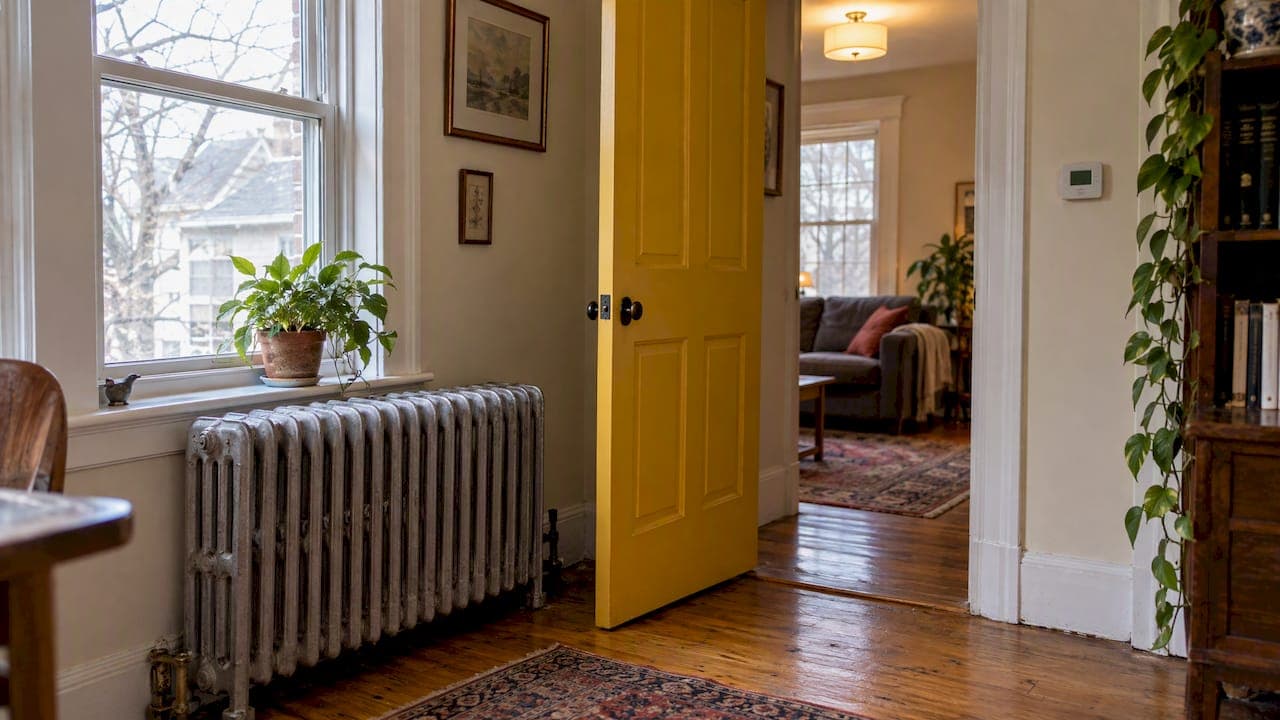
When one room is toasty and the next one is cold, the cause is almost always one of three things: the building is losing heat in some places (air leaks, thin insulation), the system is not delivering heat evenly (blocked or leaky ducts, air-locked or unbalanced radiators), or the thermostat is reading the wrong room. This guide walks you through each one, shows what you can safely check in an afternoon, and explains when it is time to call a licensed technician.
TL;DR
- Uneven heat comes from the building shell (drafts, missing insulation), the distribution system (ducts, radiators, zones), or thermostat placement.
- Start with free checks: open registers and radiator valves, clean the filter, clear furniture, and compare rooms with a simple thermometer.
- In forced-air homes, leaky or kinked ducts are a top suspect. In older hot-water and steam homes, trapped air, stuck valves and unbalanced zones are.
- Air sealing and insulation usually come before any equipment change. Duct repairs and boiler work belong to a qualified professional.
- If one room stays cold after the basics, or you smell gas or see soot, stop troubleshooting and call.
Table of Contents
- Why some rooms run hotter and colder than others
- Start with the free checks
- Causes in forced-air (ducted) homes
- Causes in hot-water and steam homes
- Can a bad thermostat cause uneven heating?
- The building itself: air leaks and insulation
- What a professional diagnosis should cover
- Fixes, from cheapest to most involved
- Our perspective
- When to stop and call
- Get it looked at by our team
- FAQ
- Sources
Why some rooms run hotter and colder than others
Heat does not spread evenly on its own. Every room gains heat from the system and loses it through walls, windows, floors and the attic. A room ends up comfortable only when those two numbers match. Energy New England groups the causes of uneven heating into thermal defects in the building, problems in the distribution system, and thermostat location. That is a useful way to sort your own house, because each group has a different fix and a different person to call.
The U.S. Department of Energy's building-science guidance puts the goal simply: comfort depends on delivering the right amount of conditioned air to each room and mixing it well with the air already there. If a room gets too little supply, loses too much, or both, you feel it.
Quick sorting guide
| What you notice | Likely group | First thing to check |
|---|---|---|
| One room always cold, others fine | Distribution or shell | Register or radiator, duct run, exterior walls |
| Rooms over a garage or at the end of the house are cold | Shell and ducts | Insulation, air sealing, long duct runs |
| Upstairs colder than downstairs (or the reverse) | Distribution and shell | Balancing, attic insulation, return air |
| Whole house swings hot and cold | Thermostat or controls | Location, calibration, cycling |
| Radiator cold at the top or not heating at all | Hydronic distribution | Trapped air, valve, zone |
Start with the free checks
Before you spend anything, rule out the simple causes. The Maryland Weatherization Field Guide used by energy auditors recommends looking for disconnected or restricted ducts, dirty filters, blowers and coils, damaged grilles, and closed registers or dampers before anyone measures airflow. You can do most of that yourself.
- Open every register and clear it. Rugs, couches and curtains over a register or baseboard cut off the supply. Closing vents in unused rooms does not reliably help; it can add pressure and leakage elsewhere in the duct system.
- Replace or clean the filter. A clogged filter restricts airflow to the whole house, and the rooms at the end of the longest duct runs lose first.
- Check interior doors. In homes with a central return, a closed bedroom door can starve that room of airflow. The Department of Energy's building-science education pages note that closed interior doors and pressure imbalances can move air across insulation and cut its effective performance.
- Walk the house with a thermometer. Put an inexpensive indoor thermometer in each problem room at chair height for a day. Write down the numbers. A technician can do far more with "the back bedroom is 6 degrees colder than the kitchen at 7 a.m." than with "it's cold."
- Look for drafts. On a windy day, feel around windows, doors, outlets on exterior walls, and the attic hatch. Drafts are a thermal defect you can often fix with weatherstripping and caulk.
If you want a fuller walkthrough of the thermostat side of things, our five safe thermostat checks cover what to look at first.
Causes in forced-air (ducted) homes
Leaky ducts
Ducts are the usual hidden culprit. ENERGY STAR says typical U.S. homes lose about 20% of the air moving through the duct system to leaks, holes and poor connections, and lists rooms that are hard to heat or cool among the symptoms. The Department of Energy adds that supply-duct leaks waste heated air, while unsealed return ducts can pull unconditioned air into the system. Ducts running through an attic, garage, crawlspace or unfinished basement deserve the closest look, because that is where leaks dump heat outside the living space.
Kinks, long runs and crushed flex duct
Even a sealed duct can fail to deliver if it is restricted. ENERGY STAR's installation guidebook lists kinks, turns and compression in ductwork as restrictions that keep the designed airflow from reaching a room. Building America guidance explains why length matters: friction and bends add pressure loss, and a single 90-degree bend can add as much as 35 feet of effective duct length, depending on construction. A bedroom at the end of a winding flex run is the classic cold room.
Missing insulation on ducts
Ducts in unconditioned space lose heat on the way to the register. The Department of Energy recommends sealing duct joints and insulating ducts in unconditioned spaces, with changes and repairs done by a qualified professional. Energy New England makes the same point and adds the order of operations: seal the connections first, then insulate.
Out-of-balance airflow
This Old House describes air balancing as fine-tuning ducts or vents so every room reaches a consistent temperature, and notes that additions, moved walls, damaged insulation, new windows or doors, and even new furniture layouts can upset a balance that used to work. If your house felt fine until a renovation, this is a prime suspect.
Causes in hot-water and steam homes
Much of the Massachusetts housing stock, especially older homes like the ones we see around Arlington, heats with boilers and radiators or baseboard rather than ducts. The problems look different here.
- Trapped air. A radiator that is warm at the bottom and cool at the top, or a baseboard loop that gurgles, usually has air in the line. Bleeding it is a quick fix on many hot-water systems, but if air keeps returning, the system may be losing water or pulling in air somewhere, and that is a job for a technician.
- Sludge and scale. Old hot-water systems collect debris that restricts flow, so rooms far from the boiler get less heat.
- Steam venting and valves. On one-pipe steam systems, radiators near the boiler heat first and far ones lag if air vents are clogged or the wrong size. A stuck inlet valve can leave a radiator cold entirely.
- Zone problems. A failed zone valve or a thermostat that never calls for heat leaves a whole floor or wing cold while the rest of the house is warm.
- Unbalanced loops. If the near radiators get most of the flow, the far ones will always be cold until the system is balanced.
We wrote a step-by-step guide on what to check when a radiator is not heating, and if your furnace is running but the air feels cool, see our fixes for a furnace blowing cold air.
Can a bad thermostat cause uneven heating?
Yes, though usually it makes the whole house feel off rather than one room. The thermostat controls the system based on the temperature at one spot. Energy New England lists thermostat location among the main causes of uneven heating, and the logic is straightforward: if the thermostat sits in a sunny hallway, near a kitchen, or on an exterior wall with a draft, it will shut the heat off too early or run it too long for the rest of the house.
Signs the thermostat is part of the problem:
- The system shuts off well before the rest of the house reaches the set temperature, or runs far past it.
- The room with the thermostat feels fine while rooms far from it are consistently colder or warmer.
- The display temperature disagrees with a separate thermometer placed nearby by several degrees.
- The heat never comes on, or the screen is blank or unresponsive. Check the batteries and settings first.
- In a multi-zone house, one zone never calls for heat while others do.
A thermostat that is poorly located can often be relocated or supplemented by a zoned control, and a failed unit is a straightforward replacement. In multi-zone hydronic homes, zone valves and thermostats work as a pair, so a technician will test both.
The building itself: air leaks and insulation
If the distribution system checks out, the shell is next. The EPA's ENERGY STAR heating guide says rooms that are too hot or too cold may indicate inadequate air sealing or insufficient insulation, and that leaky or poorly insulated ductwork can cause rooms that never become comfortable.
In New England, the typical trouble spots are:
- Attic floors with thin or compressed insulation, and gaps around chimneys, recessed lights and attic hatches.
- Rim joists and the tops of foundation walls in basements.
- Rooms over garages, cantilevered overhangs and bump-outs.
- Old single-pane or loose windows, and leaky doors.
Attics matter in both seasons. ENERGY STAR notes that the sun can heat attic air to about 140°F in summer, and that attic air sealing and insulation address both winter heat loss and summer heat gain. A well-ventilated attic also helps keep that space under control; a residential roof ventilation guide explains how intake and exhaust airflow work once leaks and insulation gaps are dealt with.
Do the shell work before replacing equipment
It is tempting to blame an old boiler or furnace and replace it. But if the house leaks heat, a new unit will still leave the same rooms cold. Mass Save says that completing weatherization and ensuring adequate insulation before replacing heating equipment can save Massachusetts customers up to 15% on heating and cooling costs and improve year-round comfort. Its income-eligible program notes that air sealing is usually the first weatherization step, addressing leakage in attics, basements and between joists, and that qualifying households may receive no-cost insulation, air sealing, and heating and cooling upgrades. Check the Mass Save site for current eligibility and the home energy assessment process.
What a professional diagnosis should cover
When the free checks do not solve it, a good technician does not guess. The Department of Energy's Building America homeowner guide says a home-performance assessment can inspect duct installation and insulation and test duct tightness and airflow at each register. ENERGY STAR's duct guidance adds that inspection should look at supply and return balance, damaged or disconnected ducts and crushed flexible duct, followed by sealing, insulation, and airflow testing after repairs.
For ducted homes, expect:
- Room-by-room temperature and airflow readings.
- A look at filters, blower, coil, grilles, dampers, and every accessible duct run.
- Duct leakage and airflow testing where warranted.
- A written list of fixes in order of impact.
For boiler homes, expect:
- A check of the boiler, circulator pumps, zone valves, and thermostats.
- Bleeding and venting, and a look for air or sludge issues.
- Flow and balance checks on loops or steam venting.
- Combustion and safety checks on the equipment.
The Department of Energy advises having duct changes or repairs done by a qualified professional and sealing tested for combustion safety and proper airflow. That matters most with gas or oil appliances: changing airflow in a house can change how a flue draws.
Choosing who does the work
Ask any contractor how they size and design a system rather than just swapping parts. Our guide to choosing an HVAC contractor covers the Manual J and AHRI proof worth asking for.
Fixes, from cheapest to most involved
| Fix | Typical use | Who does it |
|---|---|---|
| Open and clear registers, change filter | Any ducted home | You |
| Bleed radiators | Hot-water systems with air | You, or a technician if air keeps returning |
| Weatherstripping, caulk, attic hatch seal | Drafty rooms | You |
| Attic and rim joist air sealing and insulation | Persistent cold rooms, ice dams | Insulation contractor, often through Mass Save |
| Duct sealing, insulating, reconnecting | Ducts in attic, basement or crawlspace | Qualified HVAC professional |
| Duct rerouting or added return | Far-end rooms, closed-door rooms | HVAC professional |
| Zone valve, thermostat, or relocation | One zone or whole-house cycling problems | Heating technician |
| Ductless mini-split in the problem room | Additions, rooms with no practical duct path | HVAC professional |
For a room that simply cannot be reached well by the existing system, such as an attic conversion or a sunroom addition, a ductless mini-split can solve the problem without opening walls, and multi-zone designs let each space hold its own setting.
Our perspective
Most homes we visit for uneven heat do not have a broken system. They have a system that was fine for the house as built and has been out of step since someone finished a basement, added a bump-out, replaced windows, or closed in a porch. In the older homes around Arlington, we often find a good boiler feeding radiators that were never balanced for the way the family uses the house today.

So we start with a walk-through and a thermometer, not a quote for a new boiler. We would rather bleed a radiator, fix a zone valve, or tell you to air-seal the attic than sell you equipment that will not solve the problem. If the heating system itself is worn out, we will say so plainly, and we will put it in writing with the price up front.
One rule we hold to: fix the house first, then size the equipment to the house. That order saves money and gets rid of the cold room.
— Matt
When to stop and call
Some signs mean the problem is no longer a comfort question.
- Smell of gas, a boiler or furnace that shuts off repeatedly, soot, or a carbon monoxide alarm. Leave the house and call your gas utility or 911 from outside. Do not try to fix it.
- No heat in cold weather. Pipes can freeze fast. Call right away.
- A radiator or zone that stays cold after you have bled it and checked valves.
- Water leaking at the boiler, a zone valve, or a radiator valve.
- A cold room that has stayed cold despite open registers and a clean filter.
- Duct work in the attic or crawlspace that looks disconnected, crushed, or wet.
Get it looked at by our team
Mystic Valley Home Services is a licensed and insured, family-owned Massachusetts team that offers same-day or next-day service. If you have rooms that never warm up, our heating services cover boiler and furnace repair, steam and hot-water radiator service, zone valve and thermostat replacement, and no-heat emergency diagnostics. If the answer is a new system, we also install high-efficiency boilers and design multi-zone systems. A yearly tune-up is the cheapest way to catch these problems early; see how annual boiler service works. Ready to book? Start at mysticvalleyservices.com.
If you manage a larger building with tenants complaining about hot and cold units, read why multi-zone commercial heating works.
FAQ
Why is one room in my house so hot or cold compared with the others?
Usually that room gets too much or too little airflow or hot water compared with how much heat it gains and loses. Common reasons are leaky or kinked ducts, a closed register, an unbalanced radiator loop, an exposed wall or ceiling with poor insulation, or sun exposure. Measure the temperatures first, then work through registers, filters, doors and drafts.
Should I close vents in rooms I don't use?
It is not a reliable way to push more heat elsewhere. Closing registers can raise duct pressure, increase leakage, and upset a system that was designed for a certain airflow. If a room is unused, a balancing adjustment by a technician is the safer route.
Can a bad thermostat cause uneven heating?
It can. A thermostat in a sunny or drafty spot, or one that reads inaccurately, shuts the system off too soon or runs it too long for the rest of the house. Compare its reading against a separate thermometer. If it is off by several degrees or the heat does not respond, have it checked or replaced.
Will a new boiler or furnace fix uneven heating?
Not by itself. If the cause is air leaks, thin insulation, leaky ducts or an unbalanced system, new equipment will inherit the same problems. Fix the shell and distribution first, then size equipment to the improved house.
When should I call a heating professional?
Call if you smell gas, see soot, hear the boiler or furnace cycling off repeatedly, lose heat in cold weather, or if a room stays cold after the basic checks. Duct repairs and boiler work should be done by a qualified, licensed professional.
Sources
- Heating Systems, Energy New England
- Energy Saver guide, U.S. Department of Energy
- Duct Sealing brochure, ENERGY STAR
- ENERGY STAR V3 HVAC Quality Installation Guidebook
- Air Distribution Basics, U.S. Department of Energy Building America
- Guide to Energy-efficient Heating and Cooling, EPA
- Air Balancing, This Old House
- Ducted Air Distribution, Maryland Weatherization Field Guide
- Building America Best Practices Vol. 14, U.S. Department of Energy
- Building Envelope and Heat Flow, U.S. Department of Energy
- Improved Home Insulation Helps a Heat Pump Perform Better, ENERGY STAR
- Heating Comparison Calculator, Mass Save
- Income Eligible Programs, Mass Save