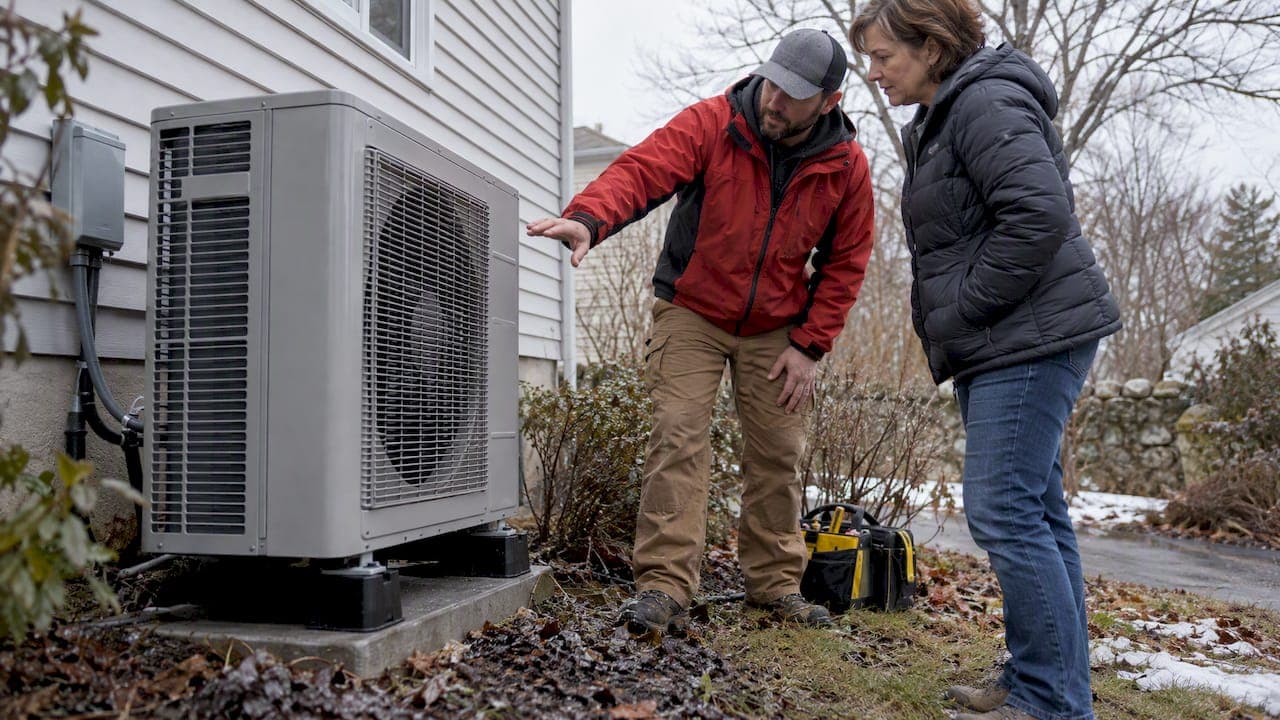
Yes, modern cold-climate heat pumps can heat your home reliably through very cold weather when you choose the right equipment and a high-quality installation. Performance depends on correct sizing, a tight building envelope, and proper commissioning, not just the brand on the box. Some homes still do better with a backup heat source for the coldest nights. The equipment meeting ENERGY STAR's cold-climate criteria has closed most of the gap that used to make heat pumps a poor fit for harsh winters.
TL;DR:
- Choosing a cold-climate heat pump with ENERGY STAR verification and proper sizing ensures most performance in extreme cold, but installation quality and building envelope are crucial.
- Variable-speed compressors, vapor injection, and advanced defrost controls are key engineering improvements that help maintain capacity down to negative 35°F.
- Proper sizing based on a Manual J load calculation and correct distribution system choice prevent common performance issues during harsh winters.
- Backup heating options like dual-fuel systems or electric resistance are recommended for regions with prolonged very cold temperatures or unreliable power supply.
- Weatherization and sealing your home can significantly reduce your heating load, making a smaller, more efficient system the better investment than larger, oversized units.
Table of Contents
- How cold-climate heat pumps work differently from older models
- What the performance numbers on the spec sheet actually mean
- How to size and select a cold-climate heat pump for your home
- Do you still need backup heat?
- What a cold-climate heat pump costs, and how weatherization changes the math
- Why installation quality matters more than the brand name
- What homeowners should expect, realistically
- How we help you plan and install the right system
- FAQ
- Sources
How cold-climate heat pumps work differently from older models
Older heat pumps lost most of their heating capacity once outdoor temperatures dropped below freezing, which is why they earned a reputation for struggling in harsh winters. Cold-climate models fix that problem with a handful of specific engineering changes, not just a bigger compressor.
Variable-speed inverter compressors are the biggest shift. Instead of cycling fully on and off like a traditional unit, an inverter compressor ramps its speed up and down to match the heat your house actually needs at that moment. This modulation keeps the system running longer at lower output, which holds onto capacity as temperatures fall and avoids the efficiency losses that come from constant starts and stops.
Vapor and flash injection add a second boost. These refrigerant-cycle techniques inject additional refrigerant vapor into the compression process, which increases the heat pump's capacity specifically at low outdoor temperatures, exactly when a standard heat pump would otherwise taper off.
Defrost control is the third piece, and it matters more than most buyers realize. Frost builds up on the outdoor coil whenever humid air meets a cold surface, and the unit has to periodically reverse cycle to melt it off. Field and lab testing from the Department of Energy's Building Technologies Office found that smarter controls and software, not just better hardware, can meaningfully cut defrost runtime and raise real-world efficiency in cold weather. Some models also use base pan heaters to stop melted frost from refreezing into ice at the bottom of the unit.
Your options for distribution also matter:
- Ducted systems push conditioned air through existing ductwork, which works well if your ducts are already sealed and sized correctly.
- Ductless mini-splits mount a compact indoor unit in each room or zone, skipping ductwork losses entirely.
- Compact-ducted systems hide a small air handler in a closet or attic and serve a few rooms through short duct runs, a middle option for homes without full ductwork.
What the performance numbers on the spec sheet actually mean
Manufacturers publish a lot of numbers, and most of them are not useful on their own. A few specific figures tell you whether a heat pump will actually perform in your climate.
The clearest benchmark is the ENERGY STAR Cold Climate designation, which requires a coefficient of performance (COP) of at least 1.75 at 5°F and at least 70% of the unit's rated heating capacity at 5°F compared to its capacity at 47°F. In plain terms, that means the system still delivers most of its heating power on a genuinely cold day, not just on a mild one. Qualifying units are also checked through a Controls Verification Procedure (CVP) to confirm the control software behaves as claimed in real operating conditions.
One standard separates marketing claims from verified cold-weather performance: a heat pump that meets the ENERGY STAR cold-climate criteria has had its 5°F capacity and COP independently checked, which a standard "high-efficiency" label does not guarantee.
Lab and field work from the DOE's peer-reviewed cold-climate evaluation backs this up further, finding that controls and software upgrades can raise operational efficiency significantly at temperatures below 25°F, and that some cold-climate models still post a COP above 1 at chamber temperatures as low as negative 35°F. That matters because it shows the gains come as much from smarter operation as from raw hardware.
When you read a spec sheet, look past the headline efficiency rating and check for three things:
- The COP and capacity figures specifically at 5°F, not just at 47°F.
- Whether the model carries the ENERGY STAR Cold Climate label and CVP verification.
- The manufacturer's stated capacity at your region's design temperature, which is often colder than 5°F.
How to size and select a cold-climate heat pump for your home
Sizing mistakes cause most of the "my heat pump can't keep up" complaints you'll find online, and they're almost always avoidable.
- Require a Manual J load calculation. This ACCA-standard calculation, recommended by NEEP's cold-climate sizing guidance, accounts for your home's insulation, window area, air leakage, and local design temperature to produce an actual heating load in BTUs, not a rule-of-thumb square footage estimate.
- Review the outputs, not just the recommendation. Ask for the design heating load, the design temperature used, and the recommended equipment capacity at that temperature, so you can see the math behind the proposal.
- Match capacity at your design temperature, not at 47°F. A unit sized to barely cover your home on a mild day will fall short during a cold snap.
- Apply the 20°F rule as a sanity check. Many installers use a balance point near 20°F to decide whether backup heat should engage automatically; if your design temperature regularly drops well below that, plan for it explicitly rather than hoping the heat pump stretches.
- Choose a distribution strategy that fits your layout. A single-zone mini-split suits an addition or one problem room; multi-zone or compact-ducted designs suit whole-home coverage, and ductwork should sit inside conditioned space and be sealed, since leaky or unconditioned ducts erase a meaningful share of the efficiency gains you're paying for.
- Check the turn-down ratio and minimum airflow. A system with a wide turn-down range avoids short-cycling on mild days while still having headroom for the coldest ones.
Pro Tip: Ask every installer to show you the Manual J printout before you sign anything. If they can't produce one, that's a reason to get a second quote.
Red flags worth walking away from include a quoted system with no Manual J behind it, vague capacity claims with no temperature attached, no mention of commissioning after install, and no cold-climate verification on the equipment itself.
Do you still need backup heat?
Even a well-sized cold-climate heat pump can benefit from a backup plan, depending on your climate and your tolerance for risk.
- Dual-fuel systems pair the heat pump with an existing furnace, switching to gas or oil automatically below a set outdoor temperature, which keeps upfront costs lower if you already have a furnace in place.
- Electric resistance backup uses built-in strip heat as a simple failsafe, though it runs at a much higher operating cost than the heat pump itself.
- Small zone heaters can cover an occasional cold room without resizing the whole system.
Backup heat makes the most sense for homes in regions with extended stretches well below your heat pump's design temperature, for anyone on a tight renovation budget who wants to phase out an old furnace gradually, or for areas with less reliable grid power. A thermostat set up to prioritize the heat pump and only call on backup when truly needed keeps your electric bill from spiking unnecessarily.
What a cold-climate heat pump costs, and how weatherization changes the math
Installed costs vary with system type and home size. A single-zone ductless mini-split typically costs less than a multi-zone system covering several rooms, and a full ducted replacement for a whole house runs higher still, driven mainly by the number of zones, the complexity of the ductwork, and electrical panel upgrades if your home needs one.
Before you spend on bigger equipment, weatherization is often the better investment. Sealing air leaks and adding attic or wall insulation lowers your home's heating load directly, which means a smaller, less expensive heat pump can do the job your drafty house would otherwise demand from a larger one. Attic air sealing also helps prevent ice dams, a cold-weather problem that The Clean Genius's guide on ice dam prevention ties directly to poor attic insulation and ventilation. Door seals matter too, and One Day Doors & Closets' winterizing guide covers simple fixes that reduce the draft losses a heat pump otherwise has to fight.
Federal tax credits and state or utility rebate programs can offset a meaningful share of installation costs, though the exact amount depends on your equipment and program rules at the time you install. In Massachusetts, our guide to Mass Save heat pump rebates walks through the paperwork and common pitfalls homeowners run into when claiming them.

Why installation quality matters more than the brand name
The single biggest factor in whether a cold-climate heat pump performs well is not the manufacturer, it's the installer. A correctly sized unit with a proper refrigerant charge, sealed and appropriately sized ductwork, and controls that are actually commissioned after install will outperform a premium brand that's been poorly set up.

PNNL's quality installation and commissioning guidance backs this directly, noting that installation quality typically has a bigger effect on real-world performance than the small differences between competing brands or models.
Common failure modes we see in cold-climate installations include:
- Frequent or prolonged defrost cycles caused by controls that were never properly tuned to the home's conditions.
- Weak airflow from undersized or leaky ductwork that starves the system of the volume it needs to hit its rated output.
- Thermostats placed in locations that don't reflect the home's actual temperature swings, causing short-cycling or constant backup use.
Pro Tip: If your heat pump seems to be defrosting constantly on cold days, ask your installer to check the control settings before assuming the equipment itself is undersized.
Our case study on achieving full heating coverage from a cold-climate heat pump in Massachusetts walks through the Manual J numbers and installation choices behind a real project, including how zone design and commissioning closed the gap between spec-sheet performance and what the homeowner actually felt in their house.
What homeowners should expect, realistically
The honest takeaway is that a cold-climate heat pump's performance is mostly in your hands, not the manufacturer's. Your building envelope, your installer's sizing work, and proper commissioning decide more about your winter comfort than which brand you chose. If your home is drafty or under-insulated, weatherize first; a smaller, correctly sized heat pump in a tight house beats an oversized one in a leaky one. Before signing any contract, request a Manual J calculation and ask to see documented performance data at your design temperature.
— Matt
How we help you plan and install the right system
We handle this from the first assessment through commissioning: a Manual J load calculation, multi-zone system design for whole-home coverage, ductless mini-split installation sized to your actual rooms, and help navigating Massachusetts rebate paperwork so you're not leaving money on the table.

A typical visit leaves you with a written load report, a proposal that shows capacity at your design temperature rather than a rounded estimate, and support filling out rebate documentation. If your home still needs a backup plan, our heating services cover furnace and boiler work alongside the heat pump side, so the whole system gets designed together instead of pieced together. Ready to get your home's numbers? Book an assessment with our cooling and ductless team and get a sizing report built around your house, not a generic estimate.
FAQ
Which heat pump is best for extreme cold weather?
The best choice is a model that carries the ENERGY STAR Cold Climate designation, which confirms at least a 1.75 COP at 5°F and at least 70% capacity retention at 5°F versus 47°F. Beyond the label, the specific model matters less than correct sizing through a Manual J calculation and a quality installation for your home.
What is a major disadvantage of a heat pump for cold climates?
Capacity and efficiency naturally decline as outdoor temperatures drop, so an undersized or poorly installed system can fall short on the coldest days without a backup plan. Choosing a model that meets ENERGY STAR's cold-climate capacity retention standard and pairing it with correct sizing largely addresses this drawback.
What is the 20 degree rule for heat pumps?
Many installers set the system's balance point, the outdoor temperature where backup heat automatically engages, near 20°F as a practical cutoff for colder regions. It's a planning guideline rather than a fixed law, and your actual balance point should come from your home's Manual J load calculation and the equipment's capacity curve.
How cold is too cold for a heat pump?
Cold-climate models verified under ENERGY STAR's criteria are designed to keep delivering meaningful heat well below freezing, and DOE lab testing has recorded workable COPs at chamber temperatures as low as negative 35°F. Whether that translates to full comfort in your home depends on correct sizing and whether you've planned for backup heat at your region's coldest extremes.
Sources
- ENERGY STAR: Air-source heat pumps — key product criteria
- BTO Peer Review: Detailed air-source heat pump evaluation for very cold climates