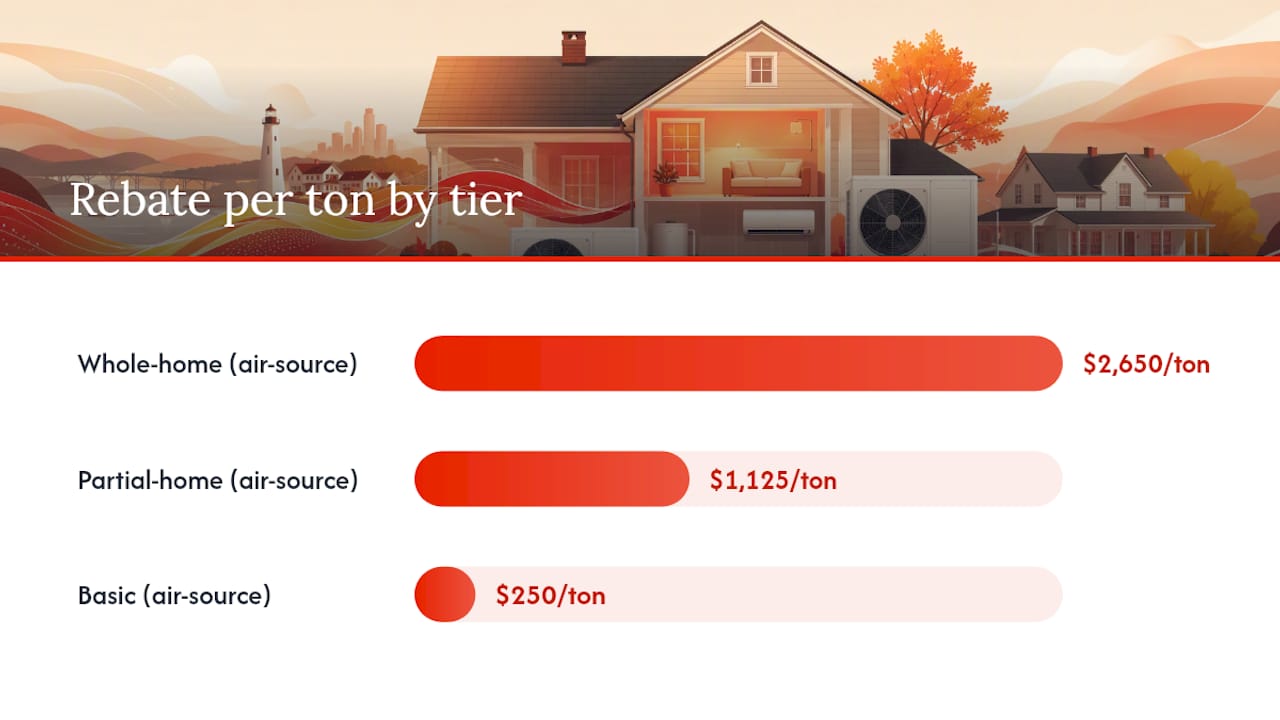
If you're a customer of an eligible Massachusetts utility sponsor and you install equipment from the Heat Pump Qualified Products List through a network installer, you're likely eligible for a Mass Save heat pump rebate worth $2,650 per ton (up to $8,500) for a whole-home installation, $1,125 per ton (up to $8,500) for partial-home, or $250 per ton (up to $2,500) for basic replacement, with income-qualified households eligible for up to $16,000.
TL;DR:
- Whole-home rebates are capped at $8,500, which applies to 2- to 3-ton systems covering the entire heating load verified by a Manual J calculation.
- Only systems on the current Qualified Products List with ENERGY STAR Cold Climate certification are eligible, and refrigerants using R-410A no longer qualify as of January 2026.
- Eligibility requires being a residential customer of a participating utility, with rebates limited to one per account and restricted to owner-occupied homes for whole- and partial-home tiers.
- Additional bonuses of $500 each for proper system sizing and weatherization work can significantly increase total incentives, but timing and documentation are crucial.
- Proper submission of documentation and pre-approval steps, including home assessments and verification forms, is critical to ensure rebate approval and to avoid delays.
Table of Contents
- What Are the Mass Save Heat Pump Rebate Amounts for 2026?
- Who Qualifies for Heat Pump Incentives in Massachusetts?
- What Equipment and Installers Qualify for Mass Save Rebates?
- How Do the Sizing and Weatherization Bonuses Work?
- What's the Application Process and Timeline?
- Prepare Your Home First: Efficiency First Checklist
- Financing and Stacking: What a Real Project Might Cost
- What Matters Most When You're Planning This Project
- Get Help Coordinating Your Mass Save Heat Pump Project
- Where to Confirm Eligibility and Submit Forms
- Sources
- FAQ
What Are the Mass Save Heat Pump Rebate Amounts for 2026?
The rebate you get depends entirely on which tier your project falls into, and that tier depends on whether the heat pump is covering your whole home's heating load or supplementing an existing fossil fuel system.
A "ton" here refers to AHRI-rated cooling capacity, not weight. One ton equals 12,000 BTU per hour. So a 2 ton ductless system qualifies for a whole-home rebate of $5,300 (2 tons times $2,650), while a 3 ton system hits the $8,500 cap even though the raw math (3 times $2,650) would technically clear it.
| Rebate tier | Amount per ton | Maximum rebate |
|---|---|---|
| Whole-home (air-source) | $2,650 | $8,500 |
| Partial-home (air-source) | $1,125 | $8,500 |
| Basic (air-source) | $250 | $2,500 |
| Income-qualified enhanced | Varies by income tier | Up to $16,000 |
These figures come directly from Mass Save's air-source heat pump program page, and sponsor-specific documents like National Grid's 2026 residential rebate summary confirm the same tiers apply across the state's major utilities.
Whole-home means the heat pump is sized and verified to carry your entire heating load with no backup fossil fuel system running in winter. Partial-home means it's supplementing an existing boiler or furnace. Basic tier typically applies to simpler single-zone replacements that don't meet whole- or partial-home documentation standards. Income-qualified homeowners can access the enhanced incentives detailed on Mass Save's enhanced rebate page, and some of those projects come with turnkey or no-cost installation options built in.
Who Qualifies for Heat Pump Incentives in Massachusetts?
Eligibility hinges on your utility account, not your address alone. You need to be a residential customer of a participating Mass Save sponsor, and the rebate application has to go through the correct account, electric or gas, per that sponsor's instructions.
The current Mass Save sponsors include major electric and gas utilities such as Eversource, National Grid, Cape Light Compact, Unitil, Berkshire Gas, and Liberty Utilities. Customers served by municipal light plants generally are not eligible for Mass Save rebates. Towns served by an MLP should check their own local efficiency program or look into the DOER MLP Z-Loan for zero-interest financing alternatives, since that gap catches a surprising number of homeowners who assume statewide programs apply everywhere.
A few other limits worth knowing before you plan a project:
- Only one whole-home rebate is allowed per utility account, ever.
- Whole- and partial-home tiers generally require the home to be owner-occupied.
- Rebates can't exceed the total documented cost of the installation.
What Equipment and Installers Qualify for Mass Save Rebates?
Not every heat pump on the market qualifies, and the list changes. Your equipment has to appear on the Mass Save Heat Pump Qualified Products List at the time of purchase, and most tiers require ENERGY STAR Cold Climate certification specifically, not just standard ENERGY STAR.
One change catches people off guard heading into 2026: systems using R-410A refrigerant were removed from the qualified list as of January 1, 2026. If a contractor is quoting older inventory, confirm the exact model number against the current HPQPL before you sign anything, because a rebate denial after installation is a far more expensive problem than a delayed order.
Beyond the equipment itself, expect these requirements:
- The installer must belong to the Mass Save Heat Pump Installer Network (HPIN).
- A load calculation following ACCA Manual J is required to confirm proper sizing.
- A Whole-Home Heat Pump Verification Form has to be completed and submitted with the application.
- Documentation should include the specific model numbers installed, matched against the HPQPL entry.
How Do the Sizing and Weatherization Bonuses Work?
Two add-on bonuses, worth $500 each, sit on top of the standard rebate tiers, and both are easy to miss if your contractor isn't paying attention to paperwork.
Undersized or oversized systems (outside that band) don't qualify, which is exactly why the load calculation needs to happen before equipment gets ordered, not after.
The weatherization bonus rewards homeowners who complete recommended insulation and air-sealing work either within the year before installation or within six months after a partial-home install. Mass Save's enhanced incentives guidance ties this timing window directly to bonus eligibility.
Income-qualified households have access to a separate enhanced pathway, with incentives reaching up to $16,000 for air-source systems, but it comes with strings: income verification and, in most cases, completed weatherization before the rebate pays out. Some enhanced projects are structured as turnkey or no-cost installs entirely.
- Sizing bonus: $500, requires 90 to 120% Manual J sizing documentation.
- Weatherization bonus: $500, requires completed work within the specified timing window.
- Enhanced incentives: up to $16,000 for income-qualified air-source projects.
Pro Tip: Ask your installer for the Manual J report as a standalone PDF, not just a line item buried in the proposal. You'll need it in writing for both the sizing bonus and the verification inspection, and chasing it down after the job is done wastes weeks.
What's the Application Process and Timeline?
Getting the rebate paid out is mostly a paperwork exercise, but the sequence matters more than most homeowners expect.
- Complete a Home Energy Assessment or decarbonization consultation before ordering equipment, since some tiers require it as a prerequisite.
- Confirm your installer is HPIN-registered and get written confirmation of the equipment model numbers against the current Qualified Products List.
- Have the installer complete the Manual J load calculation and the Whole-Home Heat Pump Verification Form for whole- or partial-home tiers.
- Submit the correct rebate form (whole-home, partial-home, or basic) through the Mass Save online portal after installation is complete.
- Keep itemized invoices showing model numbers, capacity, and any removed or disconnected heating equipment.
- Expect a verification inspection for whole- and partial-home claims before the rebate is finalized.
Under current guidance, equipment installed between January 1 and December 31, 2026 generally needs its rebate form submitted by February 28, 2027. Processing typically takes around eight weeks once a complete application is received, so submitting incomplete paperwork just to hit a deadline usually backfires and adds delay rather than saving time.
Prepare Your Home First: Efficiency First Checklist
Mass Save's Efficiency First approach exists for a practical reason: a leaky, under-insulated house makes any heat pump work harder and can disqualify you from bonus tiers. Before your installer shows up, work through this sequence.
- Schedule a no-cost Home Energy Assessment, or a decarbonization consultation if you're specifically planning whole-home electrification.
- Complete any recommended air sealing and insulation work your assessor flags as a priority.
- Request written documentation of completed weatherization work for your rebate file.
- Time the weatherization to land inside the bonus window, ideally before installation rather than scrambling after.
- Ask your installer directly whether they'll provide the Manual J calculation and verification form in writing, before you sign a contract.
Permit timing matters too. If your installer removes or disconnects an existing boiler or furnace, that needs to appear on the invoice, since some rebate reviewers check for it. Our heating upgrade checklist walks through the seasonal prep steps in more detail.
Pro Tip: A standard Home Energy Assessment is usually enough for a single mini-split addition. If you're planning to eliminate your gas or oil furnace entirely, ask for the decarbonization consultation instead. It looks at your whole heating system, not just insulation gaps.
Financing and Stacking: What a Real Project Might Cost
The Mass Save HEAT Loan offers 0% financing, with loan terms and amounts varying by income tier and sponsor. It's worth calling your sponsor's efficiency hotline directly, since terms shift year to year.
Stacking has one hard rule: you can't combine two rebates for the same piece of equipment. But separate equipment categories often stack fine. A whole-home air-source heat pump for space heating and a separate heat pump water heater are treated independently.
- Whole-home ASHP rebate: up to $8,500
- Heat pump water heater rebate: commonly around $750, per this rebate stacking example
- Total rebate value on a combined project can meaningfully cut a $20,000 to $25,000 installation's upfront cost, with HEAT Loan financing covering much of what's left.
Rebates can never exceed the documented cost of installation, so pair your budget expectations with a real quote before assuming the maximum applies.
What Matters Most When You're Planning This Project
Homeowners tend to focus on the rebate dollar amount first and the paperwork last. That's backwards. The single biggest risk in a Mass Save heat pump project isn't picking the wrong brand of equipment, it's ordering that equipment before anyone confirms sponsor eligibility, weatherization requirements, or Manual J sizing.
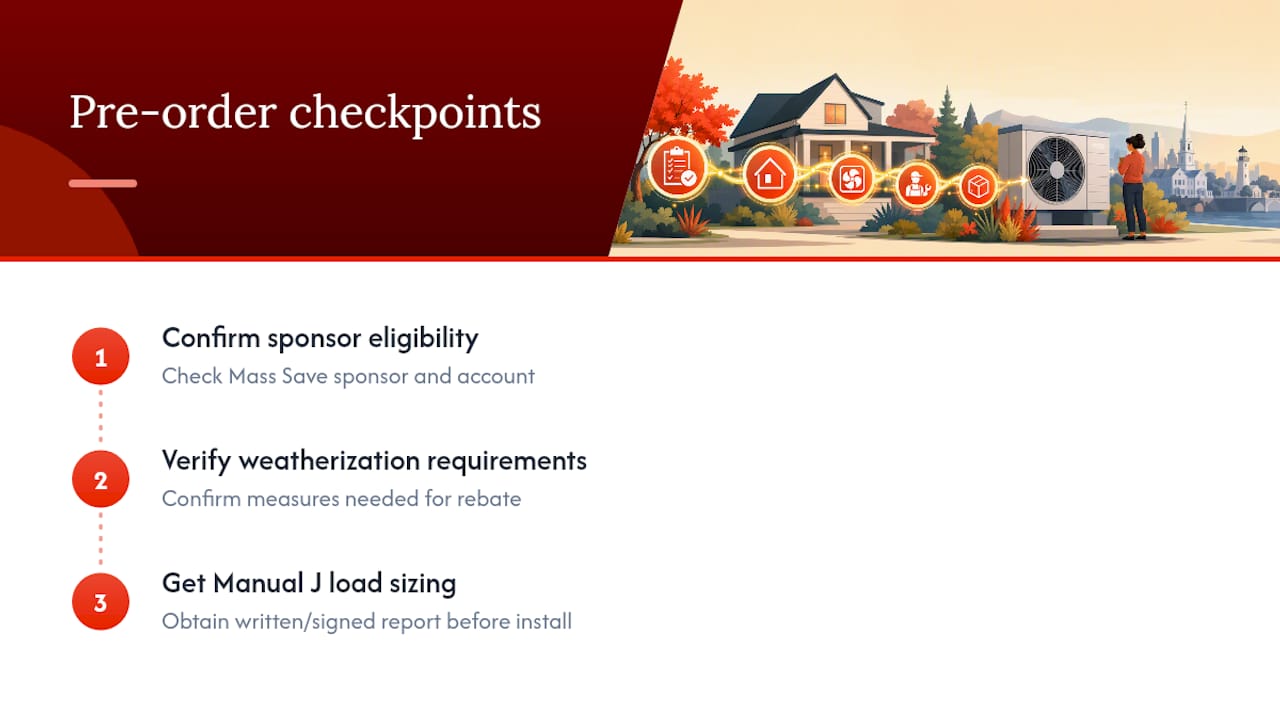
I've seen the sizing bonus alone slip through the cracks more often than any other line item, mostly because contractors treat Manual J as a formality instead of a document the homeowner actually needs in hand. Get it in writing before installation, not as an afterthought during the verification inspection.
The other pattern worth watching: assuming your town automatically has Mass Save access. Municipal light plant customers find this out the hard way, usually after they've already bought equipment. Confirm your sponsor and the correct account, electric or gas, before you spend a dollar.
— Matt
Get Help Coordinating Your Mass Save Heat Pump Project
Mass Save's paperwork rewards homeowners who prepare their documentation early. A licensed team can assist with coordinating Home Energy Assessments, Manual J load calculations, and preparing documentation that meets Mass Save verification requirements.
Our team installs ductless mini-splits and multi-zone systems from the current Qualified Products List, and we handle the heating system transition work, including disconnecting old boilers or furnaces, that rebate reviewers look for on your invoice. Work is done with older housing stock in Arlington, where sizing and weatherization requirements can be more complex.
Customers can schedule a consultation to discuss which rebate tier fits their home before ordering equipment.
Where to Confirm Eligibility and Submit Forms
Start with Mass Save's air-source heat pump page for current rebate tiers, the Qualified Products List, and sponsor links. Check the enhanced incentives page if you may qualify for income-based rebates. Keep your installer's contact information and itemized invoices on hand for submission and inspection.
Sources
- Air Source Heat Pumps | Residential | Mass Save
- 2026 Residential Rebates - Mass Save (National Grid PDF)
- Heatpumppricing
FAQ
Are Heat Pump Rebates Still Available in Massachusetts?
Yes, Mass Save's air-source heat pump rebates remain active for 2026, with whole-home incentives up to $8,500 and income-qualified enhanced incentives reaching up to $16,000. Eligibility depends on your utility sponsor and using an HPIN-registered installer.
Will Mass Save Rebates Continue Into 2026?
Current guidance covers equipment installed through December 31, 2026, with rebate forms generally due by February 28, 2027. Rebate amounts and qualified equipment lists are updated periodically, so confirm the current tier and Qualified Products List before finalizing a purchase.
Where Do I Find the Mass Save Commercial Heat Pump Rebate Form?
Commercial rebate forms and applications are separate from the residential programs covered here and are available through your utility sponsor's commercial and industrial program pages. Residential whole-home, partial-home, and basic forms are accessible through the Mass Save air-source heat pump page.
Will There Be Federal Rebates for Heat Pumps in 2026?
Federal heat pump incentive programs have shifted in recent years, and availability depends on current federal legislation and funding status. Check with your installer or a tax professional for the most current federal eligibility rules, since they operate independently of the Massachusetts state incentives detailed here.
Can Mystic Valley Home Services Help Me Apply for Mass Save Rebates?
Mystic Valley Home Services coordinates the documentation Mass Save requires, including Manual J load calculations and installation invoices, for ductless mini-split and multi-zone projects. Reach out directly to confirm current pricing and scheduling for your specific project.