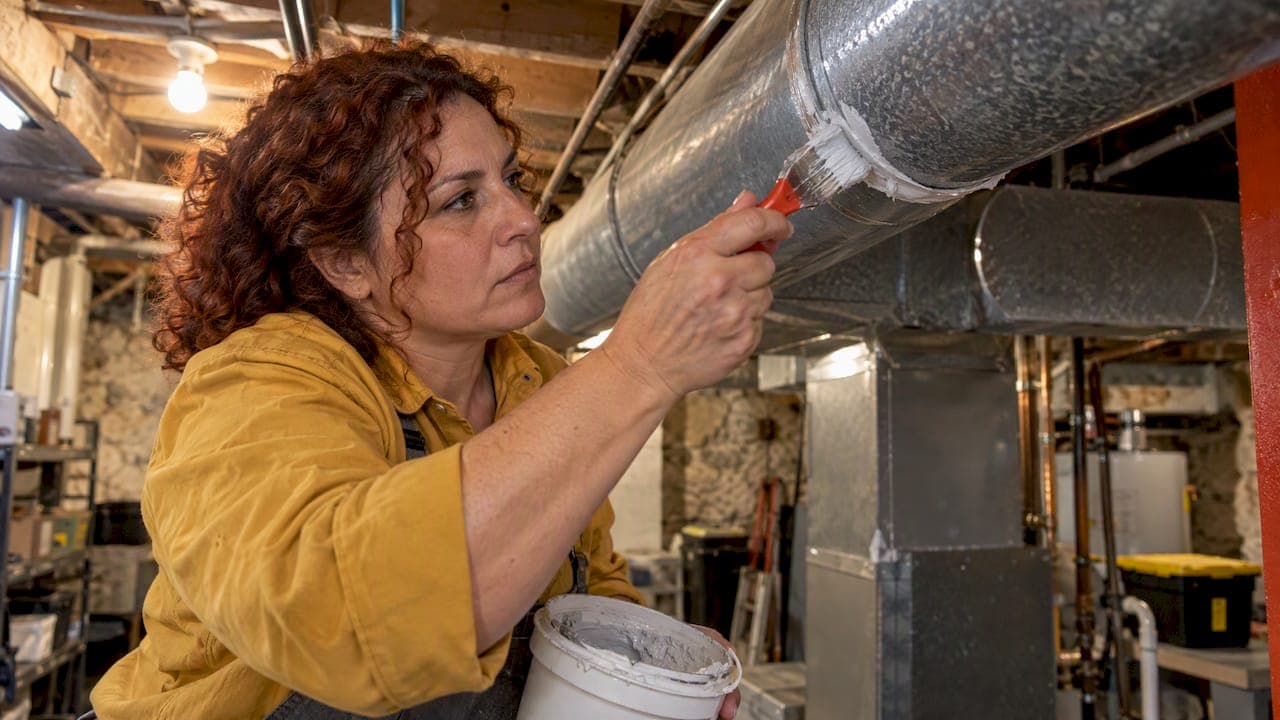
Sealing leaky ductwork lowers wasted heating and cooling, evens out room temperatures, keeps attic and basement dust out of your air, and protects gas appliances from backdrafting. The size of the payoff depends on where your ducts run, how leaky they are, and whether the job is done in the right order. This guide covers each benefit, the limits nobody mentions, and what a good job looks like in a Massachusetts home.
TL;DR
- Typical homes lose 20% to 30% of conditioned air through leaks, holes and poorly connected ducts, so sealing targets a real source of waste.
- Benefits go beyond the bill: steadier room temperatures, less dust, and lower backdrafting risk from gas appliances.
- Use mastic or foil-backed tape. Cloth duct tape often fails within months.
- Ask for an airflow check and combustion safety testing before and after sealing.
- Professional sealing runs $500 to $4,000 nationwide, averaging about $2,250.
Table of Contents
- What duct sealing actually is
- Benefit 1: Lower energy waste
- Benefit 2: Steadier comfort, room by room
- Benefit 3: Cleaner indoor air
- Benefit 4: A safety margin for gas appliances
- Benefit 5: Less strain on your equipment
- Benefit 6: You find other problems
- What duct sealing will not do
- Tape, mastic and aerosol: what to insist on
- What it costs
- Our perspective
- Get your system checked first
- Business owners: ducts in commercial buildings
- How to hire for a sealing job
- FAQ
- Sources
What duct sealing actually is
If your home has forced-air heating or cooling, ducts carry conditioned air from the furnace or air handler to each room. Over time, joints loosen, seams split, and connections at the equipment or at registers come apart. Air escapes into attics, crawlspaces, basements and wall cavities, where it does nothing for you.
Duct sealing closes those gaps. There are two main ways to do it:
- Manual sealing: a technician applies mastic (a thick paste) or foil-backed tape to seams, joints and connections they can reach.
- Aerosol sealing: a sealant is sprayed as a fog inside the duct system under pressure and collects at the leaks. It reaches spots no one can get to by hand.
Research from building science work supported by the U.S. Department of Energy shows aerosol sealing is effective for hidden leaks but does not replace manual sealing at the air handler, return plenum and register connections. The best results often combine both.
Benefit 1: Lower energy waste
This is the benefit every competing page leads with, and it is real. ENERGY STAR reports that in a typical house about 20 to 30 percent of the air moving through the duct system is lost to leaks, holes and poor connections. Your equipment burns fuel or electricity to heat or cool air that never reaches a room.
How much you save depends on where the ducts are. A Lawrence Berkeley National Laboratory summary from the Department of Energy puts heating and cooling savings from sealing basement ducts at roughly 10%, and ducts in attics and crawlspaces typically have more to gain because they sit in harsher, unconditioned space.
Some contractor pages promise a flat 20% savings. Treat that as a best case, not a guarantee. A system with short, tight ducts inside the heated envelope has little to recover. A system with long runs through a cold attic or an unfinished basement has a lot.

Why Massachusetts homes are a special case
Our winters are long, so a duct leak in an unheated space works against you for months. Many older homes also have ductwork added decades after the house was built, squeezed through basements, knee walls and attic eaves, with plenty of joints to fail. That is the situation where sealing and insulating ducts tends to matter most.
Benefit 2: Steadier comfort, room by room
Have you got a bedroom that never warms up in January or a bonus room that bakes in August? Leaks are one common cause. When a branch duct loses a lot of air before it reaches the register, the room at the end of the run gets less than it was designed to get.
Sealing sends more of the air to where it was meant to go. ENERGY STAR notes that sealing and insulating ducts can help with common comfort problems, such as rooms that are too hot or too cold.
Be realistic, though. Sealing does not fix an undersized duct, a closed damper, a bad return layout, or a room with poor insulation. If comfort is your main complaint, a good technician will look at all of those, not just the leaks.
Benefit 3: Cleaner indoor air
Return ducts pull air back to the furnace or air conditioner. If a return runs through a dusty attic, crawlspace or garage and has gaps, it pulls whatever is in that space into the system and then into your rooms. That can include insulation fibers, dust and other contaminants.

ENERGY STAR lists improved indoor air quality among the benefits of a sealed duct system, and it is most useful for households with asthma or allergies. Sealing is not a substitute for filtration or for cleaning an already dirty duct system, but it stops the system from drawing new debris in.
Benefit 4: A safety margin for gas appliances
This is the benefit that gets the least attention and deserves the most. When leaky ducts sit in an unconditioned space, they can change the air pressure in the home. In some cases that pulls combustion gases from a gas water heater or furnace back into the living space instead of venting them outside, a problem called backdrafting. ENERGY STAR describes this as one of the safety reasons to seal ducts.
The Department of Energy's measure guideline for sealing ducts in existing homes goes further: combustion safety tests should be done before and after sealing, because changing the airflow can change how appliances vent.
If you have a gas or oil appliance, carbon monoxide alarms on every level and near sleeping areas are not optional. If an alarm sounds, leave the house and call 911 or your gas utility's emergency line. Do not troubleshoot it yourself.
Benefit 5: Less strain on your equipment
A system that loses a quarter of its air has to run longer to hit the thermostat setting. More runtime means more wear on the blower, the compressor and the heat exchanger. Tightening the ducts takes some of that load off.
There is a second, less obvious payoff. Building science guidance notes that sealing leaky ducts can open the door to smaller, more efficient equipment when a furnace or air conditioner is replaced, because the system no longer has to make up for losses. That is a strong reason to fix the ducts before you buy new equipment, not after.
Humidity in summer
Right-sized equipment also removes moisture better. An oversized air conditioner cools the air fast, shuts off, and leaves the house clammy. If you are weighing how much humidity control your home needs, a dehumidifier sizing chart with cost per pint helps you work out what capacity makes sense alongside your HVAC.
Benefit 6: You find other problems
Testing and sealing put a technician inside the duct system. That is often when they spot crushed flex duct, disconnected branches, missing insulation, a rusted plenum, or a dirty evaporator coil. Finding those during a sealing visit can save you a separate service call later.
What duct sealing will not do
Sealing is not a cure-all, and a trustworthy contractor will say so.
- It will not fix a failing furnace, boiler or compressor.
- It will not correct undersized or badly routed ducts.
- It will not replace attic or wall insulation.
- It may not pay for itself quickly in a house with ducts entirely inside conditioned space.
It also carries a risk when done carelessly. The Department of Energy guideline warns that sealing a very leaky system raises static pressure, which can restrict airflow across the evaporator coil. Unmanaged, that can mean frozen coils, compressor damage and poor dehumidification. This is why an airflow check belongs before the work, not after a complaint.
Tape, mastic and aerosol: what to insist on
Most homeowners assume cloth-backed duct tape is the right sealant. It is not. Lawrence Berkeley National Laboratory testing, summarized in ASHRAE Journal, found that standard duct tape often fails under real duct temperatures and pressures, and some energy codes prohibit it. Look for:
| Method | Best for | Watch for |
|---|---|---|
| Mastic paste | Seams, joints, plenum connections you can reach | Needs clean, dry surfaces and full coverage |
| Foil-backed tape (listed) | Straight seams and some connections | Poor adhesion on dusty or damp metal |
| Aerosol sealing | Hidden leaks in cavities and walls | Does not replace manual sealing at the equipment |
| Cloth duct tape | Nothing permanent | Fails within months |
What it costs
Angi's 2026 cost guide puts professional duct sealing at $500 to $4,000 nationwide, with an average around $2,250. The spread depends on home size, how accessible the ducts are, and whether the work is manual or aerosol. Those are national averages, not Massachusetts quotes, so get a written scope and price from a local licensed contractor.
Before you pay, check with your electric or gas utility about efficiency programs and incentives, since they change from year to year and are not always available for sealing alone.
Is it worth it? The strongest cases are:
- Ducts run through an attic, crawlspace or unfinished basement.
- Your energy bills are high for the house's size.
- Some rooms are always too hot or too cold.
- You are about to replace a furnace, boiler-based air handler or air conditioner.
- You see heavy dust around registers or have allergy concerns.
Our perspective
We work on Massachusetts heating and cooling systems every week, and in Arlington's older homes we see the same patterns. Ductwork was added late, routed through whatever space was left, and nobody has looked at it in years. Homeowners call about a cold room or a high bill and assume they need new equipment.
Our advice is to diagnose before you spend. Measure airflow, check combustion safety on any gas or oil appliance, look at the duct runs, and only then decide between sealing, repair or replacement. Equipment sized to a leaky system is a mistake you pay for every month. That is also why we point homeowners toward contractors who do load calculations, as we explain in our guide to choosing an HVAC contractor.
Duct sealing is not a listed service line on our site. What we do offer is the diagnostic work around it: heating and cooling tune-ups, system diagnostics and safety checks. Our team is licensed and insured in Massachusetts, family-owned, and the owner stays involved in the work. We would rather tell you your ducts are fine than sell you a job you do not need.
— Matt
Get your system checked first
If you suspect leaky ducts, start with the equipment they serve. Our heating services cover annual tune-ups and furnace and boiler repair, our cooling services cover AC diagnostics and multi-zone system design, and our safety inspections include boiler and water heater safety checks. We offer same-day or next-day service and upfront pricing. You can start at Mystic Valley Home Services to book a visit.
For homeowners comparing service plans, our breakdown of HVAC maintenance contract costs shows what a yearly check should include.
Business owners: ducts in commercial buildings
The same logic applies to offices, shops and light commercial space. Leaky ducts waste energy, create hot and cold tenant complaints and strain rooftop or air handler equipment. Our write-up on common commercial HVAC failures covers early warning signs you can catch before a breakdown.
How to hire for a sealing job
- Ask for testing. A duct leakage test before and after shows what changed, rather than guessing.
- Ask about airflow. The contractor should check static pressure and airflow, not just seal.
- Ask about combustion safety. Any home with a gas or oil appliance needs it tested before and after.
- Ask what sealant is used. Mastic or listed foil tape, never cloth duct tape.
- Ask for a written scope. It should state which ducts, which connections and what price.
- Confirm licensing and insurance. In Massachusetts, check the license before work starts.
FAQ
Is sealing air ducts a good idea?
Usually yes, when ducts run through unconditioned space and leak. ENERGY STAR says typical homes lose 20% to 30% of their duct air, so there is often real waste to recover. It is less valuable when ducts are short, tight and already inside the heated part of the house.
How long does duct sealing last?
Mastic and foil-backed tape are meant to be long-term fixes, while cloth duct tape often fails within months. Lifespan depends on the materials, the surface prep and whether ducts get disturbed later by other work. Ask your contractor what warranty comes with the job.
How much does it cost to have your air ducts sealed?
Angi reports a national range of $500 to $4,000, averaging about $2,250. Home size, access and method drive the price. Get a written local quote that lists the scope.
What are the benefits of using duct sealant?
The main ones are less wasted conditioned air, more even room temperatures, less dust drawn in from attics and crawlspaces, and lower backdrafting risk. It can also reduce runtime on your equipment and may let you choose smaller replacement equipment. It works best with airflow and combustion safety testing.
Sources
- ENERGY STAR: Benefits of Duct Sealing
- ENERGY STAR: Duct Sealing
- Angi: How Much Does Air Duct Sealing Cost?
- U.S. DOE Building America: Measure Guideline, Sealing and Insulating of Ducts in Existing Homes
- Air Distribution Retrofit Strategies for Affordable Housing
- ASHRAE Journal on duct tape durability (LBNL)
- LBNL: Remote Duct Sealing in Residential and Commercial Buildings
- OutletPicks: Dehumidifier sizing chart