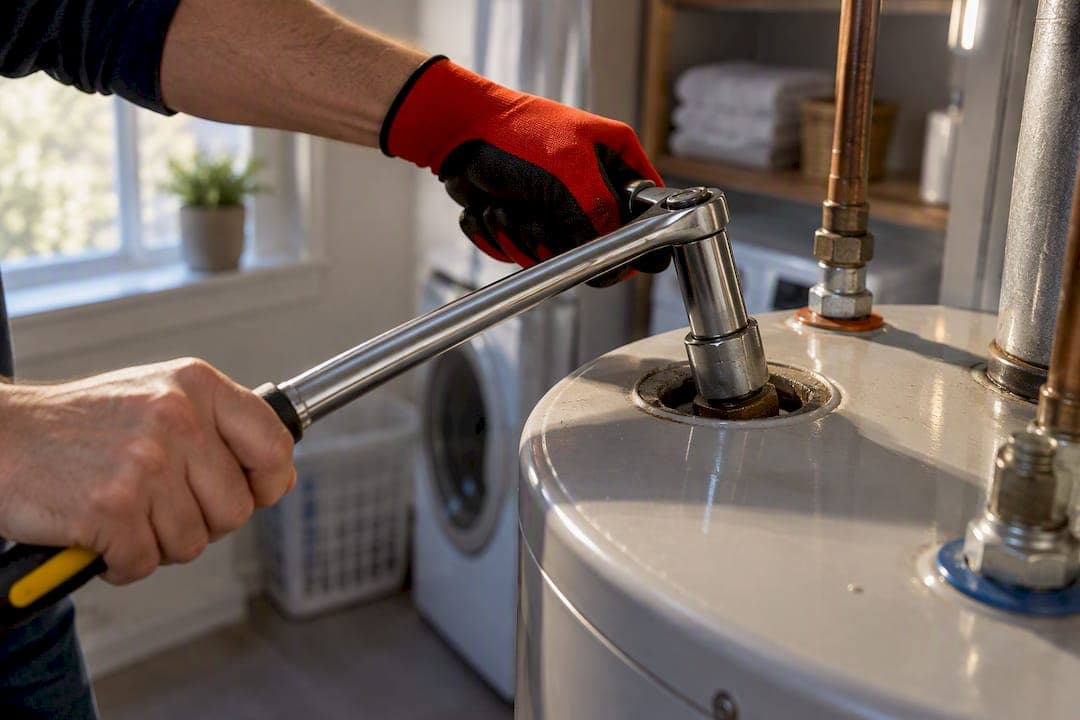
Yes, replacing your water heater's anode rod is a job most homeowners can handle in about an hour with basic tools, and it costs a fraction of what a new tank runs. Before you start, shut off the power or gas and check the tank itself for rust streaks or active leaks. If the tank shows exterior corrosion or the rod won't budge with normal leverage, that's your cue to call a plumber instead of pushing harder.
TL;DR:
- Replacing your water heater’s anode rod is generally easy and affordable but becomes difficult if the rod is seized or the tank shows rust or leaks.
- Inspection every three to five years is recommended, with more frequent checks if you have a water softener or well water that accelerates corrosion.
- Use a 1-1/16 inch socket, impact wrench, and proper safety steps, and be prepared to call a professional if the rod is tightly stuck or if there is visible tank deterioration.
- Magnesium rods are standard but consider aluminum-zinc or powered options based on water conditions, and measure ceiling clearance beforehand for proper tool use.
- DIY replacement costs about $20-$50 for parts, while professional service typically ranges from $200 to $300, especially when access is constrained or the rod is stuck.
Table of Contents
- When Should You Replace the Anode Rod?
- What Tools and Safety Steps Do You Need Before Starting?
- How Do You Replace an Anode Rod Step by Step?
- What If the Anode Rod Won't Budge?
- Which Anode Rod Type Should You Buy?
- DIY vs. Hiring a Pro: What Does Anode Rod Replacement Cost?
- What We See in the Field
- Get Help With Anode Rod Replacement or a Full Water Heater Check
- Where This Guide's Information Comes From
- Sources
- FAQ
When Should You Replace the Anode Rod?
Most manufacturers recommend pulling the anode rod for inspection every three to five years, but that window shrinks if you have a water softener or well water. Softened water strips the magnesium coating faster because it swaps calcium and magnesium ions for sodium, which speeds up the electrochemical reaction the rod is designed to absorb. Hard water does the opposite, coating the rod in mineral scale that can mask how much sacrificial metal is actually left.
Pull the rod out and look at it under good light. Replace it if you see any of these signs:
- More than six inches of the steel core wire exposed, with little magnesium or aluminum left around it
- The rod has worn down to roughly half an inch in diameter or less
- Heavy pitting, flaking, or a thick calcium crust coating most of the rod's length
- Your hot water smells like rotten eggs or comes out with a rusty tint
This Old House sets the inspection benchmark at three to five years, with the six-inch exposed-wire and half-inch diameter thresholds as the clearest signs it's time to swap the rod rather than reinstall it.
What Tools and Safety Steps Do You Need Before Starting?
Gather everything before you touch the tank. You'll need a 1-1/16 inch six-point deep socket (the standard size for most residential anode heads), a breaker bar or impact wrench, a cheater pipe for extra leverage, a garden hose, a bucket, Teflon tape, an adjustable wrench, and penetrating oil for a rod that's rusted in place. Skip the six-point socket at your own risk. A twelve-point or standard socket tends to strip the hex head on a corroded rod, and then you're dealing with a much bigger problem.
Before you loosen anything:
- Shut off the water heater's power at the breaker, or turn the gas control to "pilot" or off.
- Close the cold-water shutoff valve feeding the tank.
- Open a hot water faucet somewhere in the house to relieve pressure.
- Check the temperature and pressure relief valve to confirm the tank has depressurized.
- Let the water cool for at least 30 minutes if you've run hot water recently.
Measure the ceiling clearance above the tank before you buy a replacement rod. Some installations leave less than 44 inches, not enough room to pull a rigid rod straight up.
Pro Tip: Check your warranty paperwork before you start. Some manufacturers require the anode rod to be serviced by a licensed technician to keep the tank warranty valid, even though the part itself is simple to swap.
How Do You Replace an Anode Rod Step by Step?
Once you've killed the power or gas and relieved pressure, the actual swap follows a predictable sequence whether you're working on a top-mounted hex rod or a combination rod threaded into the hot-water outlet.
- Connect a garden hose to the tank's drain valve and route it to a floor drain or outside.
- Drain two to five gallons of water for a top-port rod, or drain the tank fully if you're working through a side-port or combo anode.
- Remove the plastic cap or insulation covering the anode head, usually located on top of the tank.
- Identify the rod type. A dedicated hex-head anode sits in its own port; a combo anode is built into the hot-water outlet nipple.
- Fit the 1-1/16 inch six-point socket onto the hex head and break it loose with a breaker bar or impact wrench, turning counterclockwise.
- Have a helper brace the tank if it starts to twist. A tank that spins on its base can stress the water and gas connections.
- Once loose, pull the old rod out slowly. Long rods may need to be angled out in sections if ceiling clearance is tight.
- Inspect the rod against the thresholds above. If it still has substantial magnesium or aluminum coating, you can reinstall it.
- Wrap the new rod's threads with several wraps of Teflon tape, working clockwise so the tape doesn't unwind as you thread it in.
- Hand-thread the rod into the port, then snug it with the socket and breaker bar. Don't over-torque. Snug is enough.
- Close the drain valve, disconnect the hose, and open the cold-water supply to refill the tank.
- Open the hot water faucet you used earlier and let it run until air stops sputtering out, confirming the tank is full.
- Restore power at the breaker, or relight the pilot and return the gas control to its normal setting.
Refilling and purging air correctly matters as much as the removal. Howtodrainahotwaterheater recommends running the hot tap until the flow is steady and air-free before you consider the job finished. If your unit is gas-fired and the pilot went out during the process, our guide on relighting a water heater pilot walks through the safe restart sequence.
What If the Anode Rod Won't Budge?
A rod that's been in place for eight or ten years can seize hard enough to defeat a standard breaker bar. Switch to an impact wrench paired with an impact-rated six-point socket. The hammering action often shocks corrosion loose that steady torque alone won't move. A cheater pipe slipped over your breaker bar adds leverage, and sometimes tightening the rod slightly before loosening it breaks the corrosion bond in the opposite direction.
The tank itself is often the harder problem to control. A helper bracing the tank with their body weight works for lighter units, but a ratchet strap cinched around the tank and anchored to something solid holds it steadier under real torque and reduces the risk of stressing the water or gas fittings, a trick This Old House technicians rely on for stubborn rods.
Stop and call a professional if:
- The tank rotates and you feel resistance building in the pipe connections
- You see rust streaks or moisture on the tank's exterior shell
- You're not comfortable running an impact wrench near gas lines
Pro Tip: If the standard hex-head rod truly won't turn, some tanks let you replace the anode via the hot-water outlet nipple instead, using a combo rod. It's a workaround, not always an option, so check your tank's configuration first.
Which Anode Rod Type Should You Buy?
- Magnesium rods offer the strongest general corrosion protection and are the factory-standard choice for most tanks, though they can react with certain bacteria to produce a sulfur odor in some water systems.
- Aluminum-zinc rods wear down more slowly, hold up better in hard water, and often eliminate the rotten-egg smell that magnesium can trigger.
- Powered (impressed-current) anodes use an electrical current instead of sacrificial metal, lasting far longer and never needing periodic replacement, at a higher upfront cost.
- Flexible, segmented rods bend to clear low ceilings and tight utility closets. Energy Vanguard points to these as the standard fix for basements and closets with limited overhead room.
Measure your clearance and check your water's smell and hardness before choosing. Switching rod types is one of the simplest upgrades in home plumbing, and it solves problems a straight swap of the same rod never will.
DIY vs. Hiring a Pro: What Does Anode Rod Replacement Cost?
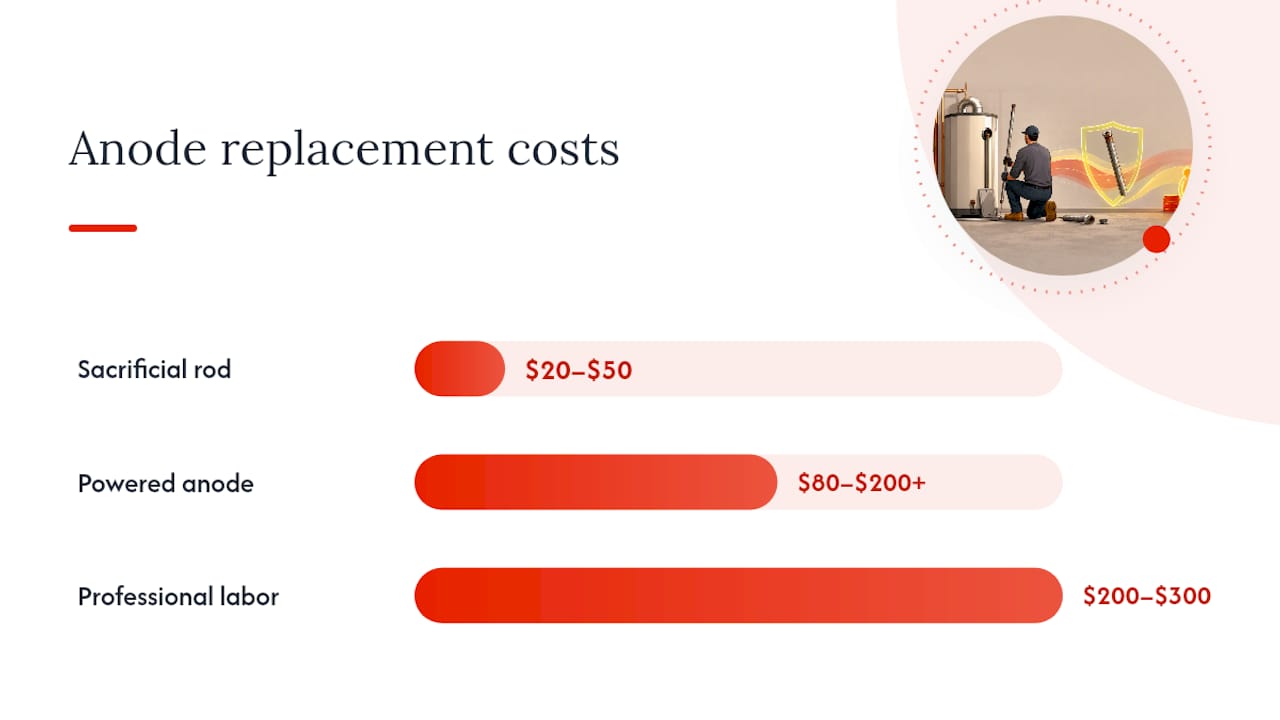
A sacrificial magnesium or aluminum-zinc rod runs roughly $20 to $50, while a powered anode costs $80 to $200 or more depending on tank size. Angi puts professional labor for this job at $200 to $300 on average, with harder access or a seized rod pushing costs higher.
Time-wise, budget about an hour for a straightforward swap on an easily accessible tank. Add 30 minutes or more if the rod is corroded in place or clearance is tight.
Hire a professional when:
- The rod won't loosen with a breaker bar and cheater pipe
- Ceiling clearance rules out even a flexible rod
- You see rust or active leaking on the tank's exterior, which usually points to a failing tank rather than a spent anode
- You don't own or want to rent an impact wrench
Pairing the anode swap with a full sediment flush, as Spring HVAC & Ventilation Maintenance Checklist for Nova Scotia Homes notes, tackles two of the most common failure points in one visit and gets more value out of the time the tank is already drained.
What We See in the Field
Some plumbing service providers keep spare flexible anode rods and Teflon tape stocked on their trucks, because tight basements and low utility closets are common in older Massachusetts homes. Rods that look fine on the surface often hide a stripped core once you pull them, which is why we treat inspection as its own task, not an afterthought tacked onto a repair call. Regular anode checks, paired with a sediment flush, catch the two failure modes that shorten a tank's life the most.
— Matt
Get Help With Anode Rod Replacement or a Full Water Heater Check
If your anode rod is seized, your ceiling clearance won't allow a rigid replacement, or you'd rather not crack open a pressurized tank yourself, Mystic Valley Home Services handles the whole job, from inspection through flexible rod installation to a full tank condition check.

The team is based in Massachusetts and familiar with tight mechanical rooms, low basement ceilings, and older housing stock typical of the area. Same-day and next-day appointments are available for active leaks or a rod that's fought you to a standstill, and routine anode checks can be scheduled alongside your regular maintenance visit. Upfront pricing means you know the cost before any tool touches the tank. If you'd rather have a technician handle the anode rod, flush the sediment, and confirm the tank's overall condition in one visit, book a water heater service appointment and we'll take it from there.
Where This Guide's Information Comes From
For deeper technical detail, see This Old House, Angi, Sears Parts Direct, Energy Vanguard, and HowToDrainAHotWaterHeater.com.
Sources
- How to replace an anode rod on a water heater | This Old House
- Howtodrainahotwaterheater
- How to replace an anode rod in a water heater | Angi
- How to replace an electric water heater anode rod | Repair guide (Sears Parts Direct)
FAQ
Can I Replace an Anode Rod Myself?
Yes, most homeowners can replace an anode rod with a 1-1/16 inch socket, a breaker bar or impact wrench, and about an hour of time. Call a plumber if the rod is seized solid or the tank itself shows rust or leaking, since that usually signals a bigger problem than the anode.
How Often Should You Replace Your Anode Rod?
Inspect it every three to five years, checking sooner (every one to two years) if you have a water softener or well water. Replace it once more than six inches of core wire is exposed or the rod thins to about half an inch in diameter.
How Much Does It Cost to Replace an Anode Rod?
A sacrificial anode rod typically costs $20 to $50, while powered anodes run $80 to $200 or more. That's a small price against replacing an entire water heater.
How Much Does a Plumber Charge to Change an Anode Rod?
Professional installation commonly runs $200 to $300, depending on tank access and how corroded the old rod is. Mystic Valley Home Services offers same-day scheduling for stuck rods and can quote your specific job through its water heater services page.