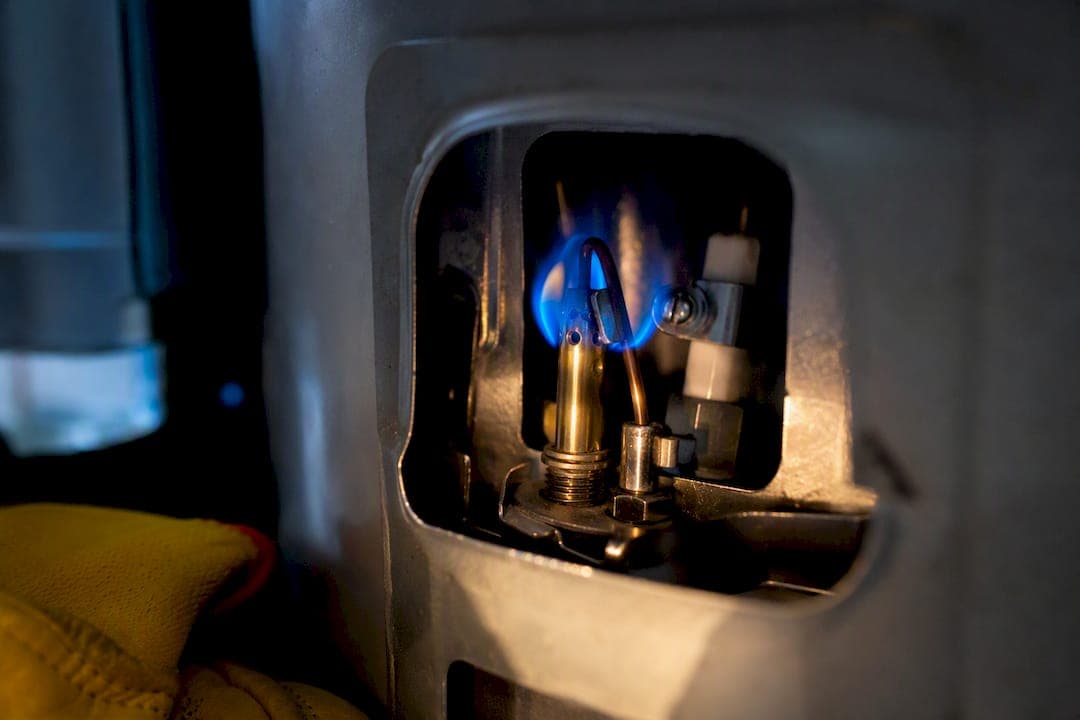
Most homeowners can relight a standing-pilot water heater quickly by following the relight sticker on the tank. Turn the gas control to OFF, wait 5 to 10 minutes, then switch to PILOT and hold the knob down for 30 to 60 seconds while you ignite it. If you smell gas at any point, stop immediately, leave the house, and call your gas utility or 911 from outside. And if the pilot won't hold after two or three tries, quit troubleshooting and call a licensed plumber.
TL;DR:
- Most pilot outages are caused by a failing thermocouple, a clogged pilot orifice, or drafts disturbing combustion, not gas pressure issues.
- If the pilot won't stay lit, replacing the thermocouple typically costs $150 to $350, including diagnosis and labor, whereas debris cleaning is cheaper and simpler.
- Outside causes like air drafts from bathroom fans or vents can weaken or extinguish the pilot, and sealing or adjusting airflow often resolves the issue without expensive repairs.
- If you smell gas at any point, evacuate immediately and call emergency services; do not attempt to troubleshoot or relight until the area is confirmed safe.
- After 2 to 3 relight attempts or a gas smell, hiring a licensed professional is essential for accurate diagnosis and safe repair, especially for gas pressure or venting problems.
Table of Contents
- How to Relight a Standing-Pilot Water Heater
- Why Does the Water Heater Pilot Keep Going Out?
- What to Do If You Smell Gas Near the Water Heater
- Standing Pilot vs. Electronic Ignition: Know Your System First
- When to Stop Troubleshooting and Call a Plumber
- What Mystic Valley Home Services Sees on Water Heater Calls
- Why the Standard Advice on Pilot Lights Undersells the Draft Problem
- Get Professional Help With Your Water Heater Pilot Light
- Sources
How to Relight a Standing-Pilot Water Heater
Before you touch anything, find the small sticker on the front of your tank, usually near the gas control valve. Every manufacturer writes slightly different instructions, and the sticker on your specific unit overrides anything you read online, including this article. Use it as your master reference and treat the steps below as the general version of what it says.
Here's the procedure most standing-pilot gas water heaters follow:
- Turn the gas control knob to OFF. Then wait 5 to 10 minutes. This isn't a suggestion you can skip to save time. It gives any residual gas in the burner chamber time to clear before you introduce a flame, and it's a step Barnett Plumbing's relight guide treats as mandatory, not optional.
- Locate the pilot opening with a flashlight while you wait. It's usually a small tube near the burner assembly, visible through the access panel or a viewing window at the base of the tank.
- Turn the control knob to PILOT. This is a separate position from OFF and ON, and most models require you to push the knob in before it will rotate that far.
- Depress the control knob and ignite the pilot. Some units have a built-in piezo igniter (a red button you press), others need a spark igniter, and older units require a long lighter held to the pilot opening. Hotwater walk through all three ignition types.
- Hold the knob down for 30 to 60 seconds after the pilot lights, then release it slowly. This is the step most people rush, and rushing it is the single most common reason a pilot lights and then dies the moment you let go. The thermocouple needs that time to heat up enough to hold the gas valve open on its own.
- Turn the knob to ON once the pilot stays lit without you holding it down.
Once the water heater is running, do a quick visual check before you walk away:
- Confirm you can see a steady blue flame through the sight glass.
- Replace the outer access cover and make sure it's seated correctly.
- Run a hot water tap somewhere in the house and listen or feel for the main burner kicking on.
If your water heater has a digital display, status lights, or no visible pilot opening at all, stop here. You have an electronic-ignition unit, and standing-pilot steps won't apply to your system. The section below on identifying your ignition type will point you in the right direction.
Why Does the Water Heater Pilot Keep Going Out?
A pilot that won't stay lit is telling you something specific, and the flame itself is usually the first clue. A healthy pilot burns a steady, tight blue cone, roughly an inch tall, with the tip touching or just wrapping around the thermocouple. If your flame looks weak, flickers wildly, or burns yellow or orange, you're looking at a combustion problem, not just bad luck.
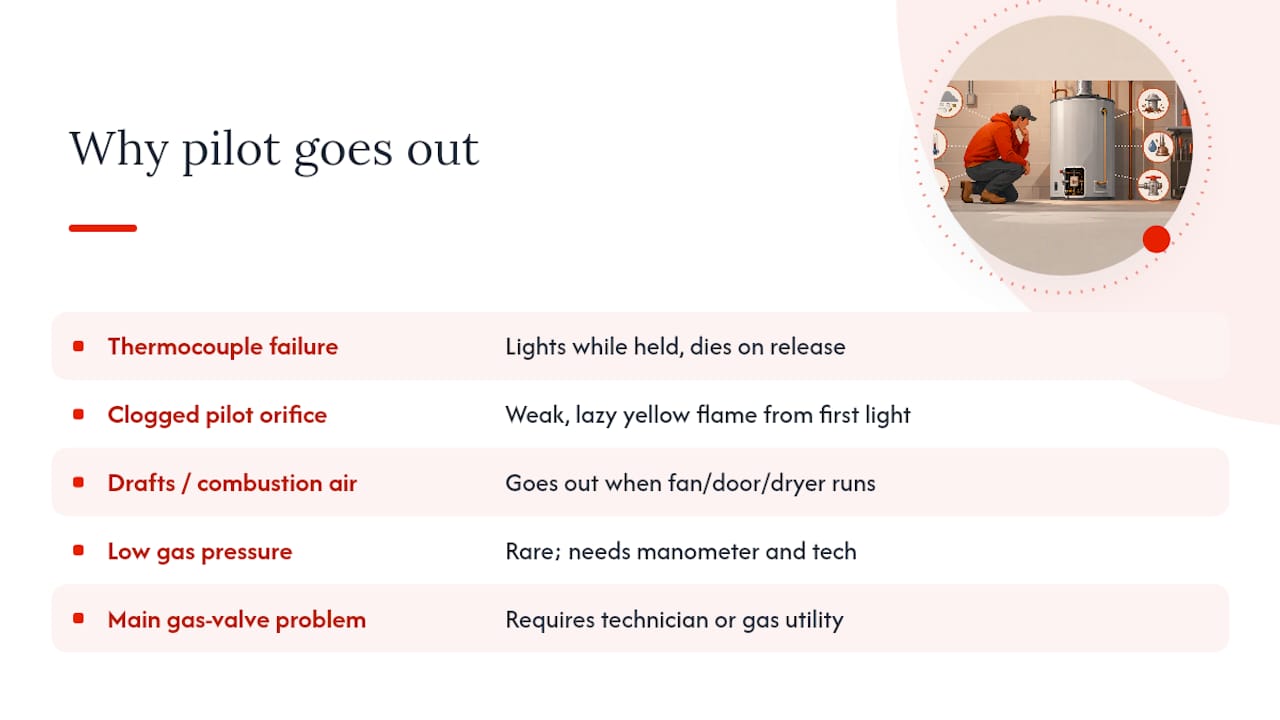
Thermocouple failure is the most common culprit. The telltale sign: the pilot lights fine while you're holding the knob down, but it dies the instant you let go. That's the thermocouple failing to signal the gas valve that a flame is present, so the valve shuts off gas as a safety response. The part itself is cheap, often $8 to $25, but a professional replacement including labor typically runs $150 to $350 once you factor in diagnosis and the safety checks a tech will run alongside it.
A clogged pilot orifice looks different. Instead of dying on release, the flame burns weak, lazy, and often yellow instead of blue from the moment you light it. Dust, lint, or rust flakes inside the small opening restrict gas flow enough to starve the flame. You can sometimes clear light debris with a soft brush or a blast of compressed air, but the orifice sits in a tight space next to a gas line, and forcing a wire into it risks damaging the opening permanently. That's a job better left to a technician with the right tool for it.
Drafts and combustion-air issues show a pattern worth tracking: does the pilot go out around the same time you run the bathroom fan, open a nearby door, or turn on the clothes dryer? If yes, you're dealing with air movement disturbing the flame or disrupting the draft hood above the burner, not a mechanical failure. Closing nearby doors and vents during the coldest months is a short-term fix, but a heater installed in a tight closet with poor air supply needs a longer-term ventilation fix.
Low gas pressure is rarer and harder to diagnose without a manometer, and it sits outside what any homeowner can safely test. The same goes for main gas-valve problems. Both need a technician or a call to your gas utility, according to Venta's breakdown of pilot-light causes.
Pro Tip: Keep a one-line log on your phone every time the pilot goes out: date, time, and what was happening in the house. Three entries in, you'll usually see whether it's a draft pattern or a thermocouple that's simply wearing out.
What to Do If You Smell Gas Near the Water Heater
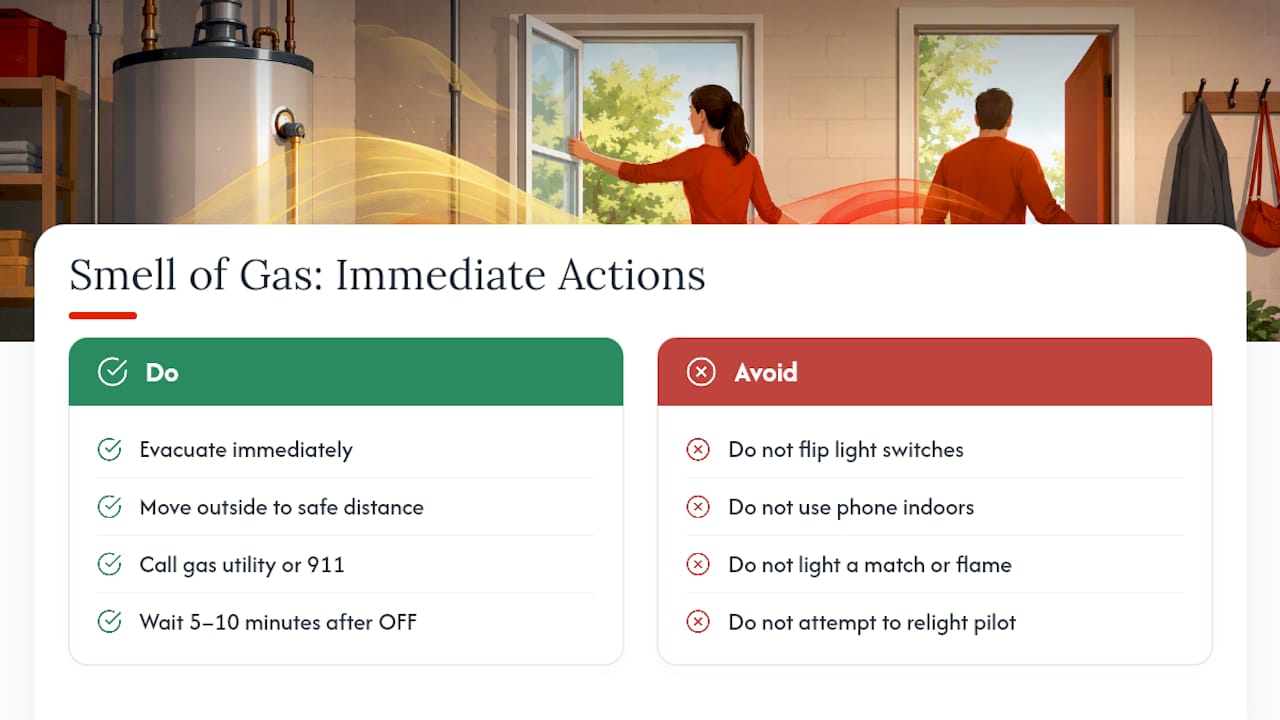
There's exactly one correct response to smelling gas near your water heater, and it has nothing to do with troubleshooting: leave the house, don't touch any switches or your phone until you're outside, and call your gas utility or 911 once you're clear of the building. This instruction from Barnett Plumbing isn't cautious advice among several options. It's the only acceptable move.
If you smell gas at any time, stop what you're doing, evacuate the house, and call the gas company or emergency services from a safe distance. Do not flip light switches, do not light a match, and do not attempt to relight the pilot.
The 5 to 10 minute wait after switching the gas control to OFF isn't a suggestion you can shorten because you're in a hurry for hot water. It's the window that lets accumulated gas clear from the burner compartment before you introduce a spark or flame. Skipping it, or cutting it to 30 seconds because the smell seems faint, is how a routine relight turns into a real hazard.
Modern water heaters build in genuine protection here. The thermocouple and gas-valve safety circuit are designed specifically to cut gas flow if the pilot flame isn't detected, which is exactly why a failing thermocouple causes outages rather than gas leaks. That safety engineering reduces risk substantially. It does not replace your own judgment. A device working correctly still can't override a torn supply line or a loose fitting, which is why the smell itself, not the equipment's status light, is always your trigger to act.
While you're working near the unit under normal circumstances, keep the access panel secure when not actively relighting, skip using your phone right next to an open burner compartment, and avoid any open flame beyond the lighter you're using for the pilot itself.
Standing Pilot vs. Electronic Ignition: Know Your System First
Before you follow any relight steps, figure out which system you actually have, because the wrong instructions won't just fail, they'll waste your time chasing a problem that doesn't exist on your unit.
A standing pilot is a small flame that burns continuously, 24 hours a day, whether the main burner is firing or not. A thermocouple sits in that flame and generates a tiny electrical signal that tells the gas valve it's safe to stay open. This is the system the relight steps above are written for.
Electronic ignition units, whether spark-based or hot-surface, don't keep a flame burning at all. Instead, they ignite the burner on demand and use status lights or digital fault codes to communicate what's wrong. Whirlpool's water heater support documentation walks through reading these status lights instead of hunting for a pilot flame that doesn't exist on these models.
Figuring out which one you have takes about ten seconds:
- Look through the sight glass or viewing window. A small, constant flame means standing pilot.
- No flame visible at rest, but a display panel or blinking light on the front? That's electronic ignition.
- Check the unit's label. It usually states the ignition type directly.
Newer water heaters increasingly skip the standing pilot entirely, since a flame burning around the clock wastes a small but real amount of gas over a year. If your unit doesn't have one, the relight steps in this article don't apply. Use the manual instead.
When to Stop Troubleshooting and Call a Plumber
Two or three careful relight attempts is the ceiling. If the pilot won't hold after that, or if you've smelled gas at any point, stop and call a licensed plumber or your gas utility. Repeatedly relighting a pilot that keeps dying doesn't fix anything and can mask a mechanical problem that gets worse the longer it goes unaddressed, a pattern PlumbingToolsReview flags as a sign to investigate the cause rather than keep relighting.
A technician arriving on-site will run tests you can't do at home:
- Measure millivolt output from the thermocouple to confirm whether it's actually failing or just needs reseating.
- Clean or replace the pilot orifice if debris is restricting flow.
- Check gas pressure with a manometer to rule out supply-side issues.
- Inspect the draft hood and venting for blockages or backdrafting.
On cost, the range is fairly predictable. The thermocouple part itself runs $8 to $25, but a professional visit that includes diagnosis, the part, and labor typically lands between $150 and $350. Gas-valve replacement, which is rarer, costs more because the valve itself is a pricier component and the labor takes longer.
Most pilot-related service calls wrap up in under an hour once a tech is on-site, since thermocouple swaps and orifice cleaning are routine work. A trickier diagnosis, especially anything involving gas pressure or venting, can run longer if the technician needs to trace the problem through the flue or supply line.
What Mystic Valley Home Services Sees on Water Heater Calls
There are many plumbing and heating repairs related to pilot-light issues commonly seen in Massachusetts. The pattern holds steady across most homes: a thermocouple that's simply worn out, a pilot orifice clogged with a season's worth of dust, or a draft issue nobody had connected to the water heater until we pointed it out.
If your hot water has stopped entirely and you're not sure the pilot is even the issue, our guide on troubleshooting no hot water walks through the broader diagnostic picture beyond just the pilot. And if you're dealing with moisture or pooling near the tank on top of pilot trouble, that's worth checking against signs of an actual leak before you assume it's just condensation.
The repairs themselves are consistent: thermocouple replacement, pilot-orifice cleaning, and combustion-air or draft checks make up the bulk of what we see. Most homeowners could theoretically attempt the first two, but a licensed visit catches the difference between "the flame looks a little off" and "the gas pressure is actually low," which isn't something you can diagnose by eye.
Why the Standard Advice on Pilot Lights Undersells the Draft Problem
Most guides treat thermocouple failure as the default explanation for a pilot that won't stay lit, and it's often the right call. But drafts get underweighted, and that's a real gap in how this problem usually gets diagnosed.
A thermocouple failing is a straightforward mechanical wear issue. A draft problem is behavioral. It shows up when the bathroom fan runs, when a door slams, when the dryer kicks on and pulls makeup air from somewhere in the house. Homeowners rarely connect those dots because the water heater sits in a closet or basement, out of sight from whatever's disturbing the airflow. The fix for a thermocouple is a $20 part. The fix for a draft problem might be as simple as leaving a door cracked, or it might mean the unit was installed in a space too tight for proper combustion air, which is a bigger conversation.
The advice I'd push back on isn't the relight steps themselves, those are fairly standardized and well documented. It's the tendency to jump straight to "replace the thermocouple" without first spending a week noting when the outages happen. That single habit, tracking the pattern before assuming the part, saves people from paying for a repair that doesn't address the actual cause.
— Matt
Get Professional Help With Your Water Heater Pilot Light
If you've hit the two or three attempt limit, smelled gas, or you'd simply rather not crawl behind your water heater with a flashlight, that's the point to call a licensed professional to take over. Unlike a one-size-fits-all repair hotline, our licensed technicians diagnose the actual cause on the first visit instead of guessing at parts.

A typical service call covers a full diagnosis of the pilot, thermocouple, and gas pressure, the part itself if a replacement is needed, and a safety check of the venting and draft hood before the technician signs off. We verify the fix by running the burner and checking hot water at a tap before we leave, so you're not left wondering if it'll hold overnight. If you're outside a standing pilot situation entirely and dealing with a broader heating or plumbing question, our full service list covers repairs, installations, and maintenance contracts for homes across our Massachusetts service area, and you can confirm coverage on our areas we serve page. Reach out to schedule a visit and get your hot water back on a reliable timeline instead of a guess.
Sources
Relight steps and safety guidance in this article come from manufacturer instructions, Hotwater.com, and Venta HVAC. Always check your unit's own label first.
- How To Relight A Water Heater's Pilot Light
- How to Relight Your Water Heater Pilot Light - Barnett Plumbing & Water Heaters
- Solved! What to Do When Your Pilot Light Goes Out | BobVila
- Lighting the Pilot / No status light guidance — Whirlpool Water Heaters
- Pilot Light Won't Stay Lit? 5 Causes and What to Do | Venta