
Precision gas piping means a code-compliant installation where every pipe is sized to the total BTU load of your appliances, approved materials are used throughout, and pressure testing is documented before the gas ever flows. The single best step you can take right now: hire a licensed, insured installer who will pull the permit, perform a documented pressure test, and hand you a written scope with BTU calculations before work begins. Mystic Valley Home Services handles exactly that process for homeowners in and around Ruckersville.
Before you call anyone, run through this quick checklist:
- Confirm the contractor holds a current state license (verify at dpor.virginia.gov) and carries liability insurance.
- Request a written pressure-test record as a deliverable, not an afterthought.
- Require a written estimate that includes BTU load calculations for every appliance on the run.
Pro Tip: Ask for the permit number before work starts. A contractor who cannot produce one within a day or two of the job start is a red flag worth acting on immediately.
Table of Contents
- What does precision gas piping actually mean?
- Which pipe materials are right for your home?
- What does the installation process look like, start to finish?
- How much does a gas line installation cost?
- Can you legally run your own gas lines?
- How do you vet and hire a qualified gas installer?
- Why local experience matters for gas piping in Ruckersville
- Key Takeaways
- Ready to schedule your gas piping estimate?
What does precision gas piping actually mean?
The term "precision gas piping" is not an official code phrase. The industry standard language comes from NFPA 54/ANSI Z223.1, the National Fuel Gas Code, and IFGC Chapter 4, which together set the technical floor for every residential gas installation in most U.S. jurisdictions. What homeowners mean when they say "precision" is simply an installation that meets or exceeds those standards at every measurable step.
In practice, that means four things:
- Pipe sizing chart reference: — Pipe diameter is selected from NFPA 54 or IFGC sizing tables based on length of run and total BTU load.
Mystic Valley Home Services manages all four steps as part of a standard installation, including permit coordination and the final municipal sign-off.
Which pipe materials are right for your home?
Common materials include black iron pipe, CSST, and flexible connectors, each suited to different parts of a gas system. Choosing the wrong one for a given application is not just a code violation; it can affect whether your insurer pays a claim after an incident.
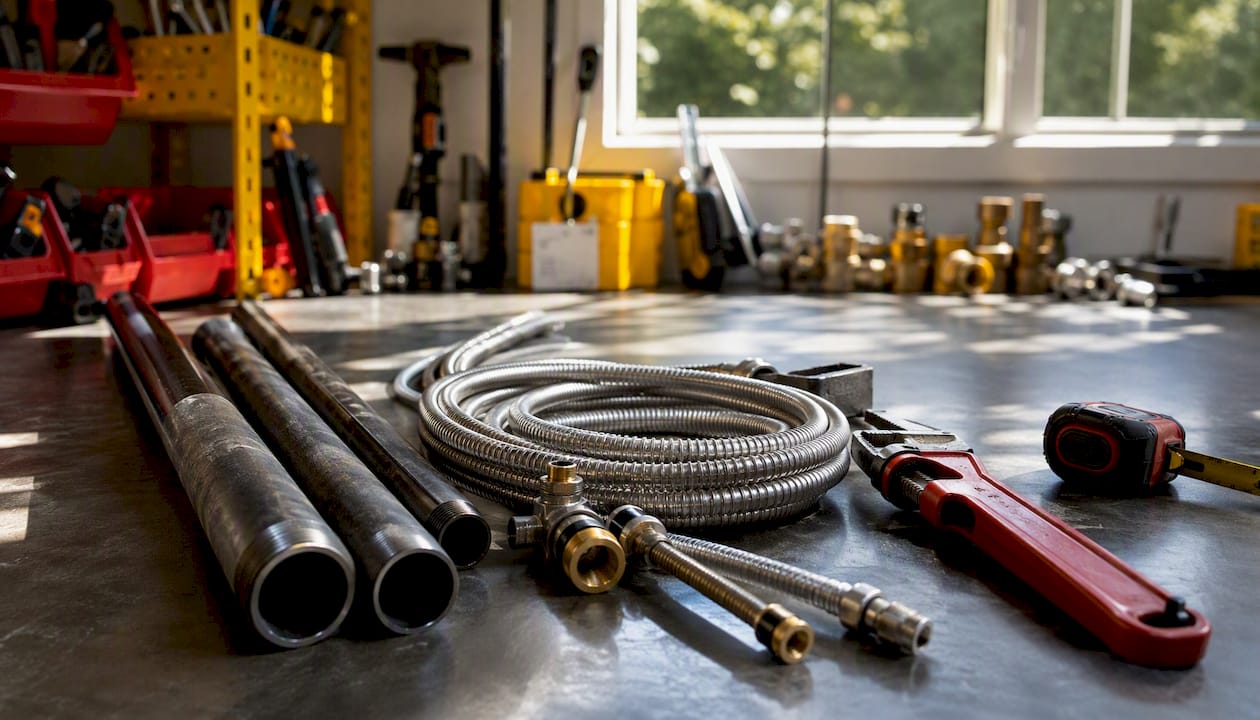
| Material | Code approval | Best for | Relative cost and complexity | Durability and lifespan |
|---|---|---|---|---|
| Black iron (steel) | Universally accepted; no special certification | Exposed rigid runs, basement mains, outdoor lines | Lower material cost; labor-intensive threading | no corrosion issues indoors over decades |
| CSST | Accepted with manufacturer certification and bonding/grounding per code | Concealed runs inside walls, flexible routing to appliances | Higher material cost; faster to install | Several decades; bonding requirement is non-negotiable |
| Flexible gas connectors | Accepted for final appliance connections only | Stove, dryer, water heater hookup at the appliance | Low cost; simple swap | Replace periodically or per manufacturer schedule |
| ProPress/press fittings | Code-approved in select jurisdictions; verify locally | Tight spaces where threading is impractical | Higher fitting cost; faster labor | Comparable to black iron when properly installed |
Manufacturer requirements for CSST grounding and termination are often required by code and inspection, so your installer must be certified by the CSST manufacturer, not just licensed by the state.
Pro Tip: For any concealed run inside a wall or ceiling, CSST is usually faster and less disruptive than black iron. For an exposed basement main or outdoor run, black iron is the more durable and cost-effective choice. Match the material to the location, not just the appliance.
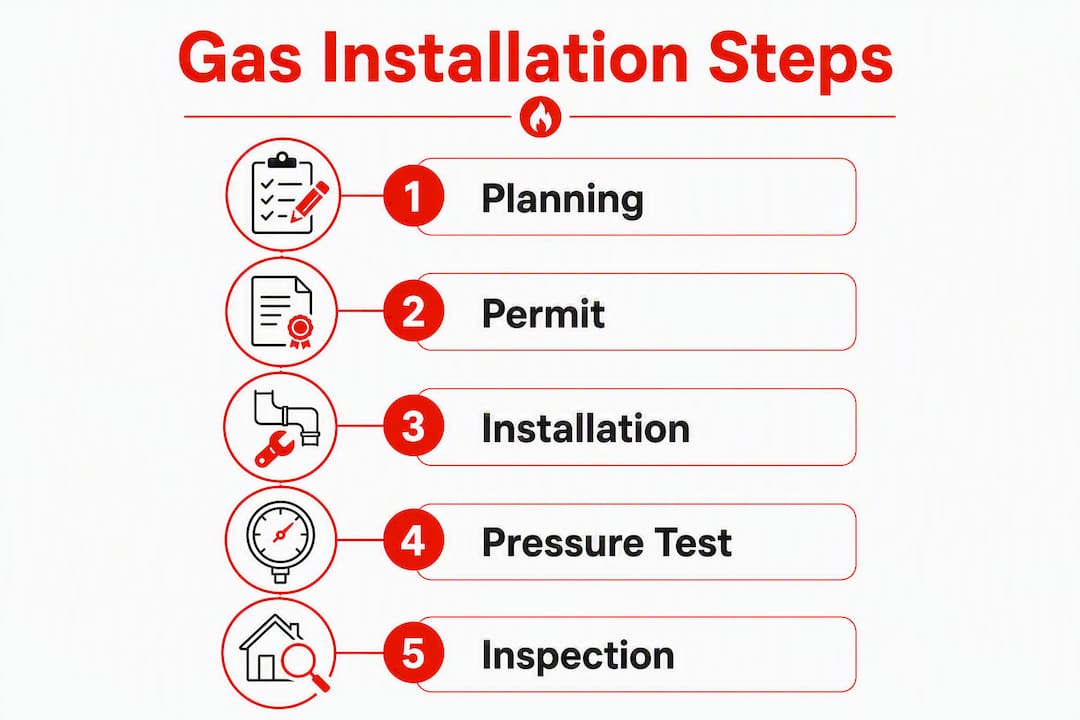
What does the installation process look like, start to finish?
A well-run gas piping job follows a predictable sequence. Knowing it helps you hold your contractor accountable at each milestone.
Pre-job phase:
- Site visit: the installer walks every appliance location, measures run lengths, and notes routing obstacles (joists, finished walls, meter location).
- BTU load calculation: total demand across all appliances is calculated and documented in writing.
- Written estimate: scope includes materials specified by type and manufacturer, permit handling, pressure test, and an as-built drawing or photo record.
- Permit pulled: the contractor submits to the local building department before any pipe is cut.
On-site sequence:
- Rough-in routing: pipe is run, secured at code-required intervals, and protected where it passes through framing.
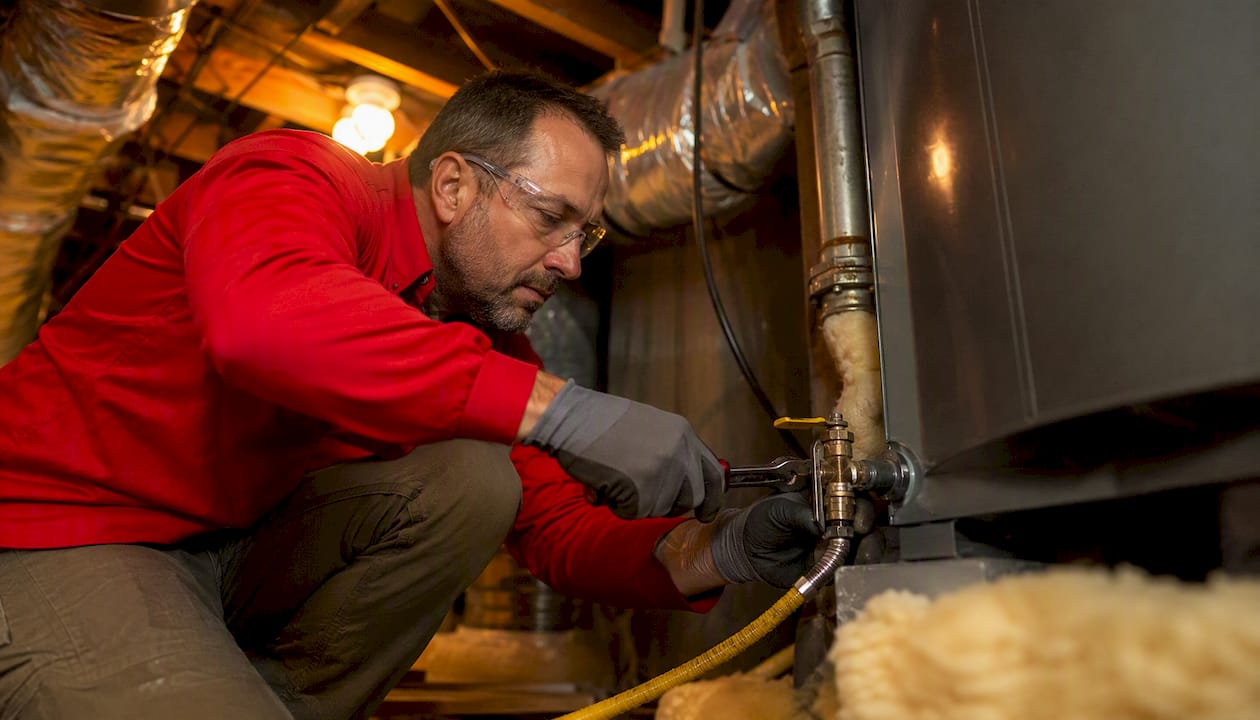
- Connections and regulator adjustment: fittings are made up, shutoffs installed at each appliance, and the regulator set to the correct delivery pressure.
- Pressure test: the system is pressurized and held for the required duration; the gauge reading is logged.
- Leak detection: every joint is checked with a listed leak-detection solution or electronic detector.
- Inspector visit: the municipal inspector reviews the installation and signs off.
- Final commissioning: gas is turned on, each appliance is lit and verified for proper operation.
For a single-appliance run (say, a new kitchen range), expect one to two days on-site plus permit turnaround, which varies by municipality but typically runs three to ten business days. A whole-house rework with multiple appliances can take three to five days of labor.
Pro Tip: Ask your contractor to text you a photo of the pressure gauge at the start and end of the hold period. It takes thirty seconds and gives you a timestamped record without any extra paperwork.
How much does a gas line installation cost?
Cost depends on more variables than most homeowners expect. Transparent contractors itemize these variables in the estimate rather than giving a single lump number.
Primary cost drivers:
- Linear footage: More pipe means more material and labor time.
- Access and routing difficulty: Finished walls, concrete slabs, and long runs through tight spaces add hours.
- Number of appliance tie-ins: Each shutoff valve and connection adds material and labor.
- Material choice: CSST costs more per foot than black iron but installs faster, so the net difference depends on run complexity.
- Permits and inspection fees: These vary by Virginia locality but are non-negotiable costs.
- Regulator or service upgrades: If your existing meter or regulator cannot support the added BTU load, an upgrade is required.
For a rough sense of scale, a straightforward 25-foot run to a new kitchen range, including a shutoff valve and documented pressure test, typically falls in the $300–$700 range depending on access and local permit fees. A plumbing repair cost breakdown from a qualified contractor will show you exactly how those variables stack up for your specific job.
Pro Tip: Get at least two written quotes that specify the same scope: footage, material type, number of connections, permit handling, and pressure-test documentation. A quote that omits any of those items is not comparable to one that includes them.
Can you legally run your own gas lines?
Short answer: in most Virginia jurisdictions, no. Unlicensed gas piping work is prohibited by safety codes and local licensing boards, and DIY gas work can void your homeowner's insurance if a claim arises from an unpermitted installation.
The safety risks are specific and serious:
- Gas leaks from improperly made-up fittings or wrong pipe sizing.
- Carbon monoxide exposure from appliances starved of gas due to undersized pipe.
- Appliance failure or fire from incorrect regulator pressure.
- Insurance coverage denial on any claim traced to unpermitted work.
There is one narrow exception most jurisdictions allow: replacing a flexible connector at an appliance with the gas shutoff closed. That is a like-for-like swap at a single connection point, not a new run. Anything involving new pipe, new fittings, or changes to the distribution system requires a licensed contractor and a permit.
Contractors should handle permits, pressure testing, and official sign-off as part of the job. If a contractor suggests skipping the permit to save money or time, that alone is reason to walk away.
Pro Tip: Require the contractor to list permit handling explicitly in the written scope. If a dispute arises later about whether required tests were performed, the permit record and signed inspection card are your protection.
How do you vet and hire a qualified gas installer?
Use this sequence before you sign anything:
- Verify the contractor's license at dpor.virginia.gov and ask for a certificate of insurance naming you as an additional insured.
- Confirm they have pulled permits for the same type of job in your municipality before.
- Ask for a written BTU load calculation as part of the estimate, not a verbal assurance.
- If CSST is being used, ask for proof of manufacturer certification by name and model.
- Get warranty terms in writing: what is covered, for how long, and what voids it.
Questions worth asking on the estimate call:
- How many installs of this appliance type have you done in the past year?
- What pressure-test method do you use, and will you give me the gauge log?
- Who attends the municipal inspection, and what happens if it fails?
- What are your bond and liability limits?
Red flags to watch for:
- Refuses to pull a permit or suggests the job "doesn't need one."
- Gives only verbal assurances about pressure testing with no written record.
- Cannot name the CSST manufacturer or model on the estimate.
- No proof of insurance or license on request.
- Estimate lists only a total price with no itemized scope.
When comparing quotes, look at scope, included tests, materials specified, and post-job documentation, not just the bottom line. A lower number that excludes permits and pressure-test documentation is a more expensive quote once you factor in the risk.
Pro Tip: After the job, request the pressure-test gauge log and a photo or PDF of the signed municipal inspection card. This prevents disputes later about whether required tests were actually performed.
Why local experience matters for gas piping in Ruckersville
Permit timelines, inspection scheduling, and code amendments vary by locality. A contractor who has worked in Greene County and the surrounding Ruckersville area knows which local amendments apply, how long the building department takes to schedule inspections, and which inspectors require specific documentation formats.
Mystic Valley Home Services approaches every gas piping job with BTU-based pipe sizing, documented pressure testing, and written as-built drawings as standard deliverables. For a typical Ruckersville homeowner job, such as an appliance upgrade with a 30-foot new run, the process looks like this: site visit and BTU calculation on day one, permit submission within 24 hours, rough-in and pressure test once the permit is issued, and a final inspection before commissioning. Every step is documented.
A reputable installer provides a written BTU load calculation, permits, pressure-test records, and an as-installed drawing or photo record. These documents protect the homeowner at every stage: during the inspection, during an insurance claim, and when the home is eventually sold.
Trust signals you should demand from any installer:
- Current state license, verifiable online.
- Certificate of liability insurance.
- Written BTU load calculation in the estimate.
- Permit number before work starts.
- Pressure-test gauge log at job completion.
- Signed municipal inspection card.
- Written workmanship warranty.
Pro Tip: Keep all gas piping documentation in a home file alongside your appliance manuals. When you sell the house, a complete permit and inspection record is a concrete selling point.
Key Takeaways
A safe, code-compliant gas piping installation requires a licensed contractor, a permit, a documented pressure test, and a written BTU load calculation before any pipe is cut.
| Point | Details |
|---|---|
| BTU sizing is the foundation | Every pipe diameter must be sized to total appliance BTU load, not just the single appliance being added. |
| Permits protect your insurance | Unpermitted gas work can void homeowner's insurance coverage; require the contractor to handle permits in writing. |
| Documentation is the deliverable | Demand a pressure-test gauge log and signed inspection card at job completion, not just a verbal sign-off. |
| Material choice affects cost and code | Black iron suits exposed rigid runs; CSST requires manufacturer certification and bonding; flexible connectors are for appliance hookups only. |
| Mystic Valley Home Services | Handles BTU-based sizing, permit management, documented pressure testing, and written as-built drawings for Ruckersville homeowners. |
What a precision install actually demands from your contractor
Most homeowners focus on price. The contractors who cut corners know that, and they price accordingly, skipping permits, skipping documented pressure tests, or using vague language on the estimate that lets them substitute materials later. The real cost of that shortcut shows up when an inspector flags unpermitted work during a home sale, or when an insurer denies a claim because the installation has no permit record.
The conventional wisdom says "get three quotes and pick the middle one." That works for painting a room. For gas piping, the middle quote from a contractor who skips documentation is worse than the highest quote from one who delivers a complete permit and test record. The paperwork is not bureaucratic overhead. It is the only proof that the system was built correctly.
Local knowledge matters more than most homeowners realize. Permit turnaround in Greene County is not the same as permit turnaround in Charlottesville. An installer who has never worked with your local building department will underestimate the schedule, which delays your appliance installation and can push your project past a heating season. Ask specifically: how many jobs have you permitted in this municipality in the last twelve months?
Ready to schedule your gas piping estimate?
Mystic Valley Home Services gives Ruckersville homeowners a straightforward path from first call to final inspection: a site visit with a written BTU load calculation, a permit pulled before work starts, a documented pressure test, and a signed inspection card at the end. No verbal assurances, no skipped steps.

To book your on-site estimate, visit the Mystic Valley Home Services services page or call directly. Before the technician arrives, have these ready:
- Locations of all gas appliances (stove, dryer, water heater, boiler).
- Access to your gas meter and main shutoff.
- Any existing permit history for prior gas work.
- Photos of the areas where new pipe will need to run.
The estimate covers BTU calculation, written scope, permit handling, and pressure-test documentation. You will know exactly what the job costs and what documentation you will receive before any work begins. For ongoing peace of mind after installation, ask about preventive plumbing contracts that include annual gas-line safety checks.
Authoritative sources and code references
The technical claims in this guide draw from the following primary sources. Use them for code lookups and to verify contractor claims:
- NFPA 54/ANSI Z223.1, National Fuel Gas Code: the national standard for safe gas piping and appliance connections; the best starting point for understanding sizing and pressure-test requirements.
- IFGC Chapter 4, Gas Piping Installations: the International Fuel Gas Code chapter most jurisdictions adopt as their inspection baseline; use this for specific installation clearances and material requirements.
- ASME B31.8, Gas Transmission and Distribution Piping Systems: covers distribution piping upstream of the meter; relevant if your project involves service line work.
- Virginia DPOR License Lookup: verify any Virginia contractor's license status before signing an estimate.
| Resource | Best for |
|---|---|
| NFPA 54/ANSI Z223.1 | Sizing tables, pressure-test requirements, appliance connection rules |
| IFGC Chapter 4 | Inspector checklist items, material clearances, local code adoption reference |
| ASME B31.8 | Distribution and transmission piping upstream of the meter |
| Virginia DPOR License Lookup | Verifying contractor license status before hiring |