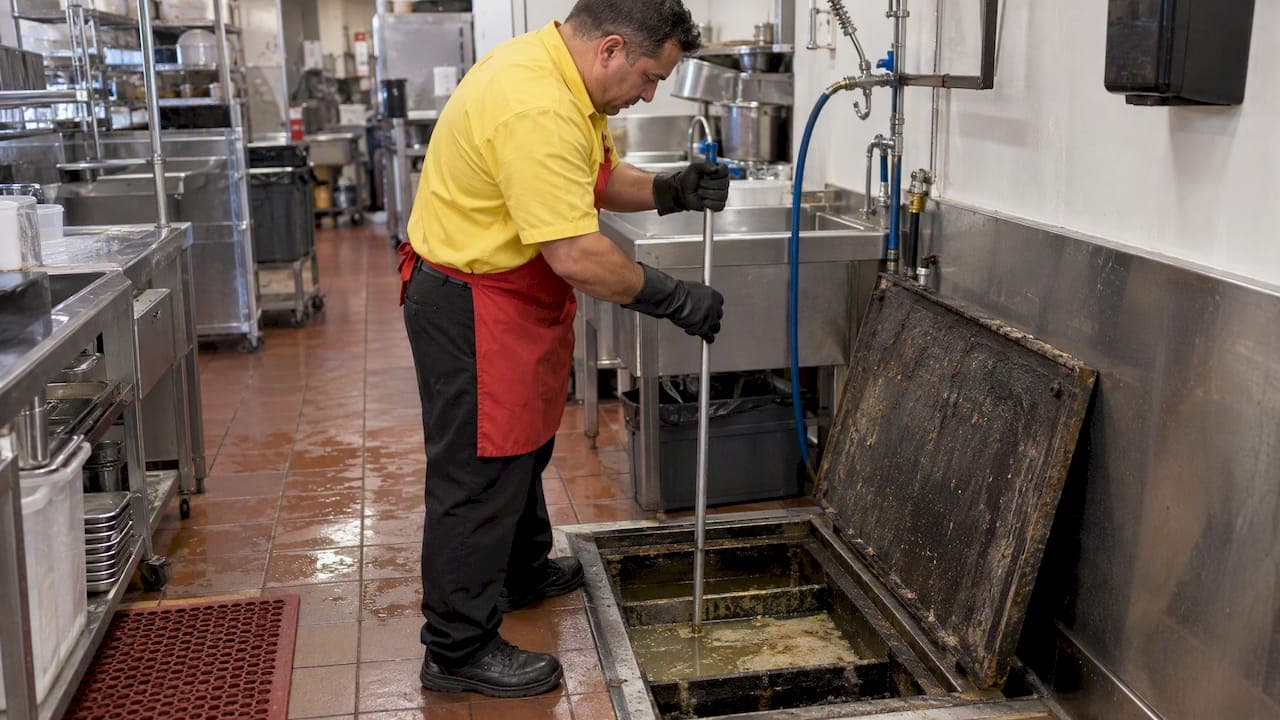
Clean undersink grease traps weekly or every two weeks, and plan on pumping larger grease interceptors every 60 to 90 days, though busy kitchens often need monthly service. The rule that sets your exact interval: check fill levels weekly, and clean before grease and solids reach 25% of the liquid depth. Keep dated service records and a signed agreement with a permitted hauler.
TL;DR:
- Automatic grease removal units need daily bucket checks, while staff should verify timers and power; haulers handle full pump outs and structural repairs.
- Track weekly fill readings for four to six weeks, then schedule service before the device reaches 25% and shorten the interval after any overfill.
- Local sewer authorities set cleaning rules because no single federal schedule applies, so confirm requirements with your municipality before changing an established service interval.
- Enzymes and bio additives cannot replace physical pump outs; they may disperse grease downstream, where it can resolidify and contribute to sewer blockages.
- Call a professional for repeated overfills, backups, damaged baffles, or odors returning within days; document response times and permits in the service contract.
Table of Contents
- Why Device Type Changes Your Service Needs
- Baseline Schedules Backed by Municipal and EPA Guidance
- Setting a Sliding-Scale Schedule for Your Facility
- Inspection Checklist for Daily and Weekly Rounds
- Daily, Weekly, and Pump-Out Tasks
- Best Management Practices That Cut Your Cleaning Costs
- Recordkeeping That Satisfies Inspectors
- When to Call in a Professional
- A Practical Checklist You Can Adapt
- Why the Calendar Approach Keeps Failing Managers
- How We Can Help With Commercial Grease Trap Maintenance
- FAQ
- Sources
Why Device Type Changes Your Service Needs
Grease control devices fall into a few categories, and each one dictates its own rhythm. Undersink passive traps sit right at the fixture, filling fast with oils and food solids, so they demand frequent attention. Hydromechanical grease interceptors (HGIs) use baffles and flow restrictions to separate grease from wastewater and typically serve a few fixtures at once. Automatic grease removal units (AGRUs) skim grease mechanically on a timer and collect it in a bucket that needs regular emptying. Large gravity interceptors, often buried outside the building, handle the full kitchen's flow and can go longer between pump-outs because of their size.
Each device has maintenance quirks that affect scheduling: AGRU buckets need daily checks, HGI baffles need periodic inspection for damage, and gravity interceptor lids need to stay accessible for the hauler's equipment.
Baseline Schedules Backed by Municipal and EPA Guidance
Most municipal fats, oil, and grease programs converge on similar numbers. Undersink traps should be cleaned weekly, or at least every two weeks, according to Pocatello's BMP fact sheet, which also notes that most grease interceptors need cleaning every 60 to 90 days unless you can document that a longer interval still works. Portland's grease interceptor guidance ties cleaning frequency to device type and wastewater volume, and recommends reporting each cleaning event.

Most interceptors need pumping once grease and solids reach about a quarter of the liquid depth, a threshold cited by Portland's wastewater program as the trigger for service regardless of the calendar date.
A workable starting point for new facilities:
- Undersink passive traps: weekly cleaning, or every two weeks at minimum
- HGIs serving moderate volume: every 30 to 60 days depending on usage
- Large gravity interceptors: every 60 to 90 days, with monthly service common at high-volume sites
There is no single federal schedule. EPA's own review of FOG programs confirms that cleaning frequency is set locally, and that source-control practices can shift intervals in either direction.
Setting a Sliding-Scale Schedule for Your Facility
A fixed calendar date is a guess. A sliding-scale schedule, built from your own measurements, holds up better under inspection and saves money on pump-outs you do not yet need.
- Check the trap or interceptor weekly using a dip-stick or a transparent ruler to estimate the percent of grease and solids relative to liquid depth.
- Log the reading with the date and your initials, building a simple trend line over four to six weeks.
- Calculate how many weeks it takes to approach 25% fill, then set your cleaning interval just ahead of that point.
- Adjust immediately if a single check jumps above 25%, and consider stretching the interval only after three consecutive cycles stay comfortably below it.
Pro Tip: Keep the logging sheet next to the trap lid so the weekly check takes thirty seconds, not a special trip.
This method turns a guess into a number you can defend to an inspector or a new hauler.
Inspection Checklist for Daily and Weekly Rounds
A short routine catches problems before they become backups.
- Grease and solids above 25% of depth: schedule cleaning immediately
- Slow drains, gurgling, or standing water near the fixture: signal a trap close to capacity
- Strong odors near the device: often mean it is overdue
- Lid and gasket condition: check for cracks or missing seals
- Baffle integrity and flow restrictor presence: confirm nothing has shifted or broken
- AGRU timers and power: verify the skimmer cycle is actually running
Staff handle the daily and weekly checks above. The hauler handles full pump-outs, disposal, and any structural repair to baffles or restrictors.
Daily, Weekly, and Pump-Out Tasks
A clear division of labor keeps the schedule from slipping.
- Daily: empty AGRU oil collection buckets, clean strainer baskets, and confirm timers and power are working.
- Weekly: remove accumulated grease from undersink traps, reseat baffles that have shifted, and check that lids and access panels close properly.
- Monthly or quarterly: a permitted hauler performs a full pump-out, removing both liquid and solid layers, scraping interior walls, and reassembling the unit.
- Every service: collect a signed receipt noting volume removed and the disposal facility used.
Hot water, enzymes, and bio-additives are not a substitute for physical cleaning. Municipal BMP manuals warn explicitly against relying on them in place of a physical pump-out, since they can emulsify grease just long enough to push it further into the sewer line.
Best Management Practices That Cut Your Cleaning Costs
Reducing how much grease enters the trap in the first place is the cheapest lever available.
- Scrape plates dry and wipe pans before washing to keep grease out of the sink
- Install mesh screens on floor drains and basins to catch solids before they reach the trap
- Divert used cooking oil to a dedicated recycling container instead of the drain
- Train staff on no-grease policies and post reminders near dish stations
BMP research on source control points to staff training as one of the more cost-effective ways to stretch pump-out intervals over time, since less grease entering the system means slower fill rates.
Pro Tip: Post the no-grease rule where dishwashers can see it, not just in a binder in the manager's office.
Recordkeeping That Satisfies Inspectors
Every cleaning event should leave a paper trail.
- Date and time of service, plus the name of the staff member or hauler present
- Volume or weight of grease and solids removed
- Hauler name, permit number, and the disposal facility used
- Retention of logs for a documented period, commonly several years, in case of an inspection
Municipal programs that apply the 25% rule can require immediate cleaning, or revise your approved schedule, if your logs show repeated overfills. Working with a preferred pumper simplifies this, since these haulers follow standardized procedures and often submit reporting directly to the municipal program, reducing your enforcement exposure.
When to Call in a Professional
Some signs mean it is time to bring in outside help rather than managing the schedule alone: repeated overfills despite a tightened interval, recurring blockages or backups, a cracked or missing baffle, or odors that return within days of a cleaning. A guide to sewer line clogs walks through the warning signs of a backup reaching the main line, which is a useful comparison if your symptoms extend beyond the trap itself.
A solid service contract should spell out inspection frequency, pump-out scheduling, documentation and reporting responsibilities, emergency response times, and confirmation that the hauler carries the right permits and insurance. Cost varies with interceptor size, access difficulty, how often you need service, and local disposal fees, so get those terms in writing before you sign.
A Practical Checklist You Can Adapt
Our Maintain Commercial Sewer System: MA Checklist 2026 lays out a logging template and a sample sliding-scale schedule built from weekly fill-level checks, useful as a starting point for your own facility's log sheet. We also cover the plumbing missteps that shorten trap life in Common restaurant plumbing mistakes to avoid in 2026, which pairs well with the BMPs above. For facilities juggling multiple vendor relationships, Manage Plumbing Maintenance Contracts Like a Pro covers what clauses to require before signing a hauler agreement.
Why the Calendar Approach Keeps Failing Managers

The biggest mistake in grease trap management is treating the interval as fixed. A quarterly pump-out date written into a lease or a checklist feels tidy, but it ignores the fact that a slow Tuesday and a catered weekend put wildly different loads on the same trap. Facilities that monitor weekly and adjust the interval accordingly spend less on emergency calls and fewer surprise fines than those that wait for a fixed date on the calendar.
The other overrated idea is that additives or enzyme treatments can stretch an interval safely. They cannot. They break grease into smaller particles that travel further down the line before resolidifying, which trades a problem in your kitchen for a bigger one in the municipal sewer. If you take one thing from this schedule, make it the weekly fill check: it is the cheapest, fastest habit that actually changes your costs and your compliance record.
— Matt
How We Can Help With Commercial Grease Trap Maintenance
We handle the plumbing side of grease trap upkeep for commercial kitchens: drain cleaning, maintenance contracts, scheduled inspections, and emergency response when a trap backs up outside business hours.

- Request a site visit to assess your current trap or interceptor setup
- Set up a maintenance contract with scheduled inspections and documented service
- Call for emergency drain or backup response when a trap overfills unexpectedly
Reach out through our plumbing services page to request a quote or schedule an evaluation.
FAQ
How often should grease traps be serviced?
Undersink traps generally need cleaning weekly or every two weeks, while larger grease interceptors are commonly serviced every 60 to 90 days. High-volume kitchens often need monthly service instead, so weekly fill-level checks should guide the exact interval rather than a fixed date.
Do grease traps need maintenance?
Yes. Without regular cleaning, grease and solids build up until they exceed the 25% fill threshold that most municipal programs used to require service, leading to slow drains, backups, and odor complaints.
How much does it cost to have a grease trap cleaned?
Cost depends on interceptor size, access difficulty, how often service is needed, and local disposal fees, so pricing varies by facility and hauler. Request quotes directly from our safety inspections page or a permitted local hauler for figures specific to your setup.
How often should grease traps be cleaned?
Most undersink traps need weekly cleaning, while interceptors are typically serviced every 60 to 90 days unless weekly monitoring shows they reach 25% fill sooner. There is no single federal schedule, since EPA guidance confirms frequency is set by local sewer authorities.
Sources
- Fats, Oil, and Grease (FOG) Best Management Practices (BMP) For Food Services (Pocatello)
- Portland
- Fats, Oils, and Grease: What we know after 23 years of FOG work | EPA