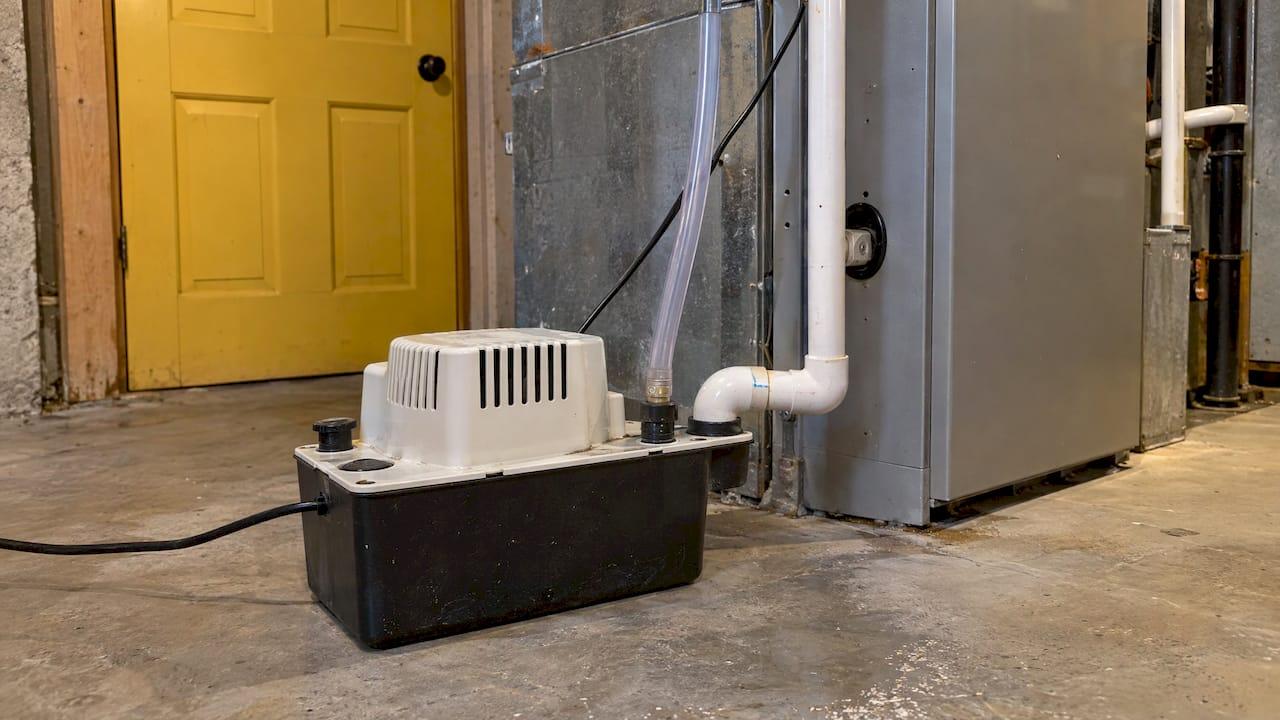
A condensate pump that won't run, runs without moving water, or never shuts off is almost always failing for one of four reasons: no power, a stuck float, a clogged reservoir or discharge line, or a worn-out motor. You can usually tell which one in about fifteen minutes by matching the symptom to the cause and checking the water path in order. If the pump has power and a free float but still does nothing, or if you are not comfortable around electrical parts, that is the point to book a technician, because a dead pump can shut down your air conditioner or high-efficiency furnace or let water reach a ceiling or finished basement. Our team handles AC diagnostics and repair and boiler and furnace repair across Massachusetts, including same-day or next-day visits.
TL;DR
- Unplug the pump before you touch it, then check the outlet, breaker and cord first. Most "dead pump" calls end here.
- Lift the float by hand. If the pump starts, the problem is sludge or a stuck float, and cleaning the reservoir usually fixes it. If it stays silent, the motor or its capacitor has likely failed.
- A pump that runs but moves no water points to a clogged discharge tube, a stuck check valve or a blocked impeller port.
- A hum with no movement means a seized impeller or failing motor. Replacement is the practical fix.
- Stop and call a pro if power and float are fine and the pump still won't run, or if the water has already reached ceilings, drywall or equipment.
Table of Contents
- What a condensate pump does and why it fails
- Match the symptom to the likely cause
- Step-by-step troubleshooting
- When the pump runs but moves no water
- When the pump won't shut off
- Repair or replace?
- When to stop and call a professional
- Get it fixed by a local team
- Our perspective
- Keep it from happening again
- FAQ
- Sources
What a condensate pump does and why it fails
Air conditioners, ductless mini-splits, high-efficiency furnaces and some humidifiers pull water out of the air or out of exhaust gases. When the equipment sits below the level of a drain, as in many basements, closets and attics, gravity can't carry that water away. A condensate pump collects it in a small reservoir, and a float switch starts the pump when the level rises and stops it when the level drops.
Three things go wrong most often. One maker's guide lists them as corroded or cracked drain pans, clogged or dislodged drain lines from bacteria and fungus, and broken or unmaintained pumps. Add the ordinary wear of a motor that runs every cooling or heating season, and you have the whole list. In older New England houses, long, awkward discharge runs and warm, damp basements make slime buildup more likely.
There is also a safety link. A safety switch in the pump or pan interrupts the equipment's control circuit when the water rises past what the pump can clear. That is why an AC that suddenly shuts off in July is often a pump problem, not a cooling problem.
Match the symptom to the likely cause
Start with what you see and hear. This table pulls together the failure patterns from the pump manual and troubleshooting guides listed in the sources.
| What you notice | Most likely cause | First thing to check |
|---|---|---|
| Silent pump, reservoir full | No power, stuck float, open motor | Outlet, breaker, then lift the float by hand |
| Pump runs, no water leaves | Clogged discharge tube, stuck check valve, blocked impeller port | Disconnect the discharge line and look inside |
| Pump never shuts off | Float stuck up, dirty sensor, backflow through the check valve | Inlet-disconnect test (below) |
| Short cycling every few seconds | Check valve stuck open, air lock, undersized or kinked line | Check valve and discharge route |
| Drip from ceiling or unit, pump dry | Clogged drain trap or line upstream of the pump | Trace the line back from the pump |
| Hums, warm motor, nothing moves | Seized impeller or failing motor or capacitor | Replacement is likely |
The manufacturer's manual for one widely installed pump series matches this pattern. A pump that does not run points to no power, too little water, a dirty reservoir, a clogged inlet or a stuck float, while a pump that runs without discharging points to a plugged discharge tube, plugged check valve or impeller port, or a float stuck on. The same manual notes the water level must reach about 2 inches below the top of the reservoir before the pump starts, so a pump that simply hasn't filled yet is not broken.
Step-by-step troubleshooting
Work through these in order. Each step rules out one cause and costs you nothing but a few minutes. Turn off the HVAC equipment and unplug the pump before you open or move anything. You will be near standing water and a mains-powered motor.

Step 1: Confirm the pump has power
Check that the pump is plugged in, then test the outlet with a lamp or a voltage tester. Look at the HVAC breaker and any emergency shut-off switch near the equipment. Guides for this job start with breakers, fuses and emergency shut-offs, and also inspect the cord for fraying.
Where it goes wrong: a tripped breaker that keeps tripping is not a pump problem to solve with a reset. Leave it off and call. Our licensed technicians can trace a wiring or breaker issue as part of an AC or furnace repair visit.
Step 2: Look at the safety float switch
Many pumps have a second, high-level float wired into the equipment's control circuit. If it has tripped, your AC or furnace will refuse to start even though the pump itself is fine. If the reservoir is full and the safety switch is up, the real question is why the pump didn't clear the water, so keep going.
Step 3: Lift the float by hand
With the pump plugged back in and the area dry, lift the float gently. If the pump starts, clean the reservoir; if it doesn't, the motor or capacitor may have failed. A float that sticks, drags or won't move freely is usually held by sediment, scale or algae. A float stuck down means the pump never starts and water backs up. A float stuck up can make the pump run continuously and burn out the motor.
Where it goes wrong: if you lift the float and hear nothing at all, stop. Opening the motor housing is not a homeowner job, and condensate pump motors are generally replaced, not rebuilt.
Step 4: Clean the reservoir
Slime is the usual culprit. Empty the reservoir, wipe out the sludge and rinse the float and sensing area. Use a 50/50 mix of water and vinegar. The maker of one common pump line says to clean it once a year, twice if slime builds up, and warns that chlorine will damage the pump. That matters because many online guides recommend bleach. Check your pump's manual before you use it.
Step 5: Check the discharge tube and check valve
Disconnect the discharge tubing and look for kinks, algae, mineral deposits or debris. The check valve is the small one-way valve near the pump outlet that stops water running back into the reservoir. If it sticks closed, the pump runs and nothing leaves. If it sticks open, the pump short cycles as water falls back in.

Flush the tubing with warm water. A wet/dry vacuum on the outlet end pulls out most sludge, and a flexible brush handles the rest. A discharge line that runs long distances or up a high lift is a common problem in older homes. If yours has been rerouted over the years, ask a tech to look at the whole run.
Step 6: Test whether water is draining
After reassembly, restore power and pour clean water in slowly. The float should respond, the motor should start, water should reach the discharge end, and the pump should shut off once the level falls. One trade procedure uses a measured quart poured into the drain pan to prove where the water stops before condemning the pump. That is a good habit: a running motor is not proof the system drains.
When the pump runs but moves no water
Start at the outlet. Pull the discharge tube and run the pump briefly into a bucket. If water comes out, the blockage is in the line or the check valve. If nothing comes out and the pump hums, the inlet screen or impeller port may be blocked, or the impeller is seized.
One more cause is geometry, not a fault. Centrifugal pumps lose flow when the hose layout is poor. A single 90-degree bend can cut flow by up to 25 percent, and several bends make it worse. The same guide says to size the pump so it is not on more than about 60 percent of the time at peak. If your pump struggles only on the hottest days, or it was fine until someone moved the unit, replacing the pump alone will not fix the problem.
When the pump won't shut off
Try the inlet-disconnect test. Pull the inlet tubing off the pump into a bucket, leave the pump powered, and watch. If the pump empties and shuts off, the fault is upstream, in the feed. If it keeps running, the fault is in the pump or its discharge.
If the water level drops normally but the motor keeps going, the float, level control or wiring is the likelier cause. A leaking discharge check valve can let water flow backward so the level falls slowly or rises again after the pump stops. A pump that runs without end will burn out, so unplug it while you decide.
If you see water dripping from the air handler or a ceiling while the pump is dry, the clog is probably upstream in the drain line or trap. Our guides on clearing a clogged AC drain line and why an AC leaks water inside walk through that side of the problem. If the pump itself is leaking, see condensate pump leaking: causes and when to call.
Repair or replace?
Most condensate pump problems are cleaning jobs. Slime, a stuck float or a clogged line fixed in ten minutes is a repair. Replacement is the better call when:
- The motor hums but does not spin. Condensate pump motors are not serviceable, so a new pump is the fix.
- The impeller is seized or the reservoir is cracked.
- The pump is old. One guide gives five to ten years as a typical service life, and replacing a pump ahead of failure is cheaper than a flooded basement.
- The pump has been cleaned and still short cycles or runs constantly.
Before you order a new one, trace the whole water path. A new pump does nothing for a blocked line, a leaking connection or a discharge route that was never suitable. Sizing matters too: the pump's flow and lift must match the equipment it serves.
When to stop and call a professional
Stop troubleshooting and book a technician if:
- The pump has power and a free float but still won't run.
- It hums and nothing moves after you check the line.
- You are not comfortable working near electrical parts.
- The breaker trips, or you see scorched wiring, a burning smell or water near outlets.
- Water has already reached drywall, a ceiling, insulation or the equipment. Turn off the system and call.
The pump maker's manual also says that pumps in areas prone to water damage need a failure alarm, a water-sensing device or a high-water safety shutoff connected to the furnace or AC thermostat. That is an installation matter for a qualified HVAC contractor, particularly for attic and upper-floor units, where a failed pump or clogged drain with no overflow protection can cause costly leaks, mold and water damage.
For business owners, a failed pump in a mechanical room, server closet or tenant space can mean downtime and a liability claim. Treat a recurring pump fault as a reason to book a diagnostic visit, not to reset and hope.
Get it fixed by a local team
If your pump is failing, or you would rather not work around standing water and wiring, Mystic Valley Home Services is a family-owned and operated team of licensed and insured Massachusetts technicians. We offer same-day or next-day service, and our pricing is upfront. We handle AC diagnostics and repair for cooling equipment and boiler and furnace repair for heating systems, and we have deep experience with Arlington's older homes. You can also reach us through our main site.

If you want fewer surprises, ask about annual heating tune-ups and seasonal AC tune-ups, which are the natural time to have the pump, float and drain line looked at.
Our perspective
The most common mistake we see with a condensate pump is treating the pump as the whole problem. The pump is the last stop on a water path that starts at the coil or heat exchanger, runs through a trap and a drain line, and ends at a discharge point. A fault anywhere along that path looks like a bad pump.
That is why we trace the whole path before we recommend a new part. A running motor does not prove water is leaving. A new pump does not fix a clogged line or an awkward discharge run. We would rather find the real cause once than come back after the next heavy week of humidity.
We also think the pump deserves a place on the maintenance list. It sits low, out of sight, and nobody thinks about it until a ceiling stains or the AC quits. Having it checked during a seasonal tune-up is a small step that protects the finished space around it, and it is part of the licensed, owner-supervised service our team stands behind.
If you are staring at a full reservoir right now, unplug the pump, protect the floor, and call us. We will tell you what we find.
Matt
Keep it from happening again
Prevention is mostly a short routine:
- Clean the reservoir and float at least once a year, and more often if you see slime. Use vinegar and water, and check the pump manual before using bleach.
- Clean the drain line every three to six months during the cooling season, and consider algaecide tablets in the reservoir if the maker allows them.
- Check the float and safety switch at each tune-up.
- Keep the discharge line short, with as few bends as possible, and keep it supported so it can't kink.
- Know where the pump is. If your unit sits in an attic or above finished space, a water sensor or overflow shutoff is cheap insurance.
Franklin Electric's guidance follows the same order we use: check power, inspect the float for debris, clean the pump and discharge line of algae or mineral deposits, then run a full operational test.
FAQ
How do I know if a condensate pump is working?
You should hear the motor start when the water rises, see water leave the discharge end, and hear the pump shut off on its own. After a test pour, water should reach the outlet and the pump should stop once the level drops. If the reservoir keeps filling, the pump stays silent, or it never stops, it is not working properly.
How long do condensate pumps last?
One trade guide puts the typical life at five to ten years. Slime, heavy use and poor discharge layout can shorten that. If your pump is near that age and acting up, replacing it is usually the sensible choice.
Can I use bleach to clean a condensate pump?
Check your pump's manual first. The maker of one common model recommends a 50/50 water and vinegar mix and warns that chlorine will damage the pump. Always unplug the pump before cleaning and rinse the reservoir well.
Why does my AC shut off when the condensate pump is full?
That is the safety switch doing its job. When the level rises past what the pump can clear, the switch cuts the equipment's control circuit so water doesn't overflow. Fix the cause, whether a clog, a stuck float or a failed pump, and the system will restart.
Should I replace the pump myself?
Swapping a plug-in pump is possible for a handy homeowner, but sizing, discharge routing and the safety shutoff wiring all affect whether the new pump works. If the unit serves a finished space or a business, have a licensed technician do it so the whole water path is checked.
Sources
- Hydromatic HCU Series Condensate Pumps Manual
- VCMA (Condensate Pump) FAQ, Little Giant
- Resolve Condensate Pump Issues with Confidence, Franklin Electric
- How to Test a Condensate Pump, Hartell
- Why Is My Condensate Pump Running Continuously, State Supply
- Condensate Pump Won't Shut Off, Every Pump
- Condensate Pump Not Working: Step-by-Step Troubleshooting, HVAC Surplus
- Condensate Pump Not Draining: A Comprehensive HVAC Guide
- Troubleshooting a Broken Condensate Pump: 7 Quick Checks, REMA
- The Ultimate Guide to HVAC Condensate Pumps, Beckett
- Condensate Pump Replacement and Verification, Manuall
- A/C System Condensate Drains, InspectAPedia