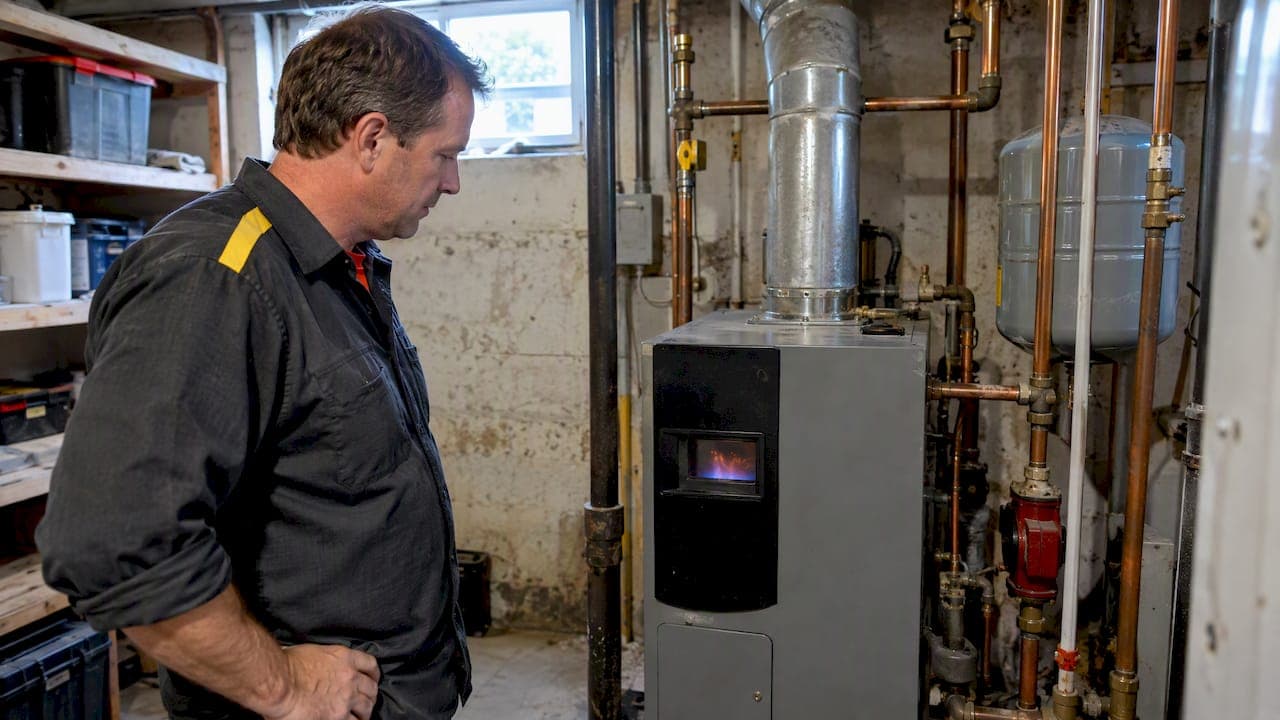
Short cycling is when your boiler repeatedly turns on and off in short bursts instead of running a full, steady heating cycle. It wastes fuel and accelerates wear on the burner, igniter, and controls. Start by timing a few cycles and noting any error codes, then work through the checks below before calling a technician.
TL;DR:
- Oversized boilers are the most common cause of short cycling, especially in homes with a high design capacity compared to actual heating needs.
- Control settings such as narrow temperature differentials and aggressive boost features often contribute to rapid on-off cycling.
- Hydronic issues like inadequate flow, missing piping, or internal recirculation can also cause the boiler to satisfy its temperature limit too quickly.
- Installing buffer tanks, widening temperature differentials, or correcting piping and flow can significantly reduce short cycling and improve efficiency.
- A professional should be called if there are repeated flame failures, gas smells, or multiple high-limit trips, as these indicate serious system problems.
Table of Contents
- How do you recognize and measure short cycling?
- What actually causes a boiler to short cycle?
- What can you safely check before calling a technician?
- Which repairs and design changes actually stop short cycling?
- When does short cycling call for a professional?
- What we look for first on a short-cycling call
- Why most short-cycling advice skips the real fix
- How Mystic Valley Services approaches boiler short cycling
- FAQ
- Sources
How do you recognize and measure short cycling?
A boiler that short cycles typically fires for just a few minutes, shuts off, then restarts again within another few minutes, often several times an hour. Normal operation usually means longer, steadier runs, especially in cold weather when the system needs to hold a setpoint. The pattern is easy to confirm with a notebook or phone timer.
- Time each cycle: note when the burner fires, when it shuts off, and how long it stays off before firing again.
- Watch for rapid supply-temperature rise on the boiler's display or gauge, which often signals the unit is satisfying its limit too fast.
- Listen for frequent clicks, relay changes, or burner starts that repeat every few minutes rather than settling into a longer run.
- Check whether a high-limit trip or lockout light appears each time the burner shuts down.
Logging even four or five cycles gives you (or a technician) real data instead of a guess about whether the behavior is abnormal.
What actually causes a boiler to short cycle?
Most short cycling traces back to one of four areas: equipment sizing, control settings, hydronic design, or a failing component. An oversized boiler, one that produces far more heat than the home's actual load needs on a mild day, satisfies its thermostat or aquastat almost immediately, then sits idle until the space cools again. This mismatch between peak design capacity and typical running load is one of the most common root causes in older homes with replacement boilers sized for worst-case cold instead of average demand.
Control settings matter just as much as sizing.
- A narrow differential between the "on" and "off" temperature setpoints forces the burner to fire and stop in quick succession.
- Incorrect high or low limit settings on the aquastat can shut the burner down before it has run long enough to be efficient.
- Thermostat "boost" or aggressive recovery features can push the system to overshoot its target, triggering an early shutdown and restart, a pattern noted in field guidance on residential hydronic performance.
Hydronic problems are less obvious but common: inadequate system flow, missing primary/secondary piping, or internal recirculation that narrows the temperature difference between supply and return water. A narrow ΔT means the boiler satisfies its limit almost as soon as it fires. Field studies found that adding thermal mass or smarter controls cut cycling by 17% to 32%, which shows how much of this problem is fixable without replacing the boiler. Finally, a failing aquastat, low-water cutoff (LWCO), zone valve, or thermostat can send false signals that mimic the same on-off pattern.
What can you safely check before calling a technician?
Before touching anything mechanical, gather information. Most of the following checks are observation only and carry no risk.
- Time and log at least four to five on/off cycles, writing down run length, off length, and any displayed temperatures.
- Check your thermostat's schedule and disable any "boost," "smart recovery," or aggressive setback feature, then watch for a change over the next few cycles.
- Confirm each zone valve opens and closes properly and that the circulator pump runs when a zone calls for heat; a stuck zone valve can starve flow to the boiler.
- Look at the boiler's display or indicator lights for error codes, flashing lights, or a tripped low-water cutoff, and photograph anything unusual for reference.
- If the manual lists a simple differential adjustment, note the current setting before changing anything so a technician has a baseline.
Our guide to thermostat troubleshooting walks through these thermostat checks in more detail, including how to find and disable boost settings safely.
Pro Tip: Stop adjusting settings the moment you see a gas smell, repeated flame failures, or a tripped LWCO, and call a professional instead of continuing to experiment.
Which repairs and design changes actually stop short cycling?
Fixes fall into two groups: changes that add thermal mass or smarter control, and changes that correct flow and piping. Both groups have documented results, which separates them from guesswork adjustments.
- Buffer tanks add stored water volume that absorbs excess heat, letting the boiler run longer before satisfying demand; field studies tied to ALM and lead-lag controllers report cycle reductions of 17% to 32% and fuel savings of 7% to 14% in shoulder-season months.
- Widening the differential between on and off setpoints, or installing an ALM (Anti-Low Mass) or dynamic controller, extends run times by delaying the next call for heat.
- Correcting hydronic flow often means adding primary/secondary piping or a boiler bypass to protect return-water temperature, a step manufacturer guidance for the Weil-McLain CGa series recommends specifically to reduce cycling.
- Sizing or replacing the circulator corrects cases where pump flow doesn't match the boiler's minimum recommended flow rate.
- Modulating burners with wide turndown ratios, or adding a small secondary boiler for low-load days, let equipment match actual demand instead of firing at full output for a five-minute call.
Eliminating short cycling altogether has produced double-digit fuel savings in documented cases, with some sites saving as much as 80%, underscoring how costly this problem can be when left alone. One caution: certain internal boiler recirculation pumps and some variable-speed pump strategies can narrow ΔT further and make cycling worse rather than better, so a pump upgrade needs to match the specific system, not just add speed control for its own sake. Insulating exposed piping and storage tanks also helps, since uninsulated runs can account for sizable standby losses that compound the cycling problem.
When does short cycling call for a professional?
Some signs mean it's time to stop troubleshooting and call someone licensed to work on the system.
- Repeated flame failures or ignition lockouts that recur after a reset.
- A low-water cutoff that trips more than once in a short period.
- Any gas smell, visible leak, or sooting around the burner.
- Persistent high-limit trips even after thermostat and zone checks look normal.
A technician will typically measure system flow, check supply and return temperatures to calculate actual ΔT, calibrate the aquastat, and review control sequencing before recommending a buffer tank, piping change, or boiler replacement. Diagnostic visits usually carry a flat fee, while control reprogramming, pump or piping work, and buffer tank installation add cost and time depending on what the diagnosis turns up. Low system pressure can also contribute to erratic burner behavior, which our piece on low boiler pressure covers in more detail.
What we look for first on a short-cycling call
On most short-cycling visits, our technicians start by timing cycles and checking error codes before touching any settings, the same baseline data homeowners can gather themselves. We separate design problems, like an oversized boiler or missing buffer tank, from simple component failures, since the fix and cost differ enormously. Our annual boiler service guide outlines what a thorough inspection covers beyond a short-cycling complaint.

Why most short-cycling advice skips the real fix
Most online advice treats short cycling as a thermostat problem, telling you to adjust a setting and move on. That's often where the trail goes cold, but the research tells a different story: a meaningful share of cases trace back to oversizing or hydronic flow, not thermostat behavior at all. A differential tweak might quiet the symptom for a season while the boiler keeps firing short and hard under the surface.

The homeowner checks in this guide matter because they generate the data a technician actually needs, cycle times, error codes, and zone behavior, rather than a vague complaint about "the heat kicking on and off a lot." That data separates a five-minute control fix from a job that needs a buffer tank or piping correction.
If there's one place conventional wisdom undersells the problem, it's buffer tanks. They get mentioned as a nice-to-have, when field data shows they're often the single highest-impact fix for cycling driven by oversizing, more reliable than chasing thermostat settings alone.
— Matt
How Mystic Valley Services approaches boiler short cycling
We diagnose short cycling by measuring flow and temperatures, checking control settings, and determining whether the problem is design, a failing component, or both, before recommending any major work. Our visits cover repairs and adjustments related to boiler and furnace components, corrections to buffer tanks and piping where flow or ΔT is the root cause, control reprogramming and sequencing adjustments to extend run times, and heating tune-ups to help prevent worsening cycling issues.

If your boiler is cycling every few minutes, schedule a diagnostic visit through our heating services page and we'll walk through the checks above with you on-site.
FAQ
Can a thermostat cause short cycling?
Yes, a thermostat with an aggressive "boost" or recovery feature can cause overshoot that triggers an early shutdown, especially in a system that's already oversized for the space. Disabling that feature and watching the next few cycles is one of the simplest homeowner checks available.
How often should a water heater cycle on and off?
A water heater's cycling depends on tank size, usage, and insulation, so there's no single normal interval, but cycles every few minutes with no load change are a sign something is off. If cycles feel unusually short and frequent, timing a few runs is the first step before assuming a fault.
Is it normal for heat on a furnace to run for 25 minutes?
Runs lasting several minutes or more are generally a sign of healthy, steady operation rather than short cycling, since the concern is cycles lasting only a few minutes with frequent restarts. Longer, steadier runs typically mean the system is sized closer to the actual heating load.
How do you fix short cycling?
Fixes range from thermostat and control adjustments to larger changes like buffer tanks, widened differentials, or corrected piping and flow, depending on the root cause. Field data tied to ALM controllers and added thermal mass show cycle reductions of 17% to 32%, which is why diagnosing the cause before choosing a fix matters.
Sources
- Optimizing Hydronic System Performance in Residential Applications
- Short-Cycle Prevention For Double-Digit Savings
- Energy
- Weil-McLain CGa Series user manual