
A properly designed, demand-controlled hot water recirculation system matters because it eliminates the wait for hot water, cuts daily water waste, and reduces net energy use in most residential layouts. The EPA estimates households waste an average of 6.35 gallons per day just waiting for hot water to arrive at the tap. Case studies show that on-demand systems can save between 3,600 and 12,000 gallons per year depending on configuration and usage patterns.
If your home has long pipe runs, multiple stories, or fixtures spread far from the water heater, a recirculation system is worth serious consideration. The design choices you make, specifically whether you use demand controls and insulated piping, determine whether you save resources or quietly waste them.
Table of Contents
- How a hot water recirculation system actually works
- System types and control strategies: which one fits your home?
- The real benefits: water savings, convenience, energy, and water quality
- Drawbacks and design mistakes that can cost you more than you save
- What does a recirculation system cost, and when does it pay back?
- How to choose the right system: a practical checklist
- What to expect during installation and how to keep the system running
- Why design controls and insulation determine whether you save or waste
- Key Takeaways
- The design detail most homeowners miss
- Mysticvalleyservices can evaluate and install your recirculation system
- Authoritative sources and further reading
How a hot water recirculation system actually works
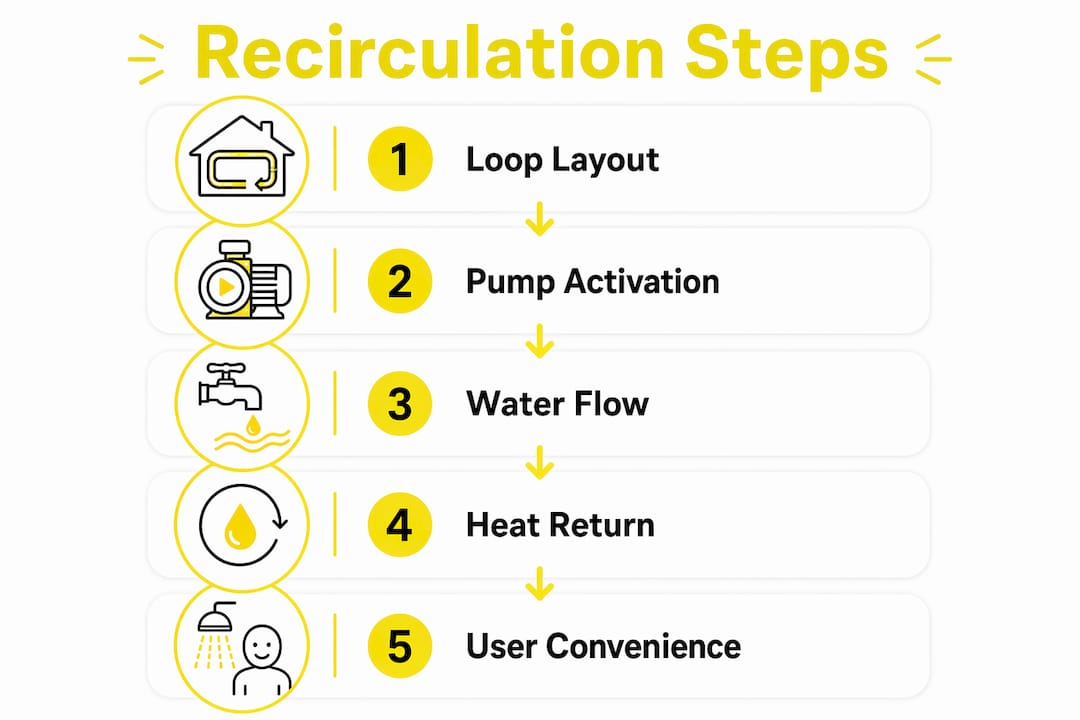
A hot water recirculation system keeps hot water circulating through your supply lines so it arrives at the tap almost instantly instead of sitting cold in the pipe. The basic setup has four parts: the water heater, the supply lines running to fixtures, a return line carrying cooled water back to the heater, and a small pump that drives the loop.
"Efficient hot water delivery reduces both water waste and the embedded energy losses that come with flushing cold water down the drain while waiting for hot water to arrive." — EPA Best Practices for Efficient Hot Water Delivery
The core components and what each one does:
- Circulation pump: Moves water through the loop; typically a small, low-wattage unit mounted at the water heater or under a sink.
- Return line: Carries cooled water back to the heater inlet (or the cold supply line in retrofit setups).
- Check valve: Prevents backflow and keeps the loop flowing in one direction.
- Balancing valves: Regulate flow across branches so every fixture gets consistent temperature, not just the closest one.
- Controls: Sensors, timers, push-buttons, or motion detectors that tell the pump when to run.
- Pipe insulation: Slows heat loss from the loop between pump cycles, which is the single biggest factor in whether the system saves or wastes energy.
Understanding the domestic hot water loop layout in your home is the right starting point before choosing a system type.
System types and control strategies: which one fits your home?
The biggest decision isn't which brand of pump to buy. It's which control strategy you choose, because that determines whether the system runs efficiently or runs constantly.
On-demand systems activate only when triggered by a push-button, motion sensor, or draw-detection. The pump runs briefly, hot water reaches the fixture, and the pump shuts off. ENERGY STAR specifically distinguishes these from continuous systems and recommends on-demand operation for residential efficiency.
Timer-based systems run the pump on a schedule, say 6–9 AM and 5–8 PM. They work reasonably well when your household follows a predictable routine, but they keep circulating during the scheduled window whether anyone is using hot water or not.
Continuous systems run the pump around the clock. In an uninsulated or long loop, the heat loss from constant circulation can exceed any energy saved from not reheating drained water. These are the systems that give recirculation a bad reputation for energy waste.
On the hardware side, you have two main configurations:
- Dedicated recirculation loop: A separate return line runs back to the water heater. Best performance, but requires additional piping, which adds cost in retrofit situations.
- Integrated retrofit pump (under-sink): A pump and crossover valve installed under the farthest fixture, using the cold supply line as the return. Lower installation cost, but it can introduce warm water into the cold line temporarily.
Pro Tip: Pair any system with insulated return lines and balancing valves. NREL and ASPE both identify this combination as the professional standard for residential efficiency. Without it, even an on-demand pump can underperform.
The real benefits: water savings, convenience, energy, and water quality
The case for recirculation rests on four measurable benefits, and they compound each other.
Water and energy savings
| Benefit | Typical Range | Source |
|---|---|---|
| Water saved per year | 3,600–12,000 gallons | NREL case studies |
| Energy saved per year | 800–4,000 kWh | NREL case studies |
| Daily water wasted without system | 6.35 gallons/household | EPA guidance |
Those energy ranges are wide because savings depend heavily on baseline usage, pipe length, insulation quality, and control type. A well-designed on-demand system with insulated lines lands toward the high end. A continuous pump on an uninsulated loop can land in negative territory.
Convenience that actually changes behavior
No-wait hot water isn't just a comfort feature. When people stop running the tap for 30–60 seconds waiting for heat, they use less water automatically, without thinking about it. That behavioral change is where the 6.35 gallons per day figure comes from.
Water quality and safety
The EPA notes that recirculation systems reduce standing water volume and increase flushing frequency in supply lines. Less stagnation means lower risk of bacterial growth, including Legionella, particularly in larger homes or multi-unit buildings where water can sit in long branch lines for hours. For property managers, this moves recirculation from a convenience upgrade to a multi-unit building plumbing health consideration.
Drawbacks and design mistakes that can cost you more than you save
A recirculation system installed without proper design doesn't just underperform. It can actively increase your utility bills and create safety risks.
Red flags that a system may be wasting energy:
- Continuous pump with no demand control or timer
- Return lines with no insulation (the loop acts like a radiator, bleeding heat into the wall cavity)
- Heat-pump water heater paired with a continuous pump (the pump forces the heat-pump to work harder and more often)
- No balancing valves (nearest fixtures get hot; distant ones still wait, so users run the tap anyway)
Common installation mistakes:
- Skipping the return line and relying entirely on the cold supply as a return, without accounting for warm water contaminating the cold side.
- Oversizing the pump, which increases velocity, causes erosion in fittings, and wastes electricity.
- Ignoring dead legs. A branch pipe longer than roughly 50 feet between the recirculation loop and a fixture defeats most of the system's benefit for that fixture.
- No check valve, allowing backflow that reverses the loop direction under certain pressure conditions.
- Installing the pump without verifying the water heater manufacturer's compatibility, especially for tankless or heat-pump models.
NREL warns explicitly that without insulation and demand-based controls, continuous circulation can cause net energy increases in a home. That's not a theoretical risk. It's a documented outcome in field studies.
Legionella risk deserves a direct mention. Poor balancing creates zones of slow-moving or stagnant water at temperatures that favor bacterial growth (roughly 77–113°F). Proper balancing and consistent flows across all branches are the primary mitigation.
What does a recirculation system cost, and when does it pay back?
Cost varies significantly based on whether you're retrofitting an existing home or installing during new construction.
| Cost Factor | Retrofit | New Construction |
|---|---|---|
| Pump and controls | Lower (under-sink units available) | Moderate (dedicated loop pump) |
| Return line piping | Higher (walls may need opening) | Lower (pipe run during framing) |
| Insulation of lines | Often skipped, adds cost if added later | Easier and cheaper to include |
| Balancing valves | Sometimes omitted, should not be | Standard in well-designed systems |
What drives payback:
- Local water and energy rates. Higher utility costs shorten payback.
- Household size and usage patterns. More people, more daily draws, faster savings accumulate.
- Pipe run length. Longer runs mean more water wasted per draw, so savings per year are larger.
- Control type. On-demand systems have lower operating costs than timer or continuous systems.
- Insulation quality. Uninsulated loops bleed heat continuously, erasing energy savings.
The 3,600–12,000 gallon annual water savings range translates directly to dollars at your local water rate. Energy savings of 800–4,000 kWh per year add to that. Payback periods vary, but homes with long pipe runs and high usage typically see the fastest return.
How to choose the right system: a practical checklist
Before you call a plumber, gather this information:
- Measure the distance from your water heater to the farthest fixture. Runs over 50 feet are the clearest case for recirculation.
- Identify where hot-water fixtures cluster and where they're isolated. Isolated fixtures with long branch runs may need local solutions.
- Note your water heater type (tank, tankless, heat-pump). Each has different compatibility requirements with recirculation pumps.
- Check whether existing supply lines are insulated. If not, budget for insulation as part of the project.
- Decide on control preference: push-button at key fixtures, motion sensor, or scheduled timer.
Questions to ask any installer:
- What pump head and GPM rating are you specifying, and how did you calculate it?
- Are you including balancing valves on each branch?
- Will the return lines be insulated?
- What's the expected pump run time per day under your control strategy?
- How do you handle dead legs at fixtures more than 50 feet from the loop?
- What's the warranty on the pump and controls?
Decision matrix:
- Retrofit, one or two problem fixtures: Under-sink pump with crossover valve, on-demand control.
- Retrofit, whole-house improvement: Dedicated return line with demand controls and insulated loop.
- New construction: Dedicated loop designed into the framing, insulated from day one, balancing valves at each branch.
Red flags that should pause hiring:
- Installer proposes a continuous pump with no controls.
- No mention of balancing valves.
- Quote doesn't include insulating the return line.
- Installer hasn't asked about your water heater type.
For property managers, the plumbing code compliance implications of recirculation in multi-unit buildings are worth reviewing with your local Authority Having Jurisdiction before committing to a design.
What to expect during installation and how to keep the system running
Installation timeline:
- Retrofit under-sink pump: typically a half-day to one day, minimal disruption, no wall opening required.
- Dedicated return loop retrofit: one to three days depending on pipe run complexity; may require opening walls or ceilings to route the return line.
- New construction: the loop is roughed in during framing, so there's no added disruption beyond normal plumbing work.
Component lifespan:
- Circulation pumps: typically 10–15 years with proper maintenance.
- Check valves and balancing valves: similar lifespan, but should be inspected every few years.
- Controls (sensors, push-buttons): 5–10 years depending on quality and use frequency.
Annual maintenance checklist:
- Clean the pump strainer (if equipped) to prevent flow restriction.
- Verify check valve operation; a failed check valve allows backflow and defeats the loop.
- Test controls and sensors for correct activation and shutoff.
- Inspect pipe insulation for gaps, compression, or moisture damage.
- Confirm balancing valve settings haven't drifted after any system pressure changes.
- Check pump for unusual noise or vibration, which can signal bearing wear.
A home plumbing maintenance checklist that includes the recirculation system keeps small issues from becoming expensive ones.
Pro Tip: Schedule recirculation pump inspection at the same time as your annual water heater service. The two systems interact, and a single visit covers both efficiently.
Why design controls and insulation determine whether you save or waste
The research on this is consistent and worth stating plainly: the design choices matter more than the brand of pump you buy.
NREL's analysis of field-installed systems found that improperly designed recirculation without insulation or demand controls can increase a home's energy footprint because the loop acts like a distributed radiator. ASPE's engineering guidance identifies pump sizing, balancing valve sizing, insulation, and control requirements as the four non-negotiable fundamentals. Skip any one of them and performance degrades.
"Without balancing valves, the nearest fixtures receive hot water first while distant ones may still require tap-running, negating the core benefit of the system." — PHCP Pros industry guidance
The dead leg problem is the most underappreciated issue in residential recirculation. A branch pipe longer than roughly 50 feet from the recirculation loop to a fixture means that fixture still has a long column of cold water sitting between it and the loop. The pump keeps the loop hot, but the branch stays cold until the user runs the tap. For homes with sprawling layouts, this means some fixtures get no benefit at all unless the installer accounts for branch length in the design.
What the best-performing systems have in common:
- On-demand controls that run the pump only when triggered.
- Fully insulated return lines with no gaps at fittings or valves.
- Balancing valves on each branch, set and verified after installation.
- Branch lengths kept under 50 feet, or local under-sink solutions added where they can't be.
- Pump sized to actual system head, not oversized "for safety."
One case study in the NREL report showed a retrofitted on-demand system with an insulated loop and balancing valves producing annual water savings at the high end of the 3,600–12,000 gallon range, with measurable energy reductions as well. The same home with a continuous pump and no insulation would have produced the opposite result.
Key Takeaways
A demand-controlled, insulated, and properly balanced recirculation system saves water and energy; an uncontrolled continuous system without insulation wastes both.
| Point | Details |
|---|---|
| When recirculation helps most | Homes with pipe runs over 50 feet or multiple stories benefit most from a dedicated recirculation loop. |
| The single biggest design rule | On-demand controls plus insulated return lines plus balancing valves is the combination that produces real savings. |
| Daily water waste without a system | The EPA documents 6.35 gallons wasted per household per day just waiting for hot water to arrive. |
| Annual savings potential | On-demand systems save 3,600–12,000 gallons of water per year and 800–4,000 kWh depending on design and usage. |
| Mysticvalleyservices | Mysticvalleyservices evaluates, designs, and installs recirculation systems in Massachusetts, covering retrofit and new-loop installations. |
The design detail most homeowners miss
The conversation about recirculation usually focuses on the pump. Should you get a push-button model? A smart sensor? A timer? Those are real questions, but they're secondary. The variable that actually determines whether a system saves money or costs money is whether the return line is insulated and whether balancing valves are installed and set correctly.
Most homeowners who've had a bad experience with recirculation, higher energy bills, lukewarm water at distant fixtures, or warm water in the cold line, had a system installed without those two elements. The pump was fine. The design wasn't.
The other thing worth saying: on-demand control is not a luxury feature. It's the baseline for any system that's supposed to save energy. A continuous pump on a long, uninsulated loop in a New England home running through a cold basement is going to bleed heat constantly. The math on that doesn't work in your favor regardless of how much water you save at the tap.
If you're evaluating a quote and the installer hasn't mentioned insulation, balancing valves, or dead leg lengths, ask directly. The answer tells you a lot about the quality of the installation you're about to get.
Mysticvalleyservices can evaluate and install your recirculation system
If you've read this far and you're thinking about a recirculation upgrade, the next step is a site evaluation, not a parts order. The right system depends on your pipe layout, water heater type, fixture locations, and how your household actually uses hot water.

Mysticvalleyservices handles the full scope: system evaluation, retrofit pump installation, dedicated loop design and installation, and ongoing maintenance for homeowners and property managers across Massachusetts. Before a site visit, it helps to have your water heater's age and model, a rough sense of which fixtures have the longest wait times, and any known problem spots like a master bath at the far end of the house.
For property managers, preventive plumbing contracts that include annual recirculation system checks keep the system performing and protect against the Legionella and stagnation risks that come with neglected balancing. Check the services page to see the full range of what Mysticvalleyservices offers, or reach out directly to schedule an evaluation for your home or building.
Authoritative sources and further reading
The following sources informed this article and are worth bookmarking if you want to go deeper:
- EPA Best Practices for Efficient Hot Water Delivery: The primary government guidance on water waste, recirculation efficiency, and water quality benefits including Legionella risk reduction.
- NREL: Hot Water Recirculation Systems — Designing for Success: The most thorough field-study analysis of on-demand vs continuous systems, energy savings ranges, and design pitfalls.
- ENERGY STAR: Demand Hot Water Recirculating Systems: Official program guidance distinguishing demand-controlled from continuous systems and recommending on-demand operation.
- ASPE: Domestic Hot Water Recirculation Systems: Engineering fundamentals for pump sizing, balancing valves, insulation, and controls from the American Society of Plumbing Engineers.
- PHCP Pros: Hot Water Distribution Through Recirculation: Practitioner-level guidance on balancing valves and uniform temperature delivery across branches.
- PNNL Technical Report on Distribution and Stagnation: The most detailed analysis of dead legs and branch length effects on recirculation performance.
- InterNACHI: Hot Water Recirculation Systems: Inspector-level overview useful for understanding what a home inspector looks for in an existing system.
If your home is in a multi-unit building or subject to local code requirements, consult your Authority Having Jurisdiction (AHJ) before finalizing a design. Recirculation requirements and restrictions vary by jurisdiction, and some municipalities have specific rules about return line connections and cross-connection control.