Trenchless sewer repair fixes or replaces a buried sewer line without digging a trench along its whole length. The plumber works from one or two small access points and uses the old pipe as a guide for a new liner or a new pipe. Whether it suits your property depends on what a camera inspection shows about the pipe, so the first step is always to find out the pipe's actual condition. We do that with leak detection and pipe repair, and with pre-purchase plumbing inspections, for homes and commercial properties in Massachusetts.
This guide covers how the main methods work, how to choose between them, what the work involves day to day, and what Massachusetts owners should check with their town before work starts.
TL;DR
- Trenchless repair uses the existing pipe as a host. Cured-in-place lining coats the inside of a pipe that is still in one piece. Pipe bursting pulls a new pipe through and breaks the old one apart.
- Lining suits cracks, offset joints and corrosion. Bursting suits pipe that is collapsed, badly broken or too small. Open-cut digging is still the answer in some cases.
- A camera inspection decides the method. Pick the contractor who inspects first and explains what the video shows.
- In Massachusetts, who owns which part of the sewer line, and which permits apply, depends on your town. Ask your local sewer department before work begins.
- Older homes with clay, cast iron or root-damaged lines are common candidates, and an inspection before you buy or sell can surface the problem early.
Table of Contents
- What trenchless sewer repair actually is
- Cured-in-place pipe lining
- Pipe bursting
- Lining vs. bursting vs. digging: how to choose
- What the job looks like, step by step
- Massachusetts: ownership, permits and local rules
- Signs your sewer line needs attention
- Buying or selling: inspect the sewer line first
- Our perspective
- Ready to find out what is in your line?
- FAQ
- Sources
What trenchless sewer repair actually is
The U.S. EPA describes trenchless sewer rehabilitation as using the existing pipe as a host for a new pipe or liner rather than excavating along the entire run. The techniques it lists are pipe bursting, sliplining, cured-in-place pipe and modified cross-section liners. For a house, two of these matter most: cured-in-place pipe lining and pipe bursting.
The EPA also frames the appeal in plain terms: less restoration, less disturbance, fewer detours, spared trees and less construction noise than dig-and-replace. For a homeowner, that means your lawn, driveway, walkway and landscaping mostly stay where they are. For a business owner, it means a parking lot or loading area stays open for more of the job.

The method is not new. The EPA's State of Technology report notes that cured-in-place lining was first installed in 1971 in a brick sewer in East London, and that trenchless techniques account for up to 70% of sewer rehabilitation work in the U.S. market. That figure is for sewer rehabilitation work overall, much of it municipal.
Cured-in-place pipe lining
Cured-in-place pipe, usually shortened to CIPP, is what most people mean when they say "pipe lining." A flexible fabric tube is soaked in resin, pulled into the old pipe, and hardened. According to the EPA, the liner is coated with thermosetting resin and cured with heat to form a new pipe inside the old one. The International Code Council's trenchless paper adds that the tube is inserted, expanded against the pipe wall and cured with ambient conditions, hot water, steam or light.

What lining fixes
The EPA says CIPP can rehabilitate pipes with cracks, offset joints and structurally deficient sections, and that the resin bonds with the existing pipe to form a tighter seal than most other trenchless techniques. That makes lining a strong fit for the problems older homes tend to have:
- hairline cracks and separated joints in clay or cast iron
- roots working in at joints
- corroded or pitted pipe that is still in one piece
Because the finished liner has no joints, there are fewer places for roots to get in. That matters in neighborhoods with mature trees.
What lining cannot do
Lining needs a host pipe that still has its shape and continuity. A section that has collapsed, or a pipe that is missing in places, has nothing for the liner to cure against. The EPA also notes that sliplining, deform-and-reform and CIPP methods all reduce the pipe's inside diameter slightly. For a normal house line that is rarely a concern. It becomes one if the pipe was already undersized for the building.
How long a liner lasts
An EPA retrospective study looked at CIPP liners that had been in municipal sewers for 5, 21, 23 and 25 years. It found no reason to expect the liners would fail short of their intended 50-year life. Those were city sewers, not house laterals, but they are the best public long-term data available for the technology.
Pipe bursting
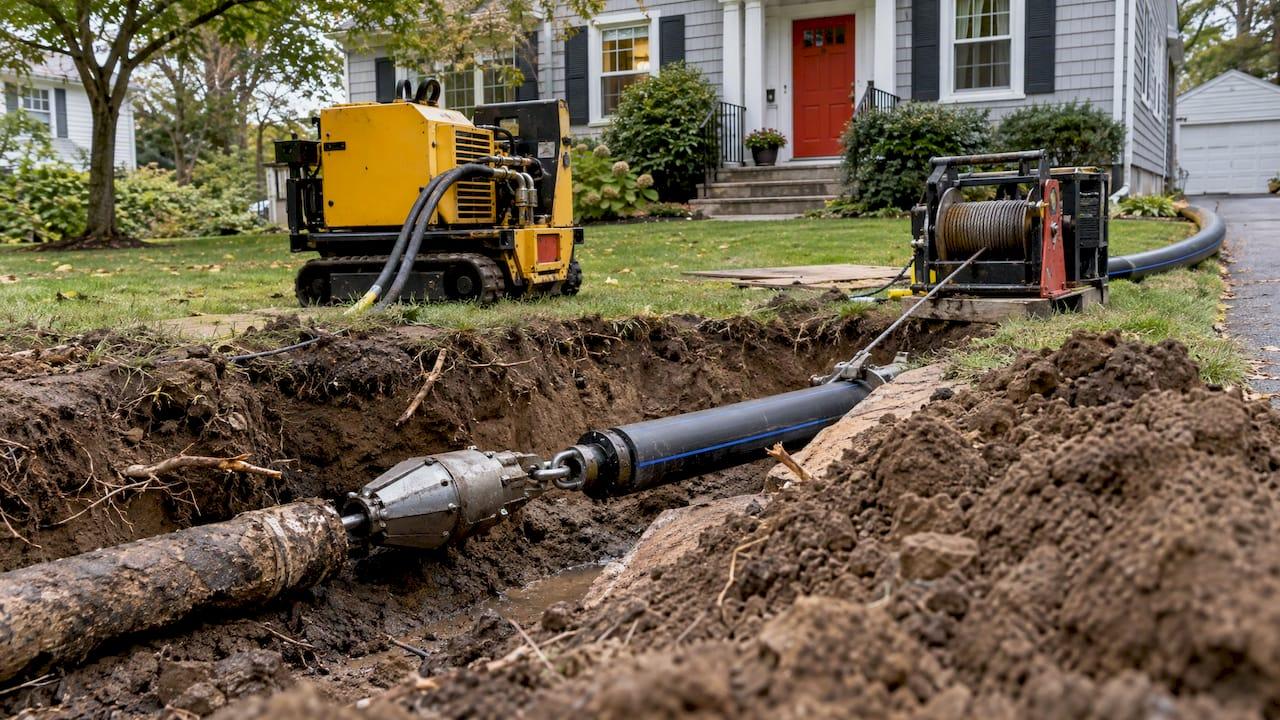
Pipe bursting replaces the pipe instead of coating it. The EPA's pipe bursting fact sheet describes a hydraulic or pneumatic expansion head pulled through the old pipe by cable and winch. It fractures the old pipe outward and pulls the new pipe into the space behind it. The fact sheet gives a typical bursting rate of about 100 feet per hour.
Where bursting wins
Because you are installing a brand new pipe, bursting works on pipe that has collapsed, sagged or broken apart, which lining cannot handle. It also lets you go larger. The EPA advises that it is usually better to go to at least the next larger pipe size rather than keep the existing size, to leave capacity for future loading. For a business adding fixtures, a kitchen or more tenants, that headroom is the point.
Where it needs care
The outward force of the expansion head can affect whatever sits close to the old pipe. The EPA fact sheet notes that ground-penetrating radar may be needed to locate undocumented utilities, and that the work includes repairing couplings, valves and any concrete encasement beforehand. That is why a thorough pre-job survey matters more here than with lining. In an older Massachusetts neighborhood, water services, gas lines and buried obstacles are not always where the old drawings say.
One piece of vocabulary to keep straight: "pipe bursting" is a repair method, while a burst pipe is an emergency. If water is escaping inside the house, shut off the supply first. This guide on stopping a burst pipe walks through the first minutes.
Lining vs. bursting vs. digging: how to choose
Owners often ask whether relining or replacement is the better call. The honest answer is that it depends on the pipe, and the camera tells you which.
| Situation found on camera | Usually points to |
|---|---|
| Cracks, offset joints, root entry, pipe still round and continuous | Cured-in-place lining |
| Collapsed, crushed or missing sections | Pipe bursting or open-cut replacement |
| Pipe too small for the building's current or planned use | Pipe bursting with a larger pipe |
| Pipe under a structure, driveway or mature landscaping | Trenchless method, if the survey supports it |
| Pipe that is shallow, easy to reach and badly failed | Open-cut replacement can be reasonable |
The EPA lists all of the trenchless methods as options; none is the winner in every case. A Nashville sewer program found that every trenchless method it used was equally effective at keeping groundwater out of the treated segments. The factor that mattered most was choosing the right line segments to rehabilitate, not the product. The same logic applies to your house: the diagnosis comes first, the method second.
What it costs
Price per foot varies with pipe length, depth, access, the number of pits, and what is above the line. Published ranges are wide, and a range from a website tells you little about your own line. Our sewer line replacement cost guide breaks down what drives the price so you can read a quote with confidence. In any quote, look for the length of pipe covered, the method, what happens at both ends of the line, and what restoration is included.
What the job looks like, step by step
The sequence is similar for lining and bursting, with the details differing.
- Camera inspection. A small camera runs through the line. It shows cracks, roots, offsets, sags and collapses, and it gives a length and a location for each. The EPA's bursting steps start with gathering pipe history and using closed-circuit TV for exactly this reason.
- Locating and planning. The plumber maps the line and its depth, and checks for other utilities nearby.
- Access points. Instead of a trench, one or two small pits are dug, or an existing cleanout is used. Bursting needs a launch and a receiving pit. The EPA notes that access pits are constructed "if necessary."
- Cleaning and preparation. The line is cleared of roots and debris. For bursting, impediments such as repair couplings are removed.
- Bypass and shutoff. The EPA states that the pipe segment must be taken out of service, blocked or bypassed, during the work. Expect limited use of toilets, sinks and laundry while it is in place. Ask how long.
- Lining or bursting. The liner is inserted and cured, or the new pipe is pulled through.
- Reconnection and testing. Side connections are reinstated, and the pipe is pressure-tested. For lining, a final camera pass confirms a smooth, sealed result.
Keep the final video. It documents the work, and it is useful if you later sell the property.
Massachusetts: ownership, permits and local rules
Before any digging, trenchless or not, find out whose pipe it is. In Massachusetts that is set town by town. Falmouth, for example, installed public sewer mains in the roads and the lateral connections up to the property line at the street, and connection work beyond that point is the property owner's responsibility. Your town may draw the line differently, so ask the sewer or public works department.
Permits and licensing also vary. Concord's sewer service standards are a useful example of what a town can require. They call for a contractor licensed as a Drain Layer by the town, 48 hours' notice before installation so the town can inspect, a right-of-way permit for work in the town's right-of-way, and as-built drawings within 10 days of completion. The same document allows an existing service to be reused only if it is under 50 years old and its integrity is acceptable, possibly shown by video inspection. That is one town's 2005 standard. Treat it as a list of questions for your own town, not as a rule that applies everywhere.
Business owners should also check with the landlord, if they lease, about who authorizes work on the building's lateral, and with the town about whether work in a sidewalk or street needs a permit.
Signs your sewer line needs attention
- Slow drains in several fixtures at once, or gurgling when you run water
- Repeated backups, especially in the basement or lowest-level floor drain
- Sewage odors indoors or in the yard
- Soggy or unusually green patches over the line
- A line that has been cleared of roots more than once
- A house or building with its original clay, cast iron or Orangeburg-style pipe
One clog is a drain-cleaning job. A pattern is a reason to put a camera in the line. Our plumbing team handles drain cleaning, leak detection and pipe repair, and the camera view is what tells you whether a clog is a one-off or a failing pipe.
Buying or selling: inspect the sewer line first
Sewer line problems are among the costliest surprises in a home sale, and an older house is where they tend to hide. A pre-purchase plumbing inspection brings the condition of the line into the negotiation before closing. We explain how that works in our guide to inspecting plumbing before closing. If you are replacing old supply piping at the same time, our Massachusetts guide to replacing galvanized pipes is a good companion.
Our perspective
Most of the sewer jobs that go sideways started with a guess. Someone decided on lining, or bursting, or digging before the pipe had been looked at properly. We think the order should be: camera first, written findings second, then the method that fits what the pipe is actually doing.
We are a family-owned team of licensed and insured Massachusetts technicians, and the owner stays directly involved in the work. We have deep experience with Arlington's older homes, and the clay and cast iron lines in those houses are exactly why we like to see the inside of a pipe before we say a word about replacing it.
We also believe in transparent upfront pricing. You should know what a job includes, what it does not, and what happens to your yard or parking area before work starts. And if the line is failing, you should not have to wait: we offer same-day or next-day service.
Matt
Ready to find out what is in your line?
If you have slow drains, repeated backups or an older line you want checked, our team can diagnose it and tell you what the pipe needs. We serve homes and commercial properties across Massachusetts, with licensed and insured technicians, upfront pricing and same-day or next-day service. Start with our plumbing services page to book leak detection or pipe repair.

For a home purchase, our pre-purchase plumbing inspections cover the plumbing before you commit. Commercial owners can also read why pipe sizing matters in commercial buildings before planning any line upgrade, and why preventive plumbing contracts help keep small drain issues from becoming sewer failures.
FAQ
Is trenchless sewer repair worth it?
It is worth it when the pipe is a good candidate and the surface above it is costly or hard to restore, such as a finished lawn, a driveway, a patio or a parking lot. The EPA points to less restoration and disturbance as the core benefits. The camera inspection tells you whether your line qualifies.
How long does trenchless sewer repair last?
An EPA study of lined municipal sewers found no reason to expect the liners to fall short of a 50-year design life, based on installations that were 5 to 25 years old at the time. Actual life depends on the pipe, the installation quality and ground conditions. A final camera inspection after the work records how the new pipe looks on day one.
What is the difference between pipe lining and pipe bursting?
Lining coats the inside of the old pipe with a resin-soaked liner that hardens into a new pipe within the old one. Bursting breaks the old pipe apart as a new one is pulled in behind it. Lining needs a pipe that is still intact. Bursting handles collapsed pipe and can increase the pipe size.
Do I need a permit for trenchless sewer work in Massachusetts?
Often yes, and the rules depend on your town. Some towns require a licensed drain layer, advance notice for an inspection, and a right-of-way permit for work in the public way. Ask your town's sewer or public works department before the work is scheduled, and ask your plumber what they will file for you.
Can trenchless repair fix a collapsed sewer line?
Lining cannot, because it needs the old pipe as its form. Pipe bursting can replace a collapsed section by pulling in new pipe, and open-cut replacement is also an option. The camera footage shows where the collapse is and how long it runs.
Sources
- EPA Collection Systems O&M Fact Sheet: Trenchless Sewer Rehabilitation
- EPA State of Technology for Rehabilitation of Wastewater Collection Systems
- ICC: Existing Sewer Lateral Pipe Repair Using Trenchless Methodology
- EPA Retrospective Evaluation of Cured-in-Place Pipe in Municipal Gravity Sewers
- EPA Pipe Bursting Fact Sheet
- Nashville I/I removal through trenchless rehabilitation
- Town of Concord Sewer Service Design Standards
- Town of Falmouth sewer service letter