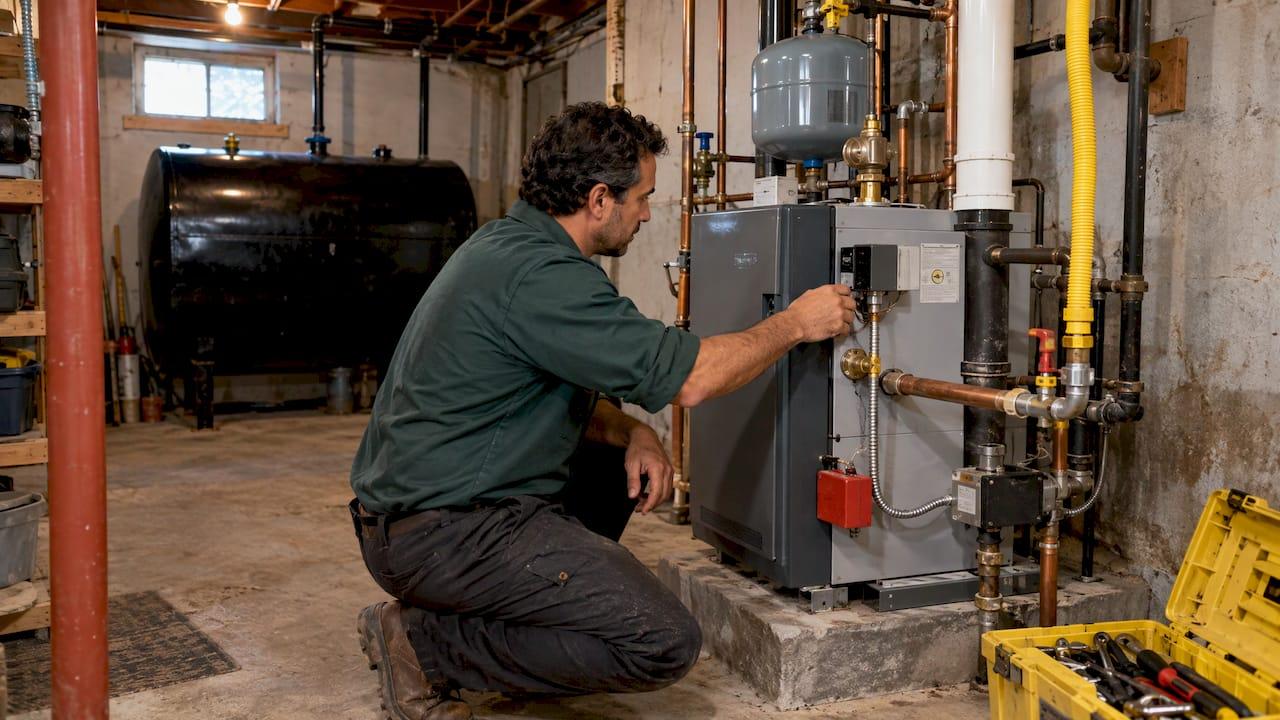
Converting from oil to natural gas in Massachusetts is a three-part job: the gas utility brings a line to your property, a licensed contractor replaces or converts your heating equipment, and the oil system is shut down and removed. The total depends mostly on how far your home sits from the gas main and what kind of boiler or furnace you end up with. Getting the order of those steps right, and having one licensed team handle the heating side, keeps the project from stalling between the utility, the town and the installer. At Mystic Valley Home Services, our licensed and insured technicians install high-efficiency boilers and do gas line leak testing for homes and businesses across Massachusetts. This guide covers what the project involves, what drives the price, and what to check before you commit.
TL;DR
- A conversion has three parts: gas service to your property (the utility's work), new gas-fired equipment and interior piping (a licensed contractor's work), and decommissioning the oil tank and lines.
- The biggest cost swing is the distance from your property to the gas main. Equipment, piping, tank removal and permits follow.
- A Harvard study of Massachusetts households puts a typical 1,800 sq ft home at $910 to $1,190 per heating season on gas versus $1,370 to $1,435 on oil.
- Since August 2025, new hookup costs fall on the household or business requesting the connection, so get the utility's quote before you plan the budget.
- Some towns, including Arlington, restrict gas heat in new construction and major renovations. Confirm with your town before you plan.
Table of Contents
- What an oil-to-gas conversion actually involves
- Step 1: Find out whether gas can reach your property
- Step 2: Understand who does what
- Step 3: Choose the new heating equipment
- Step 4: Run the interior gas piping and test it
- Step 5: Decommission the oil system
- What does it cost?
- Will it pay off? Oil versus gas operating cost
- Check your town's rules first
- Home owners and commercial owners: what differs
- Promo: one team for the heating side of the project
- Our perspective
- FAQ
- Sources
What an oil-to-gas conversion actually involves
Your home or building now burns delivered fuel oil from a tank in the basement, garage or yard. After conversion it burns natural gas from a utility pipe. That change touches four things:
- The gas supply. A service line runs from the street main to your meter and your building.
- The heating equipment. Gas-fired equipment replaces the oil burner or the whole boiler or furnace.
- Interior gas piping, venting and the chimney. Gas appliances vent differently than oil units, so the flue is part of the job.
- The oil system. The tank, fill and vent lines and fuel lines are shut down and removed.
For larger buildings the picture is similar. Boston's guide for owners of steam-heated multifamily and mixed-use buildings explains that these buildings can usually keep the same boiler and two-pipe steam system but must change the fuel and exhaust. The same guide describes shutting down the oil system, removing tanks and pipes, switching to a boiler that works with gas, and paying for the gas hookup. It also notes that long-term gas use in those Boston buildings will likely mean Alternative Compliance Payments under the city's BERDO emissions rules in later years. If you own a commercial or multifamily property in Boston, factor that in early.
Step 1: Find out whether gas can reach your property
Everything starts with availability. If the gas main runs in front of your property, the job is simple. If it does not, the utility may need to extend the main, and that is the costliest scenario.
National Grid's process for Massachusetts customers has you complete an acknowledgment form about electrification options, check availability and line proximity, then apply online. If you qualify, the utility quotes either a service line or, when gas is not in front of your property, a main extension. Eversource customers follow a similar route. Eversource's gas service FAQs say to apply as far ahead as possible, that charges vary with service line length and the proposed annual gas load, and that the meter set requirements are the customer's responsibility.
Two details trip people up:
- Easements. If a main or service line has to cross your private property, Eversource says the owner must supply a free easement, recorded at the Registry of Deeds. That takes paperwork and time.
- Timing. Utilities schedule street work around municipal permits and seasons. Apply well before the heating season, not after your oil boiler fails in January.
If you are not sure which utility serves your street, your latest gas or electric bill will tell you, and the utility's availability form will confirm whether a main is nearby.
Step 2: Understand who does what
A conversion splits cleanly between the utility and a licensed plumber or gas fitter. National Grid's residential conversion guide gives the utility the service agreement review, project design, municipal excavation permits, service line installation, meter installation and final road restoration. The licensed plumber quotes and installs the gas equipment and controls, sizes the heating system, and schedules the municipal inspection and the meter set appointment.
That last handoff matters. The meter is not set until the town inspection passes, and the inspection is not scheduled until your contractor's work is finished. A contractor who knows the local inspectors and sequence saves you from weeks of idle waiting.

Gas work is also licensed work. Boston's permitting page states that only a contractor with a valid Massachusetts trade license can apply for a Gas Permit and install or replace gas lines, gas appliances and gas heaters. Other towns run their own permitting through the local inspector, but the principle is the same: unlicensed or unpermitted gas work puts your insurance, your sale and your safety at risk. Our guide to permits and 248 CMR 10.00 in Massachusetts explains why.
Step 3: Choose the new heating equipment
You have two paths. You can convert the existing oil boiler or furnace with a gas burner, or you can replace the whole unit. In most cases, an oil unit that is already old is better replaced than converted. The Harvard study cited below notes that average oil furnace efficiency is around 80%, which is part of why oil costs more per season. A modern high-efficiency gas boiler is designed to extract far more heat from every cubic foot of gas, and that is where the operating savings come from.
For a boiler-heated home, our high-efficiency boiler installation is the natural fit. For forced-air homes, see our furnace installation cost guide, which covers Massachusetts itemized quotes in the $3,000 to $9,000 range. If you are replacing more than the heat source, the HVAC replacement cost guide shows how the pieces add up.
One technical point to raise with your installer: high-efficiency condensing equipment produces acidic condensate and exhausts cooler flue gas, so venting and drain details matter. If you later notice moisture issues after a boiler swap, this explanation of condensation after changing a boiler shows how those problems arise and why they should be solved at the design stage.
If your home has an older steam or hot-water radiator system, as many Arlington and Mystic Valley homes do, the existing piping and radiators can often stay. Our heating team services steam and hot-water radiators and replaces zone valves and thermostats, so the distribution side can be updated at the same visit.

Step 4: Run the interior gas piping and test it
Inside the building, a licensed contractor runs gas piping from the meter to the new appliance, sizes it for the load, and pressure-tests it. If you are also moving the gas water heater, a range or a dryer, this is the time to add those lines. Our gas line installation cost guide lists 2026 Massachusetts ranges from $271 to $6,000, depending on the length and complexity of the run.
Before the meter is set, and again after the work, gas line leak testing gives you documented confirmation that the piping is tight. We offer gas line leak testing and boiler and water heater safety checks as part of our inspection services.
A note on safety: if you ever smell gas, leave the building and call 911 and your gas utility from outside. Do not switch lights or appliances on or off.
Step 5: Decommission the oil system
The last piece is removing what you no longer need. That means draining and removing the oil tank (above-ground or underground), capping or removing fuel lines, and disposing of leftover oil. An underground tank is a bigger job than a basement tank. Tell your contractor early where yours sits, because that affects both price and schedule. Your town's fire or building department can tell you the local permit and inspection requirements for tank removal.
What does it cost?
No single number holds for every Massachusetts property, and anyone who quotes you one without seeing your street's gas availability is guessing. These are the line items that move the total:
| Cost driver | What moves it |
|---|---|
| Utility service line or main extension | Distance from your building to the main, street surface, easements, and the utility's own allowance rules |
| New boiler or furnace | Equipment size and efficiency, one zone or several, steam or hot water or forced air |
| Interior gas piping | Length of the run, number of appliances, basement access |
| Venting and chimney work | Whether the old chimney can be lined or a new sidewall vent is needed |
| Oil tank removal | Above-ground or underground, access, any soil issues |
| Permits and inspections | Town fees and the number of inspections |
The utility side has changed recently. In August 2025, Massachusetts regulators shifted new gas hookup costs from utility customers generally to the household or organization requesting the hookup. Under the earlier approach, costs were spread across all ratepayers, and a new installation averaged $9,000 in 2023. A 2024 analysis of line-extension allowances found that utility allowance practices differ across Massachusetts companies, creating differences of more than $2,000 for a typical residential customer. The practical lesson: get the written quote from your own utility before you budget, and do not rely on what a neighbor paid a few years ago.
For the equipment, ask for itemized quotes. Our own published ranges are a useful reference for the heating and piping pieces, and our team gives upfront pricing so you can see each line before work starts.
Will it pay off? Oil versus gas operating cost
The most rigorous Massachusetts comparison we know of is a Harvard study by Shafiee and Schrag. It estimates that an average household of about 1,800 square feet pays $910 to $1,190 per heating season on natural gas, against $1,370 to $1,435 on heating oil, with oil's higher cost partly due to average furnace efficiency of about 80%. That is a seasonal gap of a few hundred dollars at the study's assumptions.
Two things to keep in mind when you apply this to your own home:
- Prices move. Heating oil is bought at whatever the local price is on delivery day, and gas rates are reset by your utility on a published schedule. The study gives the picture for its period. Your own last two or three heating-season oil bills, set against a gas estimate for your house size, are the real test.
- Efficiency and size matter. A larger or leakier house uses more fuel, so any per-gallon or per-therm gap is multiplied. Replacing an inefficient oil unit with a high-efficiency gas boiler widens the gain.
To estimate payback, divide your total project quote by the yearly savings you expect. A conversion done when your oil equipment is already near the end of its life is easier to justify, because you are replacing the boiler anyway.
Check your town's rules first
Some Massachusetts towns now limit new fossil-fuel hookups. Under the state's Municipal Fossil Free Building Demonstration Program, which began in 2024, local bylaws in Acton, Arlington, Brookline, Concord, Lexington, Lincoln and Newton may prohibit gas service for heat in certain new construction and major renovations. National Grid asks for a building permit submitted with a Service Level Agreement form for gas connections in those projects.
If you own a home in one of those towns and are planning a gut renovation or addition, call the building department before you design the heating. A like-for-like replacement of an existing system is a different question than a major renovation, and your local inspector is the one who decides which applies. We work in older Arlington homes regularly, so we can help you frame the question for your town.
Home owners and commercial owners: what differs
Homeowners mostly care about the service line, the boiler or furnace, and the tank. The job often finishes within a few days of on-site work once the utility has set the date for the line.
Commercial owners have extra items: larger loads (which affect the meter and the service line size), tenant scheduling, any emissions rules in your city, and the need to keep heat on during the swap. In Boston, large buildings should read the BERDO guidance mentioned above before choosing a fuel. For any commercial building, request the gas load calculation up front, since utility charges depend on the proposed annual gas load.
Promo: one team for the heating side of the project
The utility handles the street and the meter. The rest, which includes the boiler or furnace, gas piping, testing, and heat that works on the first cold night, is where a licensed team earns its fee. Mystic Valley Home Services is a family-owned, owner-supervised team of licensed and insured Massachusetts technicians, offering same-day or next-day service and transparent upfront pricing. Start with our high-efficiency boiler installation or our heating services and book a visit.

If you want the whole range, from boilers and water heaters to inspections, see all our services.
Our perspective
Most of the conversion problems we hear about do not come from the gas. They come from sequence. A homeowner signs for a boiler before the utility has confirmed a line, or tears out an oil unit in November and then waits on a meter appointment.
Our advice is simple. Get the utility's availability answer and written quote first. Then price the heating equipment as a complete, itemized package, so you can see the boiler, the piping, the venting and the tank removal each on its own line. We believe in upfront pricing for that reason: you should know what you are agreeing to before anyone starts work.
Older New England houses add their own wrinkles, such as steam radiators, masonry chimneys and tight basements. That is where in-depth experience with older Arlington homes pays off, and where owner oversight on each job counts. If your oil boiler is near the end of its life, a high-efficiency gas boiler is a sound way to replace it, and we are glad to walk through your house with you.
Matt
FAQ
How much does it cost to convert from oil to gas in Massachusetts?
It depends on how far your property is from the gas main, which equipment you choose and how much piping and venting work is needed. The utility's service line quote, the boiler or furnace, interior piping, tank removal and permits are the main lines. Our gas line cost guide and furnace cost guide give 2026 Massachusetts ranges for the pieces we install.
How long does an oil-to-gas conversion take?
The on-site equipment swap is typically a matter of days, but the whole project is gated by the utility and the town. The utility must design and install the service line, and your town inspection must pass before the meter is set. Apply early, ideally in spring or summer, so you are not waiting during the heating season.
Do I need a permit to convert to gas?
Yes. Gas work requires a licensed contractor and a permit from your city or town, followed by an inspection. In Boston, only a contractor with a valid Massachusetts trade license can apply for the gas permit. Your contractor should pull it and schedule the inspection.
Can I convert if I live in Arlington or another fossil-free bylaw town?
It depends on the project. Arlington, Acton, Brookline, Concord, Lexington, Lincoln and Newton are in the state's demonstration program, and their bylaws may prohibit gas heat in certain new construction and major renovations. Contact your building department before planning, and we can help you frame the question.
Is natural gas cheaper than oil to heat a Massachusetts home?
In the Harvard study cited above, the average 1,800 sq ft home paid less per season on gas than on oil. Your result depends on your house, your current equipment and prices at the time. Compare your own oil bills with a gas estimate.
Sources
- Boston BERDO building guide for mixed-use and multifamily housing
- National Grid: Connect to Natural Gas (residential, MA)
- National Grid: Connect to Natural Gas (business, MA)
- Eversource: Gas Services FAQs
- National Grid residential conversion guide
- Boston.gov: Install or Replace a Gas Line
- Canary Media: Massachusetts gas hookup cost reform
- Groundwork Data: Future of Gas in Massachusetts
- Shafiee and Schrag, Harvard: Heat pump adoption in Massachusetts
- Condensation after changing a boiler: causes and solutions