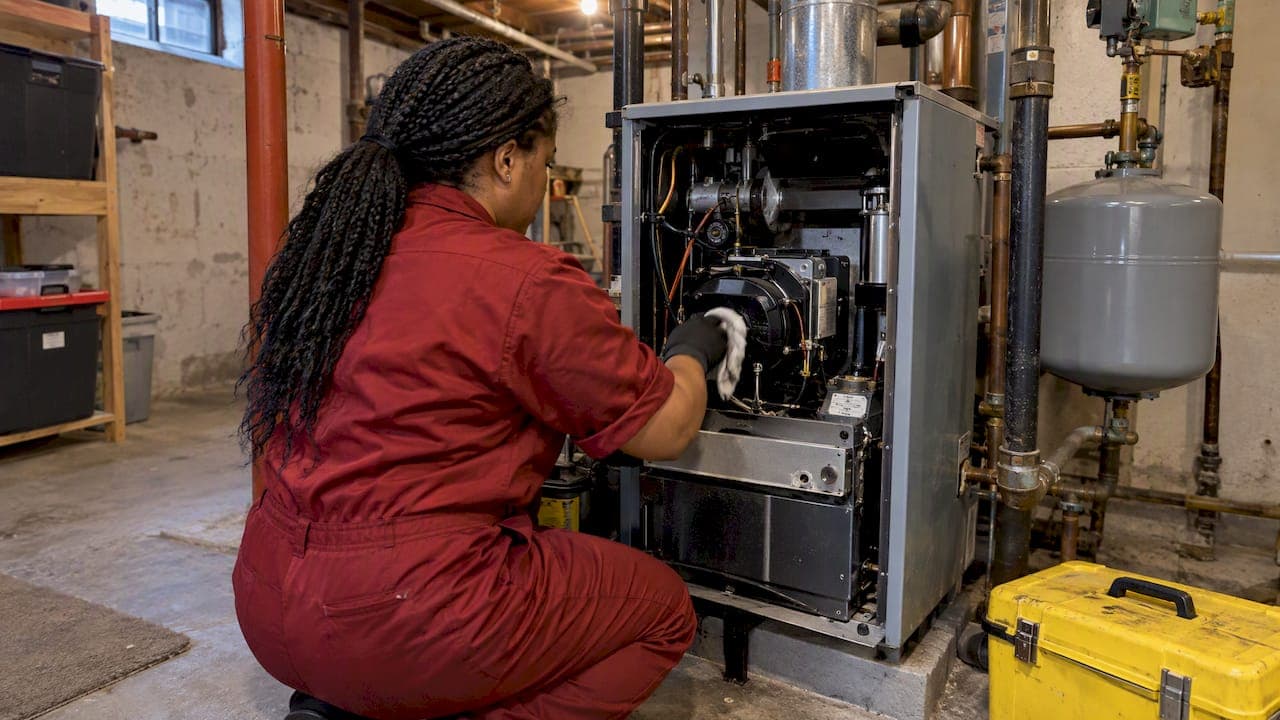
Boiler service in Massachusetts is priced per visit, and the final number depends mostly on your fuel (gas or oil), the type of boiler, its age and how easy it is to reach. A routine annual tune-up is the cheapest thing you will ever buy for a boiler. A repair is priced by the part and the labor. A replacement is a different budget entirely. This guide separates the three so you can read a quote and know what you are paying for.
We are a family-owned Massachusetts plumbing and heating company, and we do not publish flat prices for boiler work. A flat number for a service call on a 1950s Arlington cast-iron boiler would be wrong for half the homes we visit. What we can do is show you what drives the price, which published figures are worth trusting, and what a fair quote looks like.
TL;DR
- A boiler service (tune-up) is a scheduled maintenance visit. A repair is billed separately by the part and labor. Ask which one a quote covers.
- Price depends on fuel type, boiler age and type, accessibility, and whether the visit is a routine tune-up or an emergency.
- One published average for radiator and boiler repair in Boston is $384, but your own price depends on the specific fault and part.
- Skipping maintenance is the expensive choice: neglect shortens boiler life and can turn a small fault into a large failure.
- Mass Save no longer pays rebates on new gas, oil or propane boilers for most households, so check before you count on one.
Table of Contents
- Service, repair, replacement: three different bills
- What actually sets the price of a boiler service
- What a published number can and cannot tell you
- What a proper boiler tune-up includes
- Why skipping service costs more
- The perspective from our trucks
- How to read a boiler quote
- Maintenance plans: when they pay off
- When a repair bill points toward replacement
- Safety checks that belong in every visit
- Booking boiler service with us
- FAQ
- Sources
Service, repair, replacement: three different bills
People search "boiler service cost" and get results that mix three different things. Keep them apart.
Annual service. A technician inspects, cleans and tests the boiler before the heating season. You pay for time and a set of consumables, and nothing is "broken" at the end of the visit. This is the number most people are asking about.
Repair. Something has failed: a circulator pump, a zone valve, a thermostat, an igniter, a leak. The bill is a diagnostic fee plus parts plus labor. It can be small or it can be large, and it is the line where quotes differ most between companies.
Replacement. The boiler is at the end of its life, or repair costs no longer make sense. This is a project with equipment, venting, permits and often piping changes, quoted per job.
When a neighbor says "I paid $X for my boiler," ask which of the three they mean. Most online price disagreements come from comparing a tune-up with a repair.

What actually sets the price of a boiler service
Fuel type
Oil boilers generally need more during a tune-up than gas boilers. The burner, nozzle and filter are part of the job, and the combustion has to be tested and adjusted. Gas boilers have a simpler combustion side, but they have their own safety checks: venting, gas pressure and flame signal. Expect the two to be priced differently, and be wary of a quote that does not say which one it assumes.
Boiler type and age
A modern condensing boiler has a condensate drain, a heat exchanger and electronics that need specific attention. An older cast-iron boiler or a steam system has different needs: water level, low-water cutoff, gauge glass, and in steam systems the radiator venting. Older equipment can take longer, and parts can be harder to find. That is true of a lot of the housing stock in Arlington and the towns around Boston, where we see plenty of decades-old systems.
Access and condition
A boiler in an open basement with a clean flue is a faster visit than one in a tight closet with years of soot behind it. If the unit has not been serviced in a long time, expect the first visit to take longer than the ones that follow.
Timing and urgency
A scheduled tune-up in early fall costs less than a no-heat call on a January night. Emergency work usually carries after-hours pricing at most companies. If you book a tune-up before the cold weather arrives, you avoid both the premium and the wait.
Where you live
Labor rates differ between Greater Boston, the South Shore, Central and Western Massachusetts. A figure you see for one region is a guide, not a promise for yours.
What a published number can and cannot tell you
Online cost pages are useful for orientation, and risky as a budget.
For repairs, one cost guide puts the average radiator and boiler repair in Boston at $384, and says the final figure depends on the fuel type, the age of the system and the replacement parts needed. Treat it as a midpoint, not a quote. A bleed-and-adjust visit will land well under it. A failed circulator or control board will land above it.
For annual service, you will find a range of figures in forums and on contractor blogs, and they vary a lot. Homeowners in local community discussions report widely different yearly prices, and you cannot tell from a forum post whether the visit included an oil burner cleaning, a combustion test or just a quick look. That is why we suggest comparing what is included before you compare dollars.
Be even more careful with pages that give a single price for oil heating work. Some are based on thin data from a single city, and they often fold in fuel or equipment costs that have nothing to do with a service visit.
What a proper boiler tune-up includes
The price only means something against the scope. A thorough annual visit should include:
- Visual inspection of the boiler, piping, flue and surrounding area for leaks, corrosion, scorching and soot.
- Burner cleaning and inspection, and for oil, replacement of the nozzle and filter.
- Combustion test to check efficiency and carbon monoxide levels, with the readings shared with you.
- Safety control testing: low-water cutoff, high-limit, pressure relief valve and flame safeguard.
- Pressure and water level check, including the expansion tank.
- Circulators, zone valves and thermostats checked for operation.
- A written note of what was done, what was found and what is likely to fail next.
If you want the longer walk-through, we explain how annual boiler service works step by step.
One thing to know about the inspection itself: water is corrosive, and boilers often rust from the inside out. Mass.gov's guidance on heating oil systems makes the case for regular professional maintenance, and the same logic applies to an old oil-fired boiler, where the outside can look fine while the inside is failing. See the state's tips for maintaining your home heating system. It also notes that cleaning up heating oil leaks from home systems can run roughly $20,000 to $50,000, which is a good reason to treat a small oil weep as urgent.
Why skipping service costs more
The most common thing that shortens a boiler's life is a lack of maintenance. A boiler that is not running to manufacturer specifications wastes fuel, and the small problems feed each other until something major fails. That is the point made in a New England condo and HOA publication on boiler upkeep, which also notes that an annual maintenance call on a large building boiler takes about six hours and belongs with a service company, not the building's engineer. A house boiler is much smaller, but the principle holds.
In plain terms, you are choosing between a predictable fee once a year and an unpredictable bill in the coldest week of the year.
The perspective from our trucks
We work in older homes every day, and some patterns repeat:
- The boiler that "just stopped" in January was usually making noise, short-cycling or dripping in October.
- A cheap tune-up that skips the combustion test is not a tune-up. Ask to see the readings.
- Zone valves, circulators and expansion tanks fail in older systems more than people expect. We would rather tell you in the fall that a part is tired than replace it at 2 a.m.
- Homeowners are often told to replace a boiler that could be repaired, and sometimes told to repair one that should be replaced. The honest answer depends on age, efficiency, parts availability and what the repair is.
Our rule is simple: we quote before we start, we explain the fault in plain language, and the owner stays close to the work. If a repair does not make sense, we say so.
— Matt
How to read a boiler quote
When you collect two or three quotes, compare these lines, not just the total:
| Question | Why it matters |
|---|---|
| Is this a tune-up, a repair or a replacement? | The three are priced on different logic. |
| Is the diagnostic or trip fee separate? | Some companies credit it toward the repair, others do not. |
| Is the oil nozzle and filter included? | Common add-on in oil tune-ups. |
| Will you share the combustion test results? | Proof the test was done. |
| What is the labor basis: flat rate or hourly? | Hourly can grow on an old system. |
| Are after-hours or weekend charges stated? | Avoids surprises on emergency calls. |
| Are parts warrantied, and for how long? | Matters most on pumps and controls. |
A fair quote is written, itemized and shows what happens if the technician finds something unexpected. Be cautious of a very low tune-up price that leads to an expensive list of "required" repairs on arrival.
Maintenance plans: when they pay off
A maintenance agreement bundles an annual visit, often with priority scheduling. It makes sense if you have an older boiler, a rental property or a commercial building where downtime is expensive, or if you simply forget. It is less compelling if the plan price is close to what two separate visits would cost and the plan excludes the things most likely to fail. Read what is covered, whether parts are discounted, and what the priority response actually means.
For commercial owners, there is another reason: records. Consistent service logs help with insurance, tenants and inspections, and our guide on documenting plumbing repairs on business property explains how to keep them.

When a repair bill points toward replacement
A boiler tune-up can reveal a bigger problem. Signs that you should price a replacement alongside the repair:
- The boiler is around or beyond 20 years old and parts are getting scarce.
- Repairs have become annual events.
- The heat exchanger or boiler body is leaking.
- Fuel bills are climbing without a change in how you live.
- The unit has a history of soot, short-cycling or carbon monoxide readings.
Replacement is a job, not a visit. If you are headed that way, our high-efficiency boiler installation page explains what we do. For the broader numbers on heating equipment, we break down furnace installation costs with itemized quotes too, which is a useful comparison if you are weighing a switch of system type.
Rebates have changed
Many online guides still describe fossil-fuel boiler rebates that no longer exist. National Grid states that, as of October 1, 2024, rebates for natural gas, oil and propane heating equipment ended. Mass Save now steers customers toward heat pumps, with rebates up to $15,000 on qualifying heat pump installs. Income-eligible households may have different options, so check the official page for your situation before you sign anything. If a contractor's quote assumes a boiler rebate, ask to see it confirmed in writing.
If financing is part of your plan, our guide to Massachusetts HVAC financing and the Mass Save HEAT Loan covers what to line up first.
Safety checks that belong in every visit
Some boiler issues are not about cost. If you smell gas, leave the building and call your gas utility or 911 from outside. If a carbon monoxide alarm sounds, get everyone out and call 911. Do not wait for an appointment. For lesser concerns, such as a pressure relief valve that drips or a boiler that keeps losing pressure, call a licensed technician. Never cap a relief valve.
If you are buying a home, a boiler and water heater safety check as part of a pre-purchase inspection helps you price the heating system before closing, not after.
Booking boiler service with us
We are licensed and insured Massachusetts technicians, family-owned, with the owner overseeing the work. We offer same-day or next-day service, and we give transparent upfront pricing before work begins. Our heating services cover annual heating tune-ups, boiler and furnace repair, steam and hot-water radiator service, zone valve and thermostat replacement, and no-heat emergency diagnostics. We also install high-efficiency boilers. Tell us your fuel, your boiler's age and what it is doing, and we will give you a clear quote for your system rather than a number from the internet.
FAQ
How much does a boiler service cost in Massachusetts?
It varies with fuel type, boiler age and where you live, and published figures differ widely. Oil boilers usually cost more to service than gas because of the burner work. Ask for a written, itemized quote that lists exactly what the visit covers.
How often should I service my boiler?
Once a year, ideally in early fall before the heating season. Neglected boilers lose efficiency and fail sooner. A newer condensing boiler may have its own manufacturer schedule, so check your manual too.
Is it worth replacing a 20-year-old boiler?
Sometimes. If it still runs safely, is serviced yearly and parts are available, it can keep going. If repairs are frequent, the body is leaking or efficiency is poor, a quote for replacement alongside the repair estimate will show you which costs less over time.
Does Mass Save cover a new boiler?
For most households, no. Rebates for new natural gas, oil and propane boilers have ended, though heat pump incentives are available and income-eligible households may have other options. Check the official Mass Save page before you buy.
What is a diagnostic fee?
It is the charge for a technician to come out and find the fault. Some companies apply it to the repair if you go ahead. Ask before you book.
Sources
- How Much Does a Radiator and Boiler Repair Cost in Boston, MA? (Angi)
- Maintaining a Building's Boiler Requires Vigilance (New England Condominium)
- Tips for Maintaining Your Home Heating System (Mass.gov)
- Boilers & Furnaces (Mass Save)
- Natural Gas Heating (National Grid)